Somnigroup (SGI): Customer relationships that reshape margins and distribution
Somnigroup International designs, manufactures and sells bedding products and now captures downstream retail economics through the integration of Mattress Firm and legacy Tempur‑Sealy wholesale and licensing activities. The company monetizes via three clear levers: direct retail and e‑commerce (company‑owned stores and Mattress Firm), wholesale sales and distribution to third‑party retailers, and royalties from licensing its Sealy®, Stearns & Foster® and Tempur® brands. This combination increases margin capture and changes the risk profile from pure manufacturer to vertically integrated retail operator.
If you want a concise digest of SGI’s customer exposures and commercial posture, start here and then visit the research hub for deeper linkage and primary sources: https://nullexposure.com/.
How these customer ties drive the investment case
Somnigroup’s decision to fold Mattress Firm into its operating footprint converts what was historically a downstream distribution partner into an internal channel that boosts reported sales while requiring accounting eliminations for intercompany transactions. That shift materially improves consolidated gross margins and operating leverage because internal sales are removed from cost of goods sold while retail margin accrues to SGI. At the same time, royalties and third‑party wholesale remain a steady cash engine, anchoring recurring revenue outside the retail cycle.
- Commercial posture: A mix of owned retail and wholesale/licensing creates a hybrid contracting model—SGI is both seller and licensor.
- Concentration and criticality: The integration of Mattress Firm meaningfully concentrates retail exposure under company control, increasing the criticality of Mattress Firm to SGI’s near‑term top line and profit dynamics.
- Maturity and stage: Licensing relationships are established and active; direct retail operations have accelerated post‑combination, moving SGI toward a mature vertically integrated model.
Explore further company relationship mapping and primary documents at https://nullexposure.com/.
Relationship roll call — who SGI works with and what that means
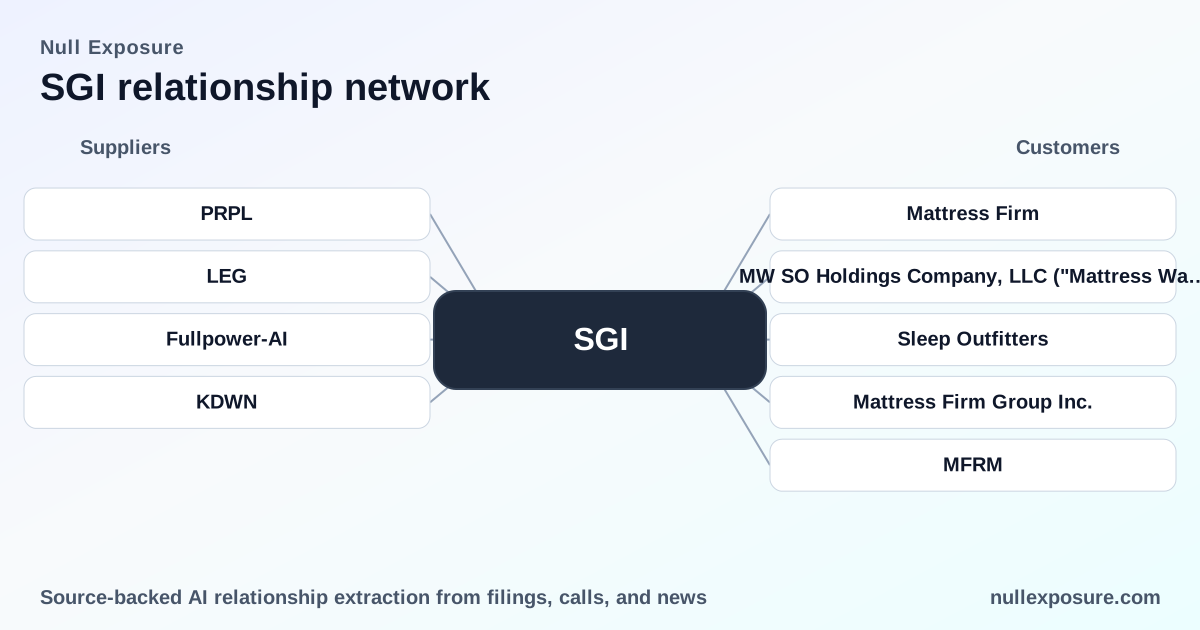
Below are the customer and partner names that surfaced in recent reporting, each followed by a plain‑English summary and a direct source reference.
Mattress Firm
SGI has folded Mattress Firm into its consolidated results, with large inclusions of Mattress Firm sales across FY2025 and FY2026 and corresponding accounting eliminations for intercompany sales between Tempur‑Sealy and Mattress Firm (for example, accounting eliminations of $130.1 million in the FY2025 stub period and $269.0 million in FY2026). This combination is driving accelerated sales and cost synergy commentary from management while materially changing reported gross margins. According to HFBusiness reporting on SGI’s financials (March 2026) and SGI’s Q4 2025 earnings commentary, the Mattress Firm integration is central to the company’s recent top‑line and margin moves. (HFBusiness, March 10, 2026; SGI 2025 Q4 earnings call, March 7, 2026)
MFRM (Mattress Firm, referenced by ticker)
SGI’s Q4 earnings call explicitly cites the Mattress Firm combination as the lever that “accelerated the pace of sales and cost synergies,” indicating management expects operational integration to continue delivering incremental benefit to consolidated results. (SGI 2025 Q4 earnings call, March 7, 2026)
Mattress Firm Group Inc.
Management and third‑party commentary reinforce long‑standing commercial ties: company executives noted a 35‑year collaboration history with Mattress Firm as the transaction closed and entities combined into the Tempur‑Sealy / Somnigroup organization. This underscores the strategic rationale for the deal: unlocking retail control over a historically durable partner. (Smileypete reporting on the acquisition completion, 2025)
MW SO Holdings Company, LLC (“Mattress Warehouse”)
As part of portfolio rationalization tied to the transaction, SGI (through Tempur‑Sealy related divestitures) planned the sale of 73 Mattress Firm stores and the Sleep Outfitters business to MW SO Holdings (Mattress Warehouse), a carve‑out expected in Q2 2025. That move shows selective disposal of non‑core retail assets while keeping the bulk of Mattress Firm under SGI control. (SmileyPete report on the transaction completion, 2025)
Sleep Outfitters
Sleep Outfitters was divested and that divestiture reduced SGI’s direct‑channel net sales in the quarter; direct‑channel sales fell by $27.2 million (‑21.1%) year‑over‑year in Q4 2025 primarily because of the Sleep Outfitters disposal. This is a concrete example of how portfolio optimization changes the direct channel composition and reported retail revenue. (HFBusiness financial results report, March 2026)
What the constraints tell investors about SGI’s commercial model
Company disclosures and the collected constraint excerpts point to a mixed go‑to‑market architecture that investors must price into SGI’s risk/return profile:
- Licensing is a steady, measurable revenue stream. Company filings report licensing royalties of approximately $31.5 million for the year ended December 31, 2024, showing royalties are material and recurring rather than token. This positions SGI as both licensor and brand steward across third‑party manufacturers. (company filing excerpts)
- Direct retail is consumer‑facing and individual‑oriented. The company’s Direct channel includes company‑owned stores, e‑commerce and call centers, signaling an omnichannel retail posture and operational responsibilities (store staffing, logistics, marketing). (company disclosures)
- Geographic mix is North America‑heavy but global in scope. Reported revenue breaks show a major U.S. footprint (over $3.4bn in a disclosed period) complemented by presence in 100+ countries via owned brands and international operations; investors should treat international operations as diversification rather than the core cash engine. (company disclosures)
- Multiple commercial roles coexist. SGI simultaneously acts as licensor, manufacturer, distributor, reseller and seller—this creates internal offsets (intercompany eliminations) and external margins (royalties, wholesale), and supports cross‑channel resilience.
These constraints are company‑level signals derived from public financial commentary and filings rather than an assertion tied to any single relationship.
Risk, reward and what to watch next
- Key risk: Vertical integration increases operational complexity—retail execution at scale (inventory, store economics, e‑commerce conversion) becomes material to the stock’s valuation. Investors must watch same‑store metrics and integration synergy realization.
- Key upside: By owning distribution, SGI captures retail margin and reduces dependence on third‑party retailers, improving long‑term profit per unit sold when integration succeeds.
- Near‑term catalysts: Q2 and FY2026 sales composition, reported intercompany eliminations, and quarter‑over‑quarter same‑store retail trends will clarify whether margin improvement is durable.
For a targeted, source‑linked dossier on SGI’s partner network and contract signatures, visit our research portal: https://nullexposure.com/.
Bottom line
Somnigroup has moved from a product‑centric manufacturer to a vertically integrated outfit that controls large parts of the mattress value chain. The Mattress Firm combination plus a persistent licensing business create a hybrid revenue mix with higher margin potential but greater operational execution risk. Investors should weigh the structural margin gains against retail complexity and track the company’s ability to extract promised synergies in upcoming quarters.