Singularity Future Technology (SGLY): Customer Footprint, Concentration Risks, and Event-Driven Exposure
Singularity Future Technology Ltd operates principally as a freight logistics and services provider, monetizing through shipping, warehousing and logistics contracts—largely for steel-sector clients—via subsidiaries such as Trans Pacific Shipping Limited. The company’s public filings show nearly all revenue sourced in the PRC and an extreme customer concentration that drives cash flow volatility; separately, press reporting documents a distinct non-logistics commercial relationship tied to crypto-mining hardware through a joint venture. Learn more about the evidence and implications at https://nullexposure.com/.
Quick take for investors
Singularity’s commercial profile is defined by three facts investors must weigh before allocating capital:
- Revenue concentration is extreme. The company disclosed that one customer accounted for 94.4% of revenue in FY2025. This is a structural counterparty risk that dominates valuation and liquidity analysis (company filings, FY2025).
- Geography is concentrated in APAC/PRC. Management reports all revenue in the PRC for FY2025, which concentrates regulatory and market risk (company filings, FY2025).
- A material one-off commercial event is documented in the press. Independent reporting links the company’s JV activity to a large $200 million purchase order from an SOS subsidiary for crypto mining rigs (Hindenburg Research, March 2026).
- Business model is services-first but with opportunistic product/JV activity. Core operating cash flows come from freight services; ancillary ventures have introduced event risk and reputational exposure.
For a concise view of the source evidence behind these points, see the relationship summaries below and the operating-model constraints analysis. If you want a focused dossier on counterparties and concentration, visit https://nullexposure.com/ for our full coverage.
Documented customer and counterparty relationships cited in public reporting
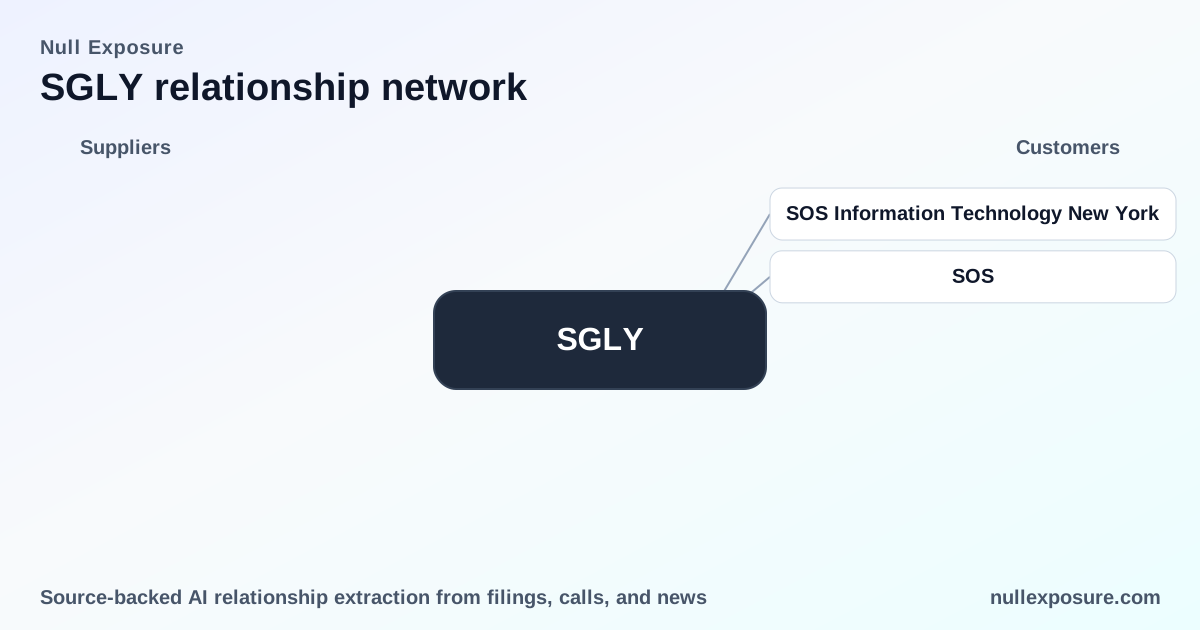
SOS (SOS Limited)
Hindenburg Research reported that in FY2022 Singularity entered a joint venture to produce crypto-mining equipment and that in January 2022 the JV disclosed a $200 million order from a subsidiary of SOS Limited. This order is described as a sizable one-off commercial event tied to Singularity’s JV activity (Hindenburg Research, March 10, 2026).
SOS Information Technology New York
The same Hindenburg report identifies SOS Information Technology New York—a U.S.-listed subsidiary—as the purchaser that placed the $200 million order for crypto mining rigs from Singularity’s joint venture, Thor Miner. The report ties an executive relationship to that subsidiary in connection with the purchase (Hindenburg Research, March 10, 2026).
SOS Limited (parent)
Hindenburg Research further frames the corporate picture by naming SOS Limited as the China-based parent of the subsidiary that placed the large order. The coverage presents SOS as the group behind the purchase and as the ultimate counterparty in the JV sales narrative (Hindenburg Research, March 10, 2026).
Note: the three items above are reported in the same investigative piece; the thrust of the article is that Singularity’s JV activity produced a major commercial commitment from an SOS corporate group in early 2022.
Chongqing Iron & Steel Ltd (dominant logistics customer)
Company filings for FY2025 identify Chongqing Iron & Steel Ltd. as the company’s main customer, accounting for 94.4% of revenue in FY2025 and 77.2% in FY2024, making Chongqing a material, revenue-dominant counterparty for Singularity (company filings, FY2025). This is a disclosure from the company’s annual reporting and represents the single largest commercial dependency in the business.
What the constraints tell investors about how Singularity operates
The public record establishes a set of operating-model characteristics that drive risk and valuation:
-
Geographic concentration (APAC/PRC): Management reports that all revenue in FY2025 originated in the PRC, which concentrates political, regulatory and foreign-receipt risk in one jurisdiction (company filings, FY2025). This affects scenario analysis for sanctions, trade disruption, and currency/collectibility stress.
-
Customer concentration and criticality: The company’s filing shows Chongqing Iron & Steel Ltd. as critical to revenue, contributing 94.4% in FY2025. This level of single-customer dependency transforms ordinary credit risk into existential revenue risk for the company.
-
Primary role as a service provider: Singularity’s core disclosures position the business as a freight logistics services provider—shipping, warehousing and logistical support to steel companies—delivering recurring service revenues through a subsidiary structure (company filings). Services contracts are the predictable element of cash generation; loss of its main customer would rapidly compress revenue.
-
Evidence of buyer and supplier roles beyond services: Filings and press show the company also operates as a buyer and as a JV product supplier in discrete episodes (for example, the crypto-miner JV), which introduces event-driven commercial exposure outside its freight services core.
-
Segment maturity and concentration: The freight-services segment represents the entire reported operating segment, which signals limited diversification and early- to mid-stage maturity in terms of product breadth and customer base.
Investment implications and risk framework
-
Valuation and liquidity hinge on client retention. With one customer supplying the vast majority of revenue, downside scenarios in which Chongqing reduces or terminates volumes are primary drivers of downside valuation. Debt service, working capital and near-term liquidity should be analyzed against that dependency.
-
Event-driven reputational and counterparty risk from the JV episode. The $200 million order reported in the press is not represented in public revenue figures for FY2025; investors must reconcile whether the JV produced recognized revenue, receivables, or contingent exposure. That episode also introduces reputational counterparty risk when an industrial services company engages in high-profile crypto-hardware transactions.
-
Jurisdictional concentration increases operational risk. Concentrated PRC revenue suggests that regulatory developments, trade policy, or local demand shocks will disproportionately affect results.
-
Operational posture is services-led but opportunistic. Management’s primary contracting posture is as a logistics services provider; the presence of a JV and large equipment orders indicates opportunistic non-core activity that can create one-off earnings noise and counterparty complexity.
Bottom line for investors
Singularity is not a diversified technology platform; it is a freight-services company with acute revenue concentration and an episodic JV-related order that elevated press scrutiny. The company-level facts—PRC revenue concentration, a single dominant steel customer, and the Hindenburg-reported $200 million JV order—are the three levers that determine credit and equity risk.
If you require a structured counterparty dossier or deeper diligence on the Chongqing relationship and the JV economics, our team has compiled a follow-up briefing. Access expanded coverage and the underlying source summaries at https://nullexposure.com/.
Conclusion: investors must underwrite extreme counterparty concentration and reconcile the implications of non-core JV activity before assigning a material weight to SGLY in a portfolio.