Sangamo Therapeutics (SGMO): Partner-led cash flow with high dependence on licensing and milestone deals
Sangamo is a clinical‑stage genomics company that monetizes primarily by licensing platform technologies and executing collaboration agreements with large pharma—generating upfront license fees, research reimbursements and milestone payments rather than drug sales. That commercial posture makes Sangamo operationally a partner‑dependent developer: near‑term cash and revenue spikes are driven by selective licensing transactions with major biopharma companies while core R&D and clinical programs remain capital intensive.
For an investor evaluating Sangamo’s customer relationships, the most important takeaway is simple and concrete: the company’s revenue base is concentrated, contract‑driven and uneven in timing; partners supply runway through upfront and milestone payments rather than recurring product revenue. Learn more about how we track customer relationships at https://nullexposure.com/ — useful if you’re modeling counterparty concentration or revenue timing.
How Sangamo’s operating model shapes risk and optionality
- Sangamo’s contracting posture is that of a seller of IP and development services: revenues “have consisted primarily of revenues from collaboration agreements, including upfront license fees, reimbursements for research services, and milestone achievements.” This is a company‑level signal drawn from the corporate disclosures in the FY2024 10‑K.
- Revenue concentration and timing risk are structural. A single large licensing deal can move reported revenue and cash substantially in a quarter; conversely, a partner termination or failed exercise of options can remove expected milestones and compress runway.
- Strategic criticality to partners varies by program. Some collaborations (e.g., capsid licensing) are broadly applicable and therefore potentially lucrative, while others are pre‑clinical and more speculative.
- Maturity profile is uneven. Sangamo is a clinical‑stage developer—partners provide commercial scale and late‑stage capabilities that Sangamo lacks in-house, increasing the value of partnerships while also creating dependency.
If you want a concise, commercial snapshot of Sangamo’s partner set and the terms that drove recent cash infusions, visit https://nullexposure.com/ for the underlying documents and deal notes.
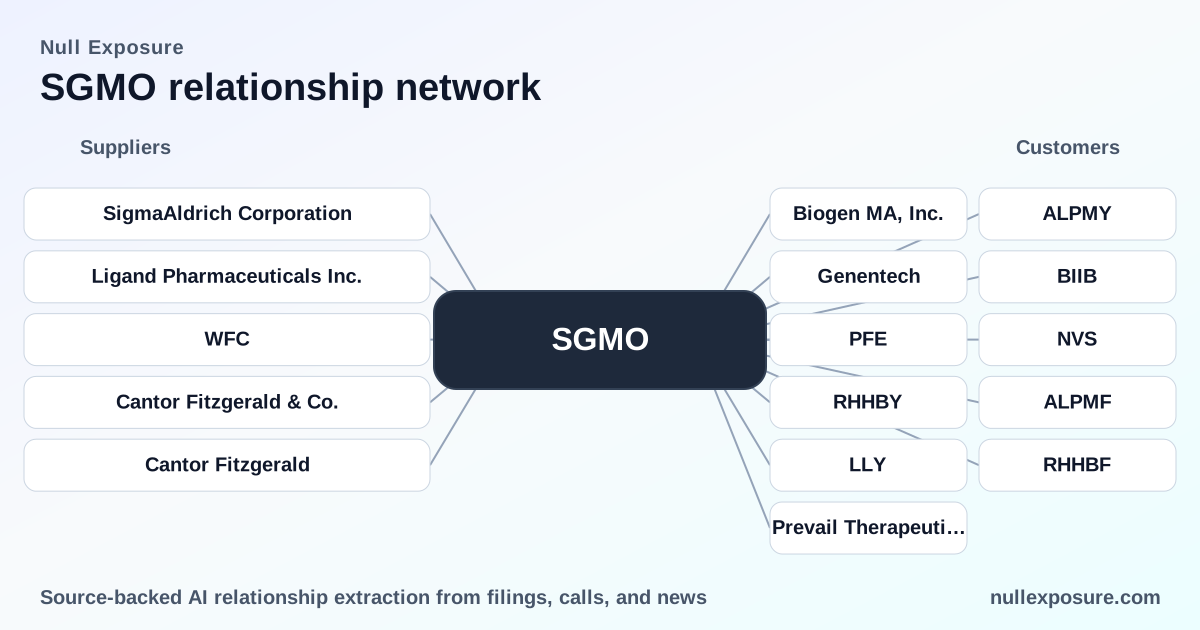
The partner map — what each relationship means for investors Below are the relationships found in Sangamo’s customer records and recent press, with short plain‑English summaries and source notes. Each item covers the mentions in the public results set.
Biogen / Biogen MA, Inc.
Biogen is identified in Sangamo’s FY2024 Form 10‑K as a customer under an existing collaboration agreement. The filing confirms Sangamo assessed the collaboration under ASC 606 and concluded Biogen is a customer, reflecting that Sangamo recognizes revenue from the arrangement. (Source: Sangamo FY2024 Form 10‑K, referenced in the FY2024 filing.)
Genentech / Roche (multiple entries)
Genentech is a clearly stated customer and a recent source of near‑term cash via an exclusive licensing deal worth $50 million in upfront and near‑term milestone payments tied to neurodegenerative programs. Sangamo’s 10‑K treats Genentech as a customer, and multiple news reports (Biospace, Yahoo Finance) described the $50m licensing arrangement announced in August 2024 and its revenue impact into 2024/2025. (Sources: Sangamo FY2024 10‑K; Biospace deal coverage and Yahoo Finance reporting, March 10, 2026.)
Pfizer (PFE)
Pfizer exercised a buyout option under a legacy 2008 license and paid Sangamo $6 million; separately, Pfizer’s earlier termination of a hemophilia A program eliminated up to $220 million in potential milestones and materially affected Sangamo’s stock. The $6m payment is recorded in FY2025 press reporting, and legacy deal termination events were noted in market coverage. (Sources: Yahoo Finance business update, March 10, 2026; FierceBiotech reporting on market reaction in FY2025.)
Eli Lilly (LLY)
Eli Lilly provided an $18 million upfront licensing payment tied to a capsid license for a CNS gene therapy program, delivering an immediate cash inflection to Sangamo’s runway. This transaction was reported in industry press as a near‑term lifeline in FY2025. (Source: FierceBiotech report, March 10, 2026.)
Prevail Therapeutics
Prevail (a Big Pharma subsidiary) previously executed a capsid deal with Sangamo in July 2023 that was presented publicly as potentially high‑value, illustrating earlier industry interest in Sangamo’s capsid technology. That upstream deal history is cited in press coverage as context for later transactions. (Source: FierceBiotech deal background, March 10, 2026.)
Astellas / ALPMY / ALPMF
Astellas is confirmed as a customer in Sangamo’s FY2024 10‑K and was reported to have executed a $20 million upfront STAC‑BBB license in December 2024, demonstrating recurring commercial interest in Sangamo’s delivery platform. Both the 10‑K and subsequent market articles list Astellas among STAC‑BBB licensees. (Sources: Sangamo FY2024 Form 10‑K; FierceBiotech and StockTwits coverage, March 2026.)
Novartis
Novartis was referenced in industry reports as one of the partners that previously terminated or altered deals with Sangamo, part of the company’s visible history of large‑pharma negotiations around its platforms. The mention is contextual in news coverage about Sangamo’s partner pipeline. (Source: FierceBiotech background mentioning Novartis in FY2025 coverage.)
BIIB (Biogen symbol)
BIIB is the symbol used for Biogen in press citations; press coverage references the 2020 Biogen upfront of $350 million as precedent for large licensing transactions that can materially change Sangamo’s balance sheet when they occur. That 2020 deal is referenced in later reporting as historical context. (Source: Biospace reporting and FierceBiotech background, March 2026.)
RHHBY / RHHBF / Roche (symbol variants)
Roche (including the RHHBY/RHHBF symbol variants used in reporting) is referenced both as the parent of Genentech and in commentary about Sangamo’s runway — specifically, analysts and company commentary noted the August 2024 Genentech licensing cash gives Sangamo liquidity into Q1 2025. This illustrates how press uses parent company symbols interchangeably when discussing Genentech‑led deals. (Sources: Biospace and Yahoo Finance articles, March 10, 2026.)
Constraints that matter for modeling and diligence
- Seller role and revenue mechanics: Sangamo explicitly frames itself as a seller under ASC 606—recognizing revenue from up‑front license fees, research reimbursements and milestone achievements. This is a company‑level disclosure in the FY2024 10‑K and is central when forecasting revenue volatility.
- Concentration and runway sensitivity: Several news items explicitly tie Sangamo’s cash runway to specific licensing payments (for example, the Genentech deal funding runway into Q1 2025). Treat partner payments as discrete cash events when modeling liquidity.
- Contract maturity and optionality: Multiple short‑ to medium‑term licensing deals (Genentech, Astellas, Eli Lilly) show a strategy of monetizing platform assets through non‑exclusive and exclusive licenses; this improves near‑term cash but does not eliminate long‑term clinical and regulatory risk.
Bottom line for investors Sangamo runs a partner‑driven commercial model: the company’s near‑term valuation and liquidity profile are linked to a small set of large licensing transactions and milestone recognitions rather than to recurring product sales. For allocation and risk analysis, model Sangamo’s revenue as lumpy, partner dependent, and highly sensitive to license timing and partner exercises. For access to the underlying filing excerpts and news traces that inform this synthesis, see https://nullexposure.com/.