SPAR Group (SGRP): Customer Relationships Drive a Services Business, Not Retail Inventory
SPAR Group operates and monetizes as a global merchandising and brand-marketing services provider: the company sells labor-intensive in-store merchandising, assembly, and promotional services to retailers and consumer goods manufacturers, recognizing revenue as it satisfies performance obligations. Revenue derives from repeat, contract-based services rather than product sales, with operating leverage coming from scale of field operations and task-standardization. For a focused review of customer relationships and what they imply for contract risk, concentration, and go-to-market durability, see NullExposure's coverage at https://nullexposure.com/.
The quick read for investors
SPAR’s customer base is deliberately broad and transactional: no single customer represented more than 10% of net revenue in FY2024, contracts skew short and tactical, but the company retains longer-standing standard merchandising contracts for core clients. That structure produces modest revenue visibility at the micro level, low customer concentration risk, and recurring demand tied to retail activity and promotional calendars rather than product cycles.
How SPAR actually books revenue and structures engagements
SPAR invoices for merchandising and related services and recognizes revenue when services are delivered against contractual performance obligations. Company disclosures describe two dominant contract types: rapid-turn, transactional engagements where over 90% of contracts are completed in less than 30 days, and standard merchandising service contracts that run 1–3 years with indexed rate increases for larger clients. As a result, SPAR’s topline is tied to execution capacity and client program cadence rather than long-tail licensing or subscription economics.
- Contracting posture: Predominantly short-term and transactional, with embedded pockets of multi-year standard contracts for major retail programs.
- Concentration: Low—company filings state no customer exceeded 10% of revenue in 2023 or 2024, which reduces single-counterparty risk.
- Criticality: Service delivery is mission-critical for clients’ retail execution, but SPAR’s services are substitutable; competitors can replicate field merchandising at scale.
- Maturity: Mixed—many long-tenured client relationships exist, reflecting investment in people and process, even though the majority of contracts are short in duration.
For more on SPAR’s operating stance and relationship signals, visit https://nullexposure.com/.
Every material customer relationship reported (one-by-one)
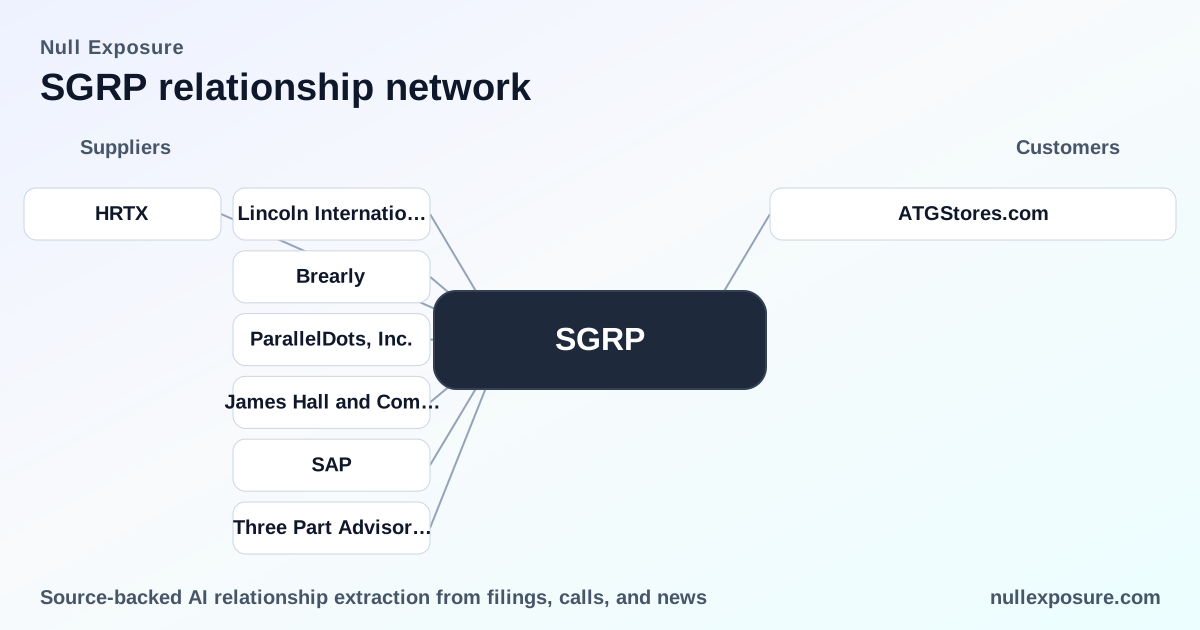
SPAR’s disclosed customer-level coverage in the pulled results contains a single named customer engagement:
- ATGStores.com — SPAR Assembly & Installation will provide professional furniture and equipment assembly services for ATGStores.com customers located in the contiguous United States. This engagement is presented as a service contract directed at retail customers requiring installation and setup. (News release, March 10, 2026 — https://www.newswire.com/news/spar-group-discusses-how-stores-can-thrive-in-the-new-retail-world-on-7969433.)
That item illustrates SPAR’s typical route-to-revenue: fielded teams executing discrete installation/assembly projects for a specialized e‑commerce-to-retail partner.
What the relationship set tells investors about revenue durability
Although the results list only one explicit customer name, the corporate disclosures behind the constraints paint a fuller picture:
- Low revenue concentration is a structural positive. Company filings for FY2024 state explicitly that no client exceeded 10% of net revenue for 2023 or 2024, which reduces single-client counterparty risk and supports stability in cash collections at the portfolio level.
- Short service cycles dominate working capital needs. With over 90% of contracts completed in under 30 days, SPAR converts services to cash quickly but also faces continuous sales and operations cycles that require steady bid activity and crew availability.
- Selective longer-term contracts provide some predictability. Standard merchandising contracts running 1–3 years (with indexed rate increases) anchor recurring revenue and justify technology and training investment, yet these represent a minority of engagements.
- Geographic footprint has contracted to North America. Historically global, SPAR exited several international markets during 2024 and, as of December 31, 2024, operated in the United States and Canada—this narrows geographic risk but concentrates exposure to North American retail trends.
Risk vectors and upside levers tied to customer relationships
Investor focus should center on how relationships affect margins and growth:
- Operational execution risk is high-reward. Because services are labor- and logistics-intensive, margin expansion depends on improving field labor productivity, route optimization, and technology-enabled scheduling.
- Client churn is a constant variable. The transactional nature of many engagements means revenue is sensitive to promotional spend cycles and retailers’ inventory strategies.
- Low client concentration is both a strength and a ceiling. Diversified clients reduce dependency risk but also limit the ability to negotiate outsized pricing with anchor accounts.
- Mature relationships underpin cross-sell potential. The company notes long-tenured clients and investments in people and technology, which support upsell from basic merchandising to higher-margin category services.
Practical takeaways for research and operations due diligence
- Focus first on execution metrics. Field fill rates, average contract duration mix, and crew utilization are leading indicators of revenue and margin trajectory.
- Monitor the mix of short-term vs. standard contracts. Moves toward a higher share of 1–3 year standard contracts would materially improve revenue visibility.
- Geography matters. With operations concentrated in the U.S. and Canada post-2024 exits, SPAR’s exposure is now tightly correlated to North American retail cycles.
Conclusion: Where relationships position SPAR for investors
SPAR Group is a services-oriented company whose customer relationships are deliberately broad and operationally intensive. The business model trades concentrated contract risk for execution risk at scale; stability comes from diversification of small customers plus a base of longer-tenured agreements. For investors, the key questions are whether field productivity and contract mix trends drive sustainable margin recovery and whether the company can translate mature client relationships into multi-year, higher-value contracts.
If you want a concise, relationship-focused intelligence summary and regular updates on SPAR and comparable merchandising services companies, explore NullExposure’s coverage at https://nullexposure.com/.