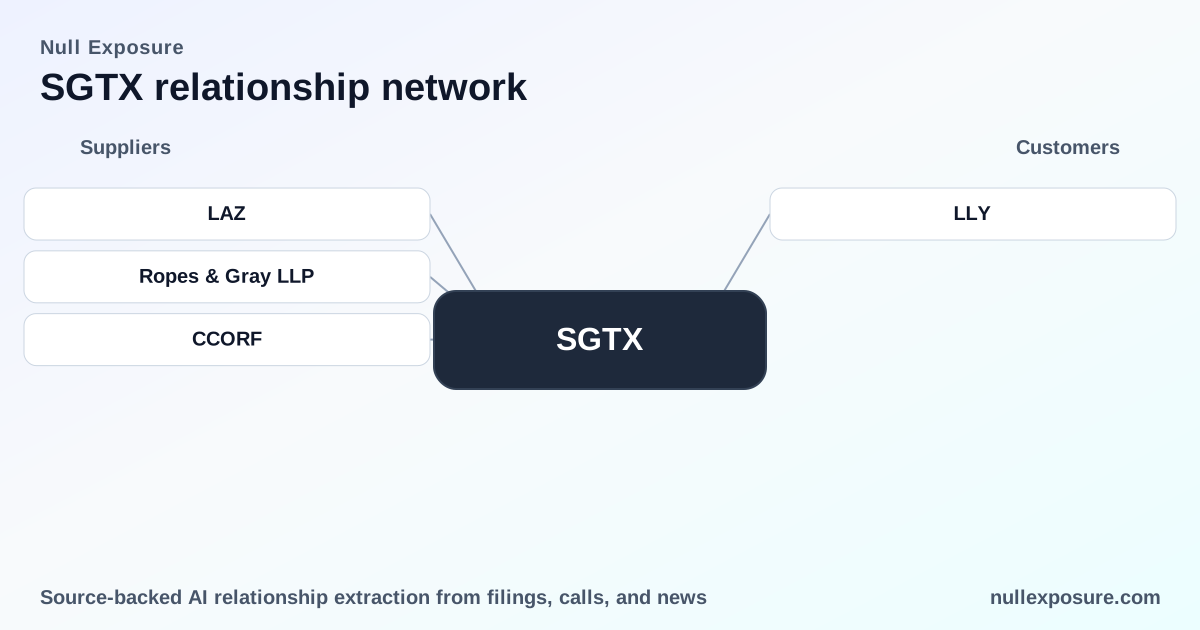
Sigilon Therapeutics (SGTX): The Lilly relationship is the company
Thesis — Sigilon developed proprietary Afibromer encapsulation technology for cell therapy and monetized that IP through an exclusive partner licensing model: upfront cash, milestone payments, and equity that ultimately culminated in a corporate purchase by Eli Lilly. Investors evaluating SGTX should treat the Eli Lilly relationship as the dominant commercial axis that converted Sigilon’s development-stage IP into realized value and exit liquidity.
If you want consolidated counterparty intelligence on partner histories and deal outcomes, visit https://nullexposure.com/ for broader coverage and comparable deal profiles.
Why the Lilly partnership controls the narrative
From first collaboration to acquisition, Sigilon’s commercial strategy relied on a single global pharmaceutical partner to underwrite development risk and fund translation. The 2018 strategic collaboration gave Lilly an exclusive worldwide license to Sigilon’s Afibromer technology in exchange for upfront cash, equity and milestone commitments, which effectively concentrated Sigilon’s commercial optionality into one counterparty relationship. Multiple press reports in 2018 documented the $63 million upfront payment and Lilly’s equity stake, while reporting in 2026 confirmed Lilly ultimately acquired Sigilon outright. The progression from license to acquisition demonstrates a contracting posture that prioritized a deep, exclusive partnership over diversified commercial channels — a structural characteristic that directly shaped Sigilon’s value realization.
Key takeaway: Sigilon’s revenue and exit outcome were concentrated through a single strategic partner that assumed development responsibility and then executed a full acquisition.
How the deal structure translated into company value
The commercial mechanics were straightforward: an exclusive license with an upfront payment, an equity investment, and milestone-based contingent payments created a two-stage monetization path — near-term non-dilutive cash plus long-term upside via milestones and an equity run. This is a classic biotech partner monetization model where the smaller innovator trades breadth for depth: depth of funding and clinical development support in exchange for concentration risk.
Operationally, that produced these company-level signals:
- Contracting posture: exclusive licensing followed by sale — Sigilon accepted a concentrated, partner-led commercialization model.
- Counterparty concentration: singular reliance on Lilly for majority of development funding and exit.
- Criticality: Sigilon’s Afibromer platform was the core asset that drove all partner economics, making the relationship strategically critical.
- Maturity and exit path: early-stage R&D through to corporate acquisition, showing a successful de-risking and exit execution.
All recorded SGTX customer relationship entries (concise, source-backed)
- Rigrodsky Law filed a shareholder alert investigating Sigilon’s agreement to be acquired by Eli Lilly, alleging possible breaches of fiduciary duties related to the buyout; this was published on Newsfile in May 2026. (NewsfileCorp, May 2026)
- BiopharmaDive reported that Lilly’s deal gave it an exclusive worldwide license to Sigilon’s technology in exchange for $63 million upfront and an undisclosed equity investment in the new partner; the article referenced the terms as part of the broader Lilly-Sigilon relationship timeline. (BiopharmaDive, referenced 2018 and cited in 2026 coverage)
- A BiopharmaDive piece from 2018 reported Lilly’s $63 million upfront payment and equity stake as the foundation of the strategic collaboration to develop encapsulated cell therapies for type 1 diabetes. (BiopharmaDive, FY2018)
- A PR Newswire release in 2018 announced the strategic collaboration, stating Lilly would receive an exclusive worldwide license to Sigilon’s Afibromer technology for islet cell encapsulation. (PR Newswire, FY2018)
- FierceBiotech summarized the commercial terms in coverage noting Lilly paid $63 million upfront and committed up to $410 million in milestones for the exclusive global license, describing the economics and strategic rationale in its 2026 write-up about the acquisition. (FierceBiotech, FY2023/2026 coverage)
- Chemical & Engineering News (C&EN) reported on the 2018 partnership between Lilly and Sigilon to develop encapsulated cell therapies, framing it as a targeted collaboration for type 1 diabetes. (C&EN, FY2018)
- European Pharmaceutical Review ran an item confirming that Lilly completed biopharma acquisitions and explicitly listed Sigilon Therapeutics among acquired assets in coverage tied to the 2026 transaction announcements. (European Pharmaceutical Review, FY2023/2026 coverage)
- FierceBiotech also covered the 2026 acquisition angle, using transactional language about Lilly buying Sigilon and characterizing the purchase as part of Lilly’s effort to expand its diabetes cell-therapy pipeline. (FierceBiotech, March 2026)
- BioSpace published a report that Eli Lilly announced it would acquire former collaborative partner Sigilon Therapeutics to broaden its diabetes pipeline, placing the acquisition in the context of a potentially functional cure for Type 1 diabetes. (BioSpace, March 2026)
- FierceBiotech repeated coverage of the initial 2018 partnership economics — $63 million upfront and milestone commitments — when reporting on the later acquisition, underscoring the continuity between the license economics and final purchase. (FierceBiotech, FY2018 and FY2023/2026 references)
- BioSpace’s acquisition reporting reiterated the strategic rationale: Lilly buying its former collaborator to deepen its diabetes capabilities and capture the Afibromer platform in-house. (BioSpace, March 2026)
Investment implications and risk profile
The Lilly axis presents a clear risk/reward profile for Sigilon stakeholders. On the reward side, the collaboration generated near-term cash and an acquisition exit that realized value for shareholders. From a risk perspective, concentration and single-counterparty dependency were defining features: Sigilon exchanged diversification for the resources required to advance complex cell therapies.
Operationally, the company’s contracting posture shows a willingness to surrender broad commercialization to a strategic partner in return for deep development funding. That posture accelerates de-risking but also funnels valuation outcomes through the partner’s strategic calculus — observable here in the license-to-acquisition arc.
Bottom line for investors and operators
For investors and corporate strategists, Sigilon is a case study in turning platform IP into partner-funded development and then into an acquisition exit. The Eli Lilly relationship was the single most consequential customer/partner for Sigilon, shaping both the company’s financing runway and its ultimate corporate fate. Any comparable evaluation of SGTX should weight the partner economics and concentration risk as primary determinants of value realization.
For more partner-focused diligence and comparative deal analysis, visit https://nullexposure.com/ for curated relationship intelligence and historical deal outcomes.