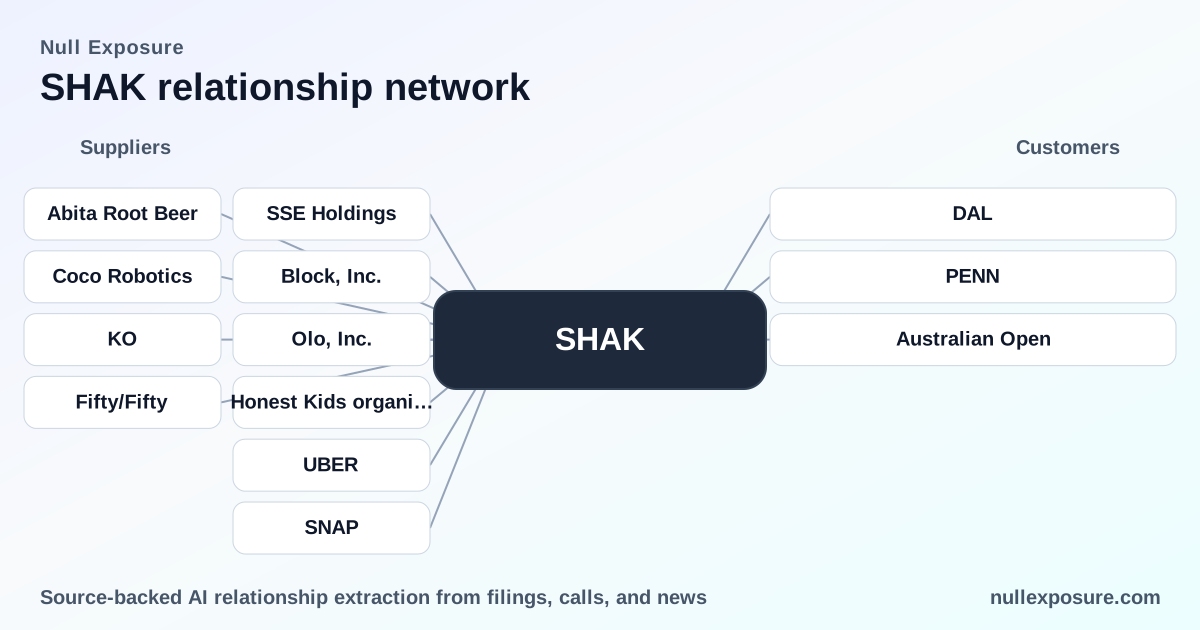
Shake Shack’s customer map: partnerships that extend the brand beyond the counter
Shake Shack (SHAK) operates and monetizes a two‑track business: company‑operated restaurants that drive retail margins and licensed/licensor relationships that generate territory fees, opening fees and ongoing sales‑based royalties. Management leverages brand equity to expand through licensing and experiential partnerships while maintaining cash flow from in‑house Shacks; these arrangements both diversify revenue streams and concentrate the company’s exposure to consumer footfall and partner distribution channels. For investors evaluating customer relationships, the recent media disclosures and earnings commentary show a clear strategy of brand extensions into travel, gaming and live events, supported by a stable menu of branded beverage suppliers. Explore full coverage and signals at https://nullexposure.com/.
Why partnerships matter for valuation and growth
Shake Shack’s customer and partner relationships are not peripheral marketing exercises—they are revenue channels with differing margin and risk profiles. Licensed Shacks deliver recurring, royalty‑style revenue with low operational capex for the parent company, while placement agreements (airline first‑class service, casino concessions, tournament pop‑ups) act as high‑visibility distribution that can accelerate brand adoption and support same‑store sales. For valuation, treat licensing as higher‑margin, asset‑light income and placement partnerships as promotional investments that can raise incremental volume but are subject to channel concentration and event timing.
Notable customer and partner relationships — what investors need to know
Below I list every relationship surfaced in recent sources and provide a concise investor‑oriented takeaway with source references.
Delta Air Lines (DAL) — airline first‑class licensing and service
Shake Shack has a licensing and in‑flight service arrangement with Delta to serve Shack burgers on select domestic flights departing Boston, placing the brand directly into a captive first‑class audience and creating a packaged revenue/marketing channel. According to Delta’s announcement (March 2026), the program is positioned as a premium in‑flight offering that complements Shake Shack’s retail channels (news.delta.com, Mar 2026).
Penn Entertainment (PENN) — casino concessions expansion
Management disclosed a partnership with Penn Entertainment to open Shake Shack locations inside casino properties, with an initial rollout of casino‑based spots starting in 2026; this expands Shack footprint into destination leisure venues and leverages Penn’s customer base. The relationship was called out in earnings commentary and press reporting about the company’s planned openings (earnings transcript reported by The Globe and Mail / Motley Fool, Mar 2026).
Australian Open — event pop‑ups and experiential placement
Shake Shack partnered with the Australian Open to run two pop‑up Shacks at the tennis tournament, using high‑traffic events to trial localized formats and brand activations that feed both short‑term sales and longer‑term awareness in new markets. Management cited the tournament pop‑ups in quarterly remarks as an example of experiential distribution (earnings commentary reported by The Globe and Mail, Mar 2026).
Abita Root Beer — menu beverage supplier
Shake Shack lists Abita Root Beer among the bottled and draft beverage offerings available across Shacks, maintaining a curated set of regional craft beverage partners to complement food sales and uplift check averages. MarketScreener’s coverage of Q3 results references Abita as part of the company’s beverage lineup (MarketScreener, May 2026).
Honest Kids organic apple juice — kids’ beverage SKU partner
Honest Kids organic apple juice is identified as one of the branded beverage SKUs carried in outlets, a low‑ticket item that supports family traffic and keeps the menu aligned with premium and better‑for‑you positioning. This supplier appears in the company’s list of beverages in published earnings summaries (MarketScreener, May 2026).
Fifty/Fifty — nonalcoholic beverage offering
Fifty/Fifty is listed among Shack beverage options, reflecting a deliberate assortment strategy that balances classic soft drinks with specialty and branded beverage partners to preserve menu premiumization. The inclusion was noted in Q3 revenue reporting coverage (MarketScreener, May 2026).
Company‑level constraints and what they signal for operating posture
The public record yields several consistent company‑level signals that shape how these relationships function and their investment implications:
-
Licensing is a formalized revenue stream. Shake Shack reports licensing revenue that includes initial territory fees, Shack opening fees and ongoing sales‑based royalties, indicating an established contract posture that supports recurring, royalty‑style income rather than ad‑hoc promotional payments. This is a structural feature of the business model (company filings and licensing descriptions).
-
Retail counterparty base is primarily individuals (guests). Guest payments are largely cash or card at point of sale, which keeps working capital requirements modest and gives the company high cash conversion on company‑operated sales, while licensing shifts capital commitment to partners. The company explicitly notes low working capital needs tied to guest payments (company filing language).
-
Geographic footprint is global but revenue remains U.S.‑centric. Management reported 579 Shacks globally as of Dec 25, 2024, yet 2024 revenues remain heavily weighted to the United States (US: ~$1.219B; other countries: ~$33.3M), signaling expansion ambition but continued domestic revenue concentration (company fiscal data).
-
Relationships skew to licensee/partner models and are generally active. Licensing and partnership language in filings and commentary indicate active, ongoing collaborations rather than one‑off experiments; management lists partner initiatives as part of growth plans and store count expansion.
-
Core product remains the strategic anchor. The company defines its segment around premium burgers, chicken, shakes and branded beverages—partners are used to extend distribution or complement the menu rather than replace the core offering.
Investment implications and risk framing
-
Upside: Licensing and partnerships such as Delta and Penn accelerate brand reach with limited capital outlay and support margin improvement via royalties and territory fees. Event placements (Australian Open) increase brand exposure in new markets at controlled cost.
-
Risk: The move into third‑party channels raises concentration and reputational risk—performance tied to partners (airline service quality, casino foot traffic) is outside Shake Shack’s direct control. Domestic revenue concentration also means macro‑consumer trends in the U.S. disproportionately impact results.
-
What to watch next: rollout cadence with Penn properties, pilot expansion beyond Boston on Delta flights, and incremental royalty recognition from new licensed territories; beverage supplier changes are lower materiality but reflect menu strategy.
Bottom line
Shake Shack is executing an asset‑light extension of its retail franchise through licensing and selective experiential partnerships that can deliver recurring, royalty‑style revenue and high‑visibility distribution. Investors should value licensing separately from company‑operated restaurants and monitor partner execution risk and U.S. revenue concentration closely. For a deeper view of partner signals and how they influence revenue mix, visit https://nullexposure.com/.