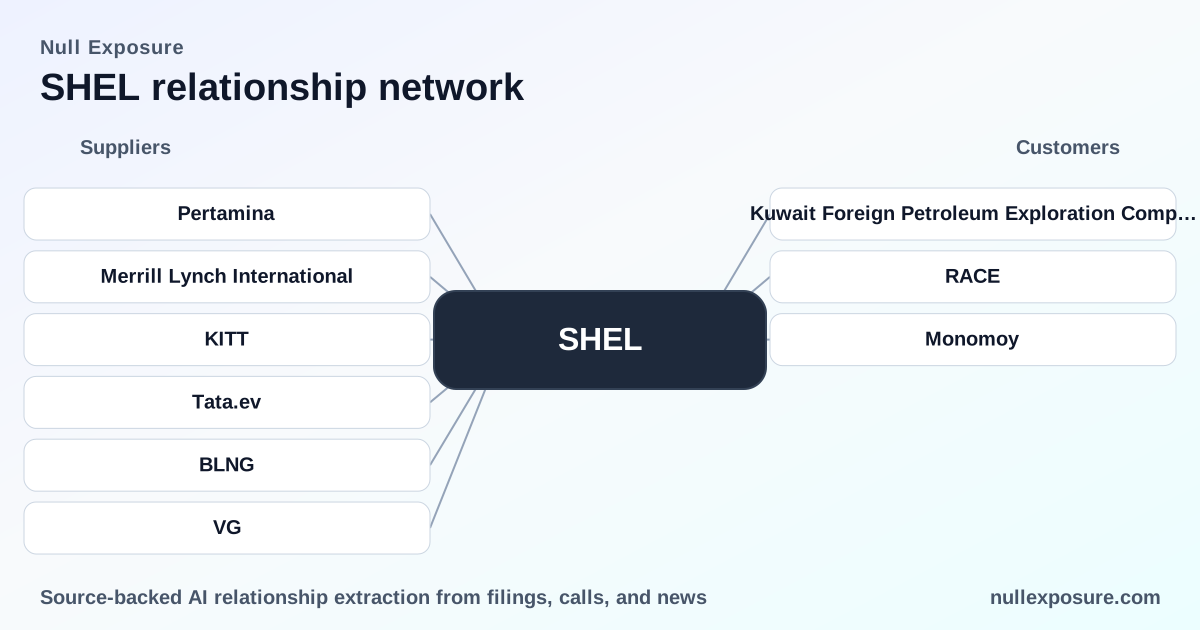
Shell PLC (SHEL) — customer relationships that drive revenue, de‑risk assets and reframe the business
Thesis: Shell is a vertically integrated energy company that monetizes through commodity production and trading, long‑term supply contracts, and technology/ services licensing. Revenue stems from hydrocarbons and refined products sales, long‑dated LNG and power contracts, strategic asset sales, and specialist technology agreements; each customer relationship both locks in cash flow and shapes Shell’s asset allocation between legacy oil-and-gas and lower‑carbon businesses. For deal and counterparty intelligence, see https://nullexposure.com/ for ongoing coverage.
How Shell runs commercial relationships: the operating logic investors need to know
Shell operates with a mixed contracting posture: long‑term offtakes and PPAs for energy and LNG sit alongside opportunistic asset sales and one‑off divestments. That structure produces a portfolio with differentiated maturity — stable, long‑dated cash flows from supply contracts and PPAs, and episodic, lump‑sum proceeds from asset disposals. Concentration is low by counterparty but high by product class: fuel and LNG contracts are critical to industrial and shipping customers, while technology and catalyst deals are niche but strategically important. This operating mix implies steady baseline earnings with episodic balance‑sheet events as Shell rotates capital between hydrocarbons and lower‑carbon projects.
Key signals for operators and investors:
- Contracting posture: Predominantly long‑dated supply agreements for gas, LNG and power; transactional for asset and business divestitures.
- Concentration & criticality: Wide counterparty base, but critical exposures where Shell is a primary supplier (LNG for utilities, fuel for carriers).
- Maturity: Legacy oil‑sands and refining cash flows are mature; renewables and carbon‑tech deals are earlier stage and often partnership‑based.
Relationship roll‑call: every customer relationship in the record, and what it means
Below are the captured customer links to Shell from the provided results, each with a concise plain‑English summary and the public source.
-
KUFPEC — Kuwait Foreign Petroleum Exploration Company
Shell Brasil sold a 20% stake in the Orca deep‑water project in Brazil’s Santos Basin to KUFPEC while retaining operational control, a classic move to de‑risk capex while keeping project upside. Source: SahmCapital news report (March 10, 2026). -
Ferrari (RACE) — long‑term renewable power PPA
Shell committed to supply roughly 650 GWh of renewable electricity over ten years to Ferrari under a long‑term PPA running through 2034, reflecting Shell’s role as a corporate power supplier for major industrials. Source: TS2.Tech report (November 26, 2025). -
RACE — duplicate capture of the Ferrari PPA record
A mirrored entry records the same 650 GWh/10‑year renewable electricity PPA to Ferrari, reinforcing that Shell is locking in multi‑year corporate offtakes for power. Source: TS2.Tech report (November 26, 2025). -
ZIM — LNG supply for shipping expansion
ZIM expanded into car‑carrier services and secured LNG supply agreements with Shell, showing how Shell leverages fuel supply to underpin shipping sector growth tied to cleaner fuel transitions. Source: MarineLink (March 2026). -
Energy Vault (NRGV) — asset sale of SOSA Energy Center LLC
Energy Vault acquired SOSA Energy Center LLC from Shell, a transaction that signals Shell’s monetization of specific non‑core energy‑storage assets as it refocuses capital. Source: SimplyWall (May 3, 2026). -
Phillips 66 (PSX) — carbon capture & technology collaboration
Phillips 66 is working with Shell Catalysts & Technologies to deploy carbon capture and storage technology in the Humber, with Shell supplying the technology solution component. This is a technology‑licensing/implementation relationship rather than a commodity sale. Source: Business‑Live (March 2026). -
Enel Generacion Chile (ENIC) — LNG supply agreement
Enel Generacion Chile signed a new LNG supply agreement with Shell, reflecting utilities’ continued reliance on diversified LNG suppliers for generation stability. Source: SahmCapital earnings coverage (April 29, 2026). -
Monomoy Capital Partners — lubricants supply agreement linked to Jiffy Lube sale
As Shell sold the Jiffy Lube network, Shell USA facilitated a long‑term lubricants supply agreement (Pennzoil Quaker State/SOPUS Products) with Monomoy, preserving downstream commercial ties post‑divestiture. Source: TradingView / Zacks summary (May 3, 2026). -
Ioneer (IONR) — sulphur supply MoU (FY2022)
In earlier activity, Shell Canada signed a non‑binding MoU to sell sulphur to Ioneer for its Rhyolite Ridge lithium‑boron project — a commodities‑to‑minerals supply linkage relevant to battery metals value chains. Source: IM‑Mining (December 8, 2022). -
Ioneer (IONR) — sulphur supply MoU (FY2023 filing reference)
A follow‑up corporate filing reiterates the sulphur supply MoU with Shell Canada, underscoring multi‑year commercial discussions with materials consumers in mining. Source: InvestingNews (December 31, 2022). -
Monomoy (Monomoy / Monomoy Capital Partners) — Jiffy Lube network sale (FY2025/FY2026 captures)
Multiple captures report Shell’s sale of the Jiffy Lube network to Monomoy in a roughly $1.3 billion deal, a strategic divestment of retail auto service assets with transitional supply arrangements. Sources: Finviz (March 2026) and additional news captures (March–May 2026). -
Canadian Natural Resources (CNQ) — oil sands asset swap / full ownership transfer
Canadian Natural closed an asset swap with Shell that transferred 100% ownership and operation of the Albian oil sands mines to CNQ, part of Shell’s longer‑term retreat from certain oil‑sands operations. Sources: RigZone (February 20, 2026) and The Globe and Mail (reporting closing on Nov. 1, 2025). -
Eco Wave Power (WAVE) — wave energy pilot with Shell Marine Renewable Energy
Eco Wave Power launched an onshore wave energy pilot at the Port of Los Angeles in collaboration with Shell Marine Renewable Energy, an example of Shell partnering on marine renewables R&D and pilots. Source: Eco Wave Power press release (March 2026). -
Petrobras (PBR) — field acquisition involving Shell and partners
Petrobras agreed to acquire the Argonauta field in a transaction described as complex and involving Shell and its partners, reflecting asset reshaping and partner reallocation in Brazil’s Campos Basin. Source: Intellectia.ai summary (May 3, 2026). -
Apollo / Private equity interest (APO‑P‑A / APOS captures) — bids for LNG Canada stake
Market commentary captured Apollo, Blackstone and KKR competing to acquire Shell’s LNG Canada stake, signalling private‑equity appetite for midstream LNG positions as Shell contemplates portfolio exits. Sources: MarketScreener coverage (Apr. 30, 2026).
Notes on duplicate captures: several relationships are recorded multiple times across different publishers; each entry above corresponds to a recorded result and is sourced accordingly.
What this web of customers means for investors and operators
- Revenue diversity is real but product‑centric: Shell serves utilities (PPAs and LNG), industrials (power to Ferrari), shipping (LNG for ZIM), and downstream buyers (lubricant supply after Jiffy Lube sale). That reduces single‑buyer exposure but retains product concentration risk in gas and fuels.
- Capital recycling is explicit: multiple asset disposals (Orca stake, Jiffy Lube, SOSA sale, oil‑sands swaps) show Shell actively monetizing mature assets to fund lower‑carbon investments or simplify the portfolio.
- Strategic technology and services play a growing role: collaborations on carbon capture, catalysts, and marine renewables indicate Shell selling differentiated technology and implementation capabilities in addition to commodities.
- Counterparty mix elevates optionality and execution risk: long‑dated PPAs and LNG contracts provide earnings visibility; simultaneous negotiations with private equity and partners for major stakes create transaction execution and timing risk.
For a concise, continuously updated view of these counterparty movements and how they affect Shell’s cash‑flow profile and asset plan, visit our research hub at https://nullexposure.com/.
Risk and monitoring checklist for investors
- Track closing and reinvestment timing for asset sales (Orca stake, Jiffy Lube, LNG Canada stake) — timing affects free cash flow and leverage.
- Monitor long‑dated supply contracts (LNG, PPAs) for price indexation and termination clauses — contract structure determines earnings stability.
- Watch evolving tech partnerships (carbon capture, marine renewables) for commercialization milestones — technology rollouts change margin profiles.
Conclusion: Shell’s customer relationships reflect a deliberate commercial strategy — lock in long‑term offtakes where Shell can secure structural margins, and monetize non‑core assets while expanding technology and lower‑carbon services. That duality explains current earnings stability and the episodic nature of balance‑sheet events investors should anticipate.