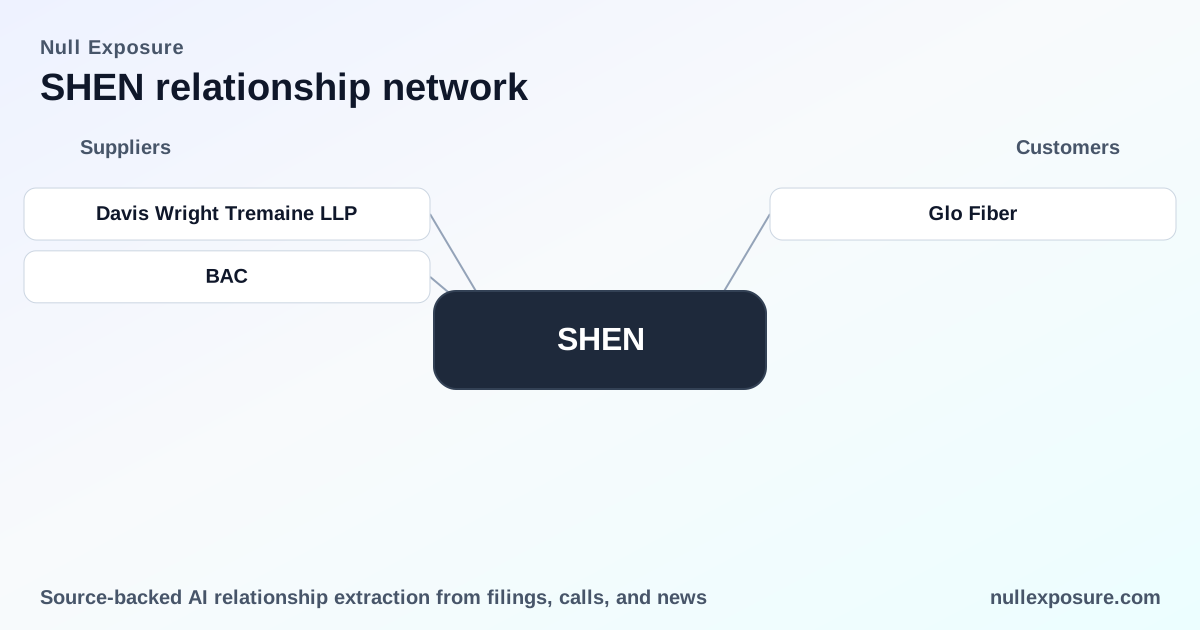
Shentel (SHEN) — Customer Relationships and What They Mean for Revenue Quality
Shenandoah Telecommunications Company operates a two‑track broadband and fiber business that monetizes through recurring residential subscriptions under the Glo Fiber and Shentel brands, plus higher‑margin wholesale and long‑term fiber leases and enterprise services. The company’s operating footprint is concentrated across eight contiguous eastern states, and revenue mixes between cancelable subscription customers and contracted dark‑fiber/enterprise deals. Investors should value Shentel on a blended cashflow profile: predictable base from subscriptions plus episodic, more durable revenue from leased fiber and wholesale customers.
For a concise commercial snapshot and ongoing monitoring, see the company profile at NullExposure: https://nullexposure.com/
Quick takeaways investors need up front
- Recurring subscriptions drive scale and churn risk — residential customers provide steady top line but are cancelable at will.
- Dark fiber and enterprise leases provide durable, higher‑margin revenue that de‑risks subscriber volatility when scaled.
- Customer concentration is low; no single customer exceeded 10% of revenue in recent years, which reduces counterparty credit risk.
- Geographic concentration is regional (mid‑Atlantic/Midwest states), which concentrates market risk but also enables operational efficiency.
Customer relationship snapshots — what the sources report
Glo Fiber — symmetrical 8 Gig service rollout (March 2026)
Shentel is rolling out symmetrical 8 Gig fiber internet for residential customers across Virginia, West Virginia, Maryland, Pennsylvania, Delaware, and Ohio under the Glo Fiber brand, reflecting a continued push to expand high‑speed subscription offerings. A March 10, 2026 release on QuiverQuant described the service launch and the geographic breadth of the rollout.
Glo Fiber — deployment in Springettsbury Township, PA (May 2026)
Glo Fiber, powered by Shentel, launched 100% fiber optic broadband service in initial neighborhoods in Springettsbury Township, Pennsylvania, underscoring the company’s market expansion into targeted suburban neighborhoods and its ongoing last‑mile buildout. This deployment was reported by Finviz on May 3, 2026.
Sprint / T‑Mobile backhaul effects referenced in earnings (Q4 2025 / FY2026 commentary)
Shentel’s management cited a one‑time network rationalization tied to the T‑Mobile acquisition of Sprint that resulted in approximately $7 million of lower EBITDA from backhaul revenue churn, and earlier tower divestitures reduced EBITDA by roughly $12 million—illustrating sensitivity of wholesale/backhaul revenue to major carrier consolidation. Management discussed these impacts in an earnings call transcript covering Q4 2025 that was published in May 2026 on InsiderMonkey.
How customer‑level signals shape the operating model
The available constraints read as company‑level signals about how Shentel runs its business and the character of its customer mix.
- Contracting posture: Shentel operates a mixed contracting posture. Residential broadband revenues are predominantly subscription‑based and cancelable, which produces steady but churnable cashflow. Simultaneously, the company executes long‑term dark‑fiber leases that are accounted for as leases under ASC 842, providing durable revenue streams.
- Counterparty mix and criticality: The customer base is diverse — individual residential customers represent the volume base, while SMBs and large enterprises take dark fiber, Ethernet and wavelength services. This diversity balances unit economics: mass subscriptions deliver scale; enterprise/wholesale customers deliver higher ARPU and contractual stickiness.
- Geographic concentration: Operations are concentrated in the eastern U.S. across eight contiguous states, producing operational efficiency but regional demand sensitivity.
- Concentration and credit risk: No single customer contributed more than 10% of revenue, which lowers single‑counterparty exposure and supports predictable collections.
- Role and segment: Shentel functions both as a seller of consumer services and a service provider to wholesale/enterprise customers, positioning it on both retail and wholesale margins.
- Maturity: The business blends mature subscription economics with a growing base of institutionalized long‑term leases, improving revenue visibility as dark‑fiber contracts scale.
Implications for revenue quality and downside risks
Shentel’s revenue profile has actionable implications for investors assessing sustainability and volatility.
- Revenue stability is improving but still exposed to churn. The expansion of Glo Fiber’s high‑speed offerings strengthens the value proposition and supports ARPU gains, but the subscription model retains churn risk because customers can cancel without penalty.
- Wholesale and dark‑fiber contracts materially raise revenue durability. Long‑term leases accounted under ASC 842 provide multi‑year visibility and cushioning against subscriber cycles.
- Carrier consolidation is a clear operational risk. The post‑Sprint/T‑Mobile rationalization demonstrates that wholesale/backhaul revenues can decline sharply when large carriers reconfigure networks; that event reduced EBITDA in the most recent commentary.
- Low customer concentration is a positive credit signal. No customer over 10% of revenue reduces counterparty concentration risk and supports stable receivables.
- Geographic concentration creates correlated demand exposure. Economic weakness or competitive intensity in the mid‑Atlantic footprint would affect both retail and wholesale lines simultaneously.
What investors should watch next
- Net adds and churn trends for Glo Fiber subscriptions, especially after the 8 Gig service expansion.
- Growth trajectory of dark‑fiber leases and wholesale Ethernet/Wavelength sales—these are the clearest route to higher margin, repeatable cashflow.
- Backhaul contract renewals and carrier relationships given prior EBITDA impacts from carrier consolidation.
- Capital allocation choices between continued fiber buildouts versus yield‑accretive returns to shareholders.
Bottom line — investment framing
Shentel is a regional telecom operator that combines high‑volume, cancelable consumer subscriptions with durable, higher‑margin enterprise fiber leases. That dual model gives investors a blend of growth optionality and improving revenue durability as long‑term leases scale. The principal risks are subscription churn and sensitivity to large carrier network decisions, both of which are manageable through disciplined deployment and enterprise sales growth. For monitoring and comparative customer intelligence on SHEN, visit NullExposure for structured signals and ongoing coverage: https://nullexposure.com/
Bold, actionable monitoring of subscriber economics and enterprise contract rollouts will separate investors who treat Shentel as a steady broadband consolidator from those who misprice carrier consolidation risk.