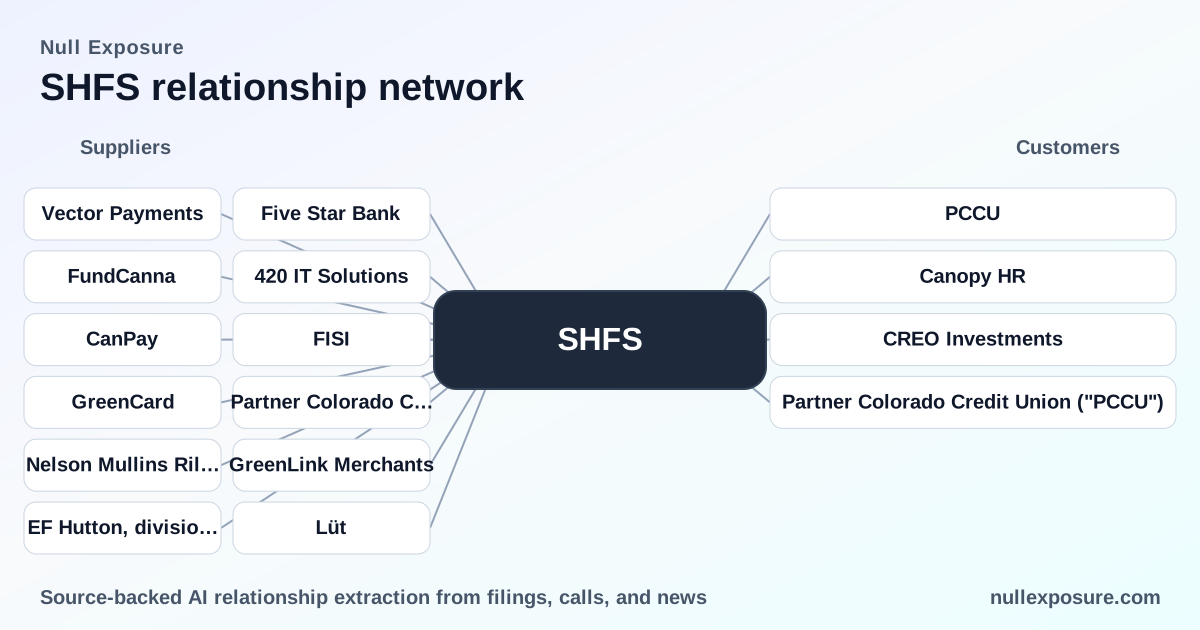
SHF Holdings (SHFS) — Customer Relationships Drive the Franchise Value
SHF Holdings monetizes a compliance and banking services platform targeted at financial institutions that serve the cannabis industry, earning recurring fees from deposit onboarding, servicing and credit products, and licensing its proprietary Safe Harbor Program and software to partner banks and credit unions. Revenue is concentrated in recurring service fees and loan-related economics; recent contract extensions and a strategic capital commitment underpin growth and liquidity optionality. For a deeper view of the company’s customer relationships and implications for investors, see the company homepage: https://nullexposure.com/.
Why customers are the business — an investor-oriented read
SHF operates as a business-to-financial-institution service provider: it sells compliance and loan origination services, and in selected markets it licenses software and program frameworks to banks and credit unions. Fees tied to deposits and servicing are a core revenue stream, and the company reports that these represent a significant portion of 2024 revenue. That business model produces a mix of predictable annuity revenue (licensing and servicing) and variable interest/loan economics, which amplifies upside when portfolio volumes increase and compresses margins when origination slows.
- Business model drivers: licensing + services, deposit-linked fees, and loan servicing economics.
- Scale and reach: SHF reports a national footprint across 41 U.S. states and territories where cannabis is legal in some form, supporting over 600 customers.
- Capital posture: access to committed equity capacity through a sizeable stock purchase agreement adds optional liquidity to fund growth and balance-sheet flexibility.
For additional context on the firm’s platform and product set, visit the company homepage: https://nullexposure.com/.
The customer relationships that matter (what each partner delivers)
This section reviews every customer relationship disclosed in the available materials, with concise plain-English summaries and source attribution.
Partner Colorado Credit Union (PCCU)
PCCU is a strategic commercial partner that funds and/or finances loans on which SHF collects servicing fees; SHF’s 2024 Form 10‑K discloses servicing fees of 0.25% annually on loans funded by PCCU and 0.35% on loans both financed and serviced by PCCU, establishing a clear fee schedule for loan economics. According to a company announcement in February 2026, SHF amended its Commercial Alliance Agreement with PCCU to extend the relationship through December 2031 (from 2029) with automatic two‑year renewals, which the company said will generate an estimated $9 million in incremental revenue through 2031. (Sources: SHF Form 10‑K FY2024; company press release / Sahm Capital, 2026‑02‑09.)
CREO Investments LLC (CREO Investments)
CREO Investments has executed a stock purchase agreement that provides SHF with a committed equity purchasing vehicle: SHF signed an agreement allowing the sale of up to $150 million of Class A common stock, with the potential to increase to $500 million by mutual agreement. That capital commitment significantly expands SHF’s financing optionality and underpins both working capital and growth investments. (Sources: Investing.com SEC filing coverage, March–May 2026; Reuters coverage cited via TradingView, March 2026.)
Canopy HR
Canopy HR, one of the largest payroll-service providers in the cannabis sector, selected SHF’s Safe Harbor platform to support nearly all of its cannabis payroll banking operations—effectively routing payroll banking flows through SHF’s services and enhancing deposit and fee volumes tied to payroll processing. This win strengthens SHF’s value proposition in payroll-adjacent banking services for cannabis businesses. (Source: company announcement via Sahm Capital, March 10, 2026.)
What the disclosed constraints tell investors about the operating model
The company disclosures include several signals that shape how customers convert into durable cash flows and what operational risks look like.
- Contracting posture — licensing and services coexist. SHF licenses its proprietary software and Program to other financial institutions in selected geographies while also directly providing compliance and loan origination services. This mixed delivery model increases revenue diversity but requires careful partner governance to preserve service quality and pricing power.
- Geographic and customer footprint — national but niche-focused. SHF reports operations across 41 states and territories and maintains over 600 customers, indicating broad distribution among financial institutions that serve cannabis-related businesses; this breadth reduces single‑counterparty concentration but keeps exposure tightly linked to the cannabis vertical.
- Materiality — customer economics are significant. The company states that fees based on deposits onboarded and interest on daily balances represent a significant portion of 2024 revenue, making deposit flow retention and growth central to valuation.
- Role and go-to-market — both licensee and seller. SHF operates as a licensee (software/Program licensing) and as a seller (services and loan origination). That dual role increases upside from software scale but keeps labor and service delivery risks on the P&L.
- Maturity and stage — active commercial relationships. The platform is active and growing, evidenced by contract extensions (PCCU) and new commercial wins (Canopy HR), indicating a maturing franchise rather than an early-stage pilot operator.
Those constraints together imply a business that is operationally dependent on deposit flows and servicing contracts, benefits from scale in licensed software distribution, and requires ongoing capital and partner management to sustain growth.
Investment implications and risk profile
- Upside: The CREO equity commitment materially improves liquidity, enabling SHF to scale services and capitalize on large channel wins like Canopy HR; extended PCCU economics lock in a multi‑year revenue base. These elements support revenue visibility and funding optionality.
- Key operational risks: Reliance on the cannabis vertical and deposit-linked fee economics creates sensitivity to regulatory shifts and partner underwriting decisions; execution risk in licensing vs. direct service delivery can pressure margins if partner compliance performance requires remediation.
- Concentration dynamics: While SHF serves hundreds of institutions, a handful of strategic partners (PCCU, payroll processors like Canopy HR) drive outsized economics—monitor partner contract health and renewal terms closely.
What to watch next
Investors should focus on three near-term signals:
- Continued deployment of capital from the CREO facility and any exercises under the purchase agreement.
- Realized revenue impact from the PCCU extension and the timing of the estimated $9 million incremental revenue.
- Customer retention and onboarding metrics within payroll and deposit flows (Canopy HR activation cadence).
For an ongoing feed of relationship and funding developments, the company homepage maintains filings and press disclosures: https://nullexposure.com/.
Bold takeaways: SHF converts regulatory and compliance expertise into recurring, deposit-linked revenue; strategic capital and partner extensions make near-term revenue more predictable, but valuation depends on execution across licensing and service delivery.