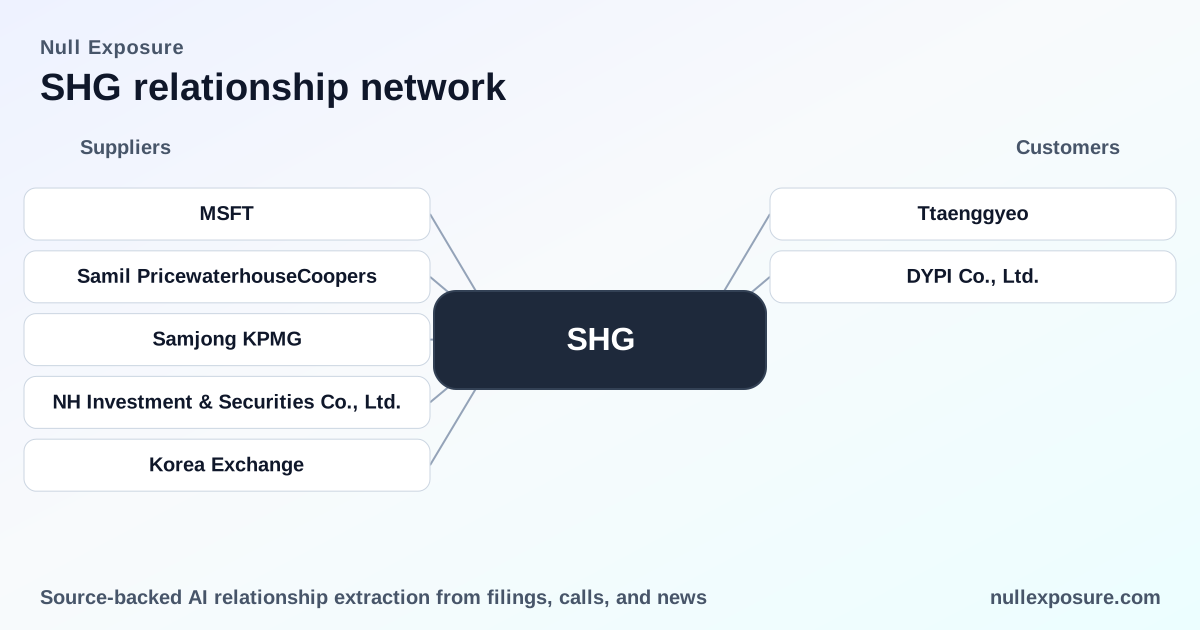
Shinhan Financial Group: customer relationships that drive productive finance and SME penetration
Shinhan Financial Group monetizes through a diversified financial services platform built around interest income from retail and corporate lending, fee income from wealth and transaction services, and cross-sell of group capabilities (banking, insurance, card, and fintech). Its customer relationships increasingly target productive finance—working capital, ERP-linked business loans, and sector-specific support—which converts balance-sheet capacity into repeatable fee and interest streams while deepening client stickiness.
Discover relationship-level reporting and signal synthesis for investors and operators at https://nullexposure.com/.
How these customer links translate to business economics
Shinhan’s relationship playbook drives two commercial levers. First, scale and spreads: broad retail and commercial deposit franchises fund lending growth and net interest income. Second, specialized productization: sector-targeted lending (delivery economy, beauty manufacturing, technology services) and ERP banking unlock higher fee capture and reduce origination friction. These relationships are not one-off corporate gestures; they reflect a systematic push to embed Shinhan services into client operating workflows, which increases lifetime value and lowers acquisition costs.
Relationship snapshots: Ttaenggyeo, DYPI, and Seoul Cosmetics
Ttaenggyeo — delivery app financing tied to ERP banking
Shinhan plans to establish a financial support system linking group company specialist services—including business loans for the delivery app Ttaenggyeo—and ERP banking to back self-employed individuals, SMEs, and local communities. This is operationally significant because it signals direct product bundling: loans paired with ERP and banking services to increase underwriting data and reduce servicing friction. Source: BusinessKorea, March 10, 2026 (news report).
DYPI Co., Ltd. — leveraging bank capability to accelerate growth-stage investment execution
Company leadership stated they will actively leverage Shinhan Bank’s financial capabilities to enhance financial accessibility and execution speed across DYPI’s investment and growth processes, indicating Shinhan provides not just credit but execution support for portfolio expansion and M&A. This points to Shinhan’s role as both financier and transaction enabler for strategic partners. Source: Asiae (Korea), February 2, 2026 (news report).
Seoul Cosmetics — productive finance to a K‑beauty OEM/ODM specialist
Shinhan Bank’s CEO visited Seoul Cosmetics’ research and production facilities and discussed tailored support to address the company’s difficulties and growth needs, reflecting productive finance for manufacturing and export-oriented SMEs where relationship banking and operational knowledge influence credit and advisory choices. Source: DigitalToday, March 10, 2026 (news report).
What the relationship mix reveals about Shinhan’s operating model
These customer engagements collectively show a coherent, group-led approach: Shinhan is packaging traditional banking with adjacent services to increase customer dependency and reduce cost-to-serve. Several operating-model characteristics are evident:
- Contracting posture: Shinhan operates as a lead financier and service integrator, offering bundled facilities (loans, ERP banking, advisory) rather than standalone cash products. This posture improves pricing power and secures multi-year revenue streams.
- Concentration and client strategy: Relationships skew toward SMEs and growth-stage partners in specific sectors (delivery platforms, K‑beauty, technology investors). This reduces single-client concentration risk but increases sector exposure to cyclical demand in retail and services.
- Criticality to customers: By linking ERP and banking, Shinhan becomes operationally critical to clients’ cash conversion cycles and payment flows, which materially raises switching costs.
- Maturity and execution: The cited interactions are active, management-led initiatives in FY2025–FY2026, indicating these are current, executable strategies rather than long‑range aspirations.
These are company-level signals rather than relationship-specific constraints.
Investment implications and risk considerations
Shinhan’s execution of productive finance strategies creates clear upside to core earnings through higher net interest margins on SME lending and incremental fee income from integrated services. The bank’s ability to convert operational relationships into sustainable revenue depends on three factors:
- Underwriting rigor: Embedding into client workflows provides more data but also increases exposure to sector downturns; credit performance will determine the net benefit.
- Operational delivery: ERP and platform integrations increase client stickiness, but execution failure would raise costs and reputational risk.
- Regulatory and macro sensitivity: SME portfolios and platform-linked lending carry cyclical sensitivity to consumer spending and policy rates; investors should monitor asset-quality metrics and provisioning cadence.
Operational guidance for partners and operators
For operators evaluating Shinhan as a counterparty, the relationship model implies specific operational expectations:
- Expect integrated implementation timelines—ERP and banking rollouts are multi-quarter programs requiring coordinated IT and credit teams.
- Expect close credit monitoring tied to operational KPIs; Shinhan will likely use transaction flow and ERP data to trigger facility adjustments.
- For fintech or platform partners, Shinhan offers a combination of balance-sheet capacity and distribution, useful for scaling customer lending or embedded finance products.
Explore deeper relationship analytics and data-driven monitoring at https://nullexposure.com/.
Bottom line: sticky, productized customer finance that scales value
Shinhan Financial Group is translating balance-sheet strength into productized, relationship-driven finance for SMEs and growth companies. The three reported engagements—Ttaenggyeo (delivery app/ERP lending), DYPI (growth and execution financing), and Seoul Cosmetics (manufacturing/ODM support)—illustrate a deliberate pivot to embed banking into client operations and capture both interest and fee economics. Investors should view these relationships as revenue amplifiers that raise exposure to sector cycles and execution risk, making asset-quality monitoring and management execution the key watchpoints for the next 12–24 months.
Key takeaways:
- Business model: Bundled banking + specialist services to increase client lifetime value.
- Revenue mechanics: Higher NII from SME lending and incremental fee capture from ERP and advisory services.
- Primary risks: Credit concentration by sector, execution of integrations, and macro sensitivity of SME demand.
For operational due diligence or investor briefings built on relationship-level signals, visit https://nullexposure.com/.