Seanergy Maritime (SHIP): Customer relationships that fund a fleet renewal
Seanergy Maritime is a cash-generative drybulk owner-operator that monetizes through vessel charters, periodic asset sales, and short-term related-party financings, recycling proceeds into newbuild acquisitions and dividends. Its 2025–2026 activity shows a repeatable pattern: staggered time‑charter and bareboat contracts deliver recurring cashflows while selective disposals and intra-group financings accelerate fleet renewal. For investors evaluating counterparty exposure, the company’s commercial counterparties are a mix of global commodity traders and related-party shipping operators that underpin both near-term revenue and strategic fleet rotation.
If you want a consolidated view of Seanergy’s counterparties and how they shape cash flow, see this company-level dossier at https://nullexposure.com/.
How Seanergy gets paid: charters, disposals and short-term credit
Seanergy’s revenue base is dominated by charter income — time charter (T/C) and bareboat charters — supplemented by one-off cash receipts from vessel sales. The company’s FY2025–FY2026 disclosures and press releases show an operational posture that balances fixed-duration charters (10–24 months typical in recent deals) with opportunistic vessel disposals to generate liquidity for newbuilds. That dual model produces both predictable near-term EBITDA and cyclical capital events that drive cash conversion and dividend capacity.
The counterparties that matter (plain-English summaries)
Below I cover every counterparty mentioned in the reporting set, with concise takeaways and source notes.
-
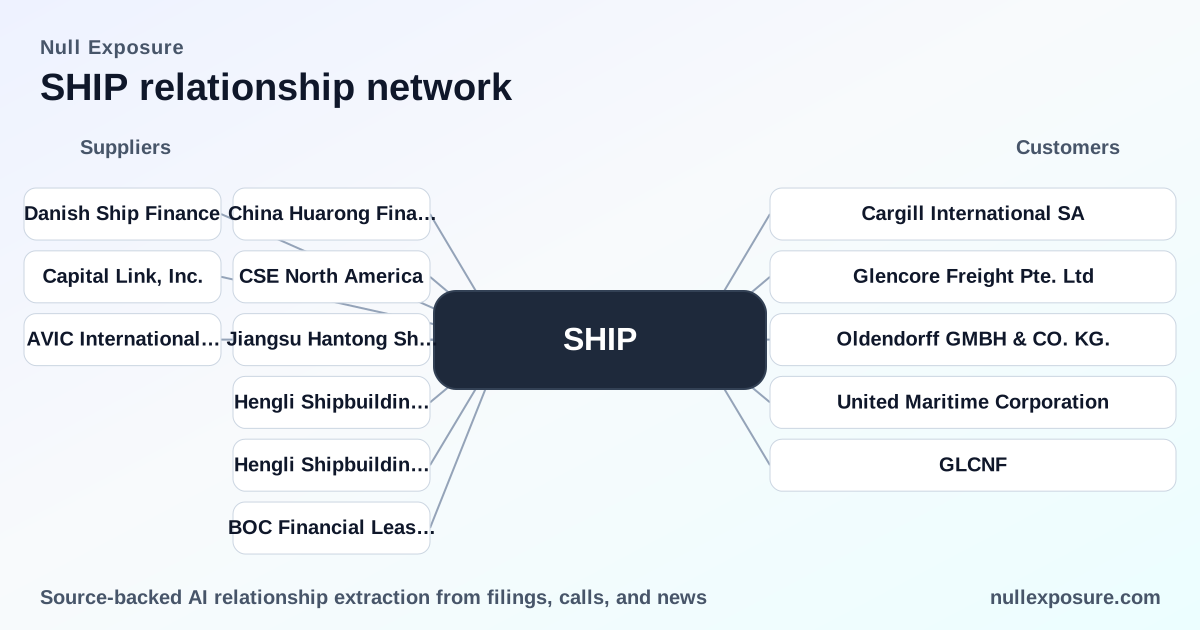
United Maritime Corporation / USEA — related-party purchaser and charter counterparty. Seanergy agreed to sell the 2010-built Capesize M/V Squireship for approximately $29.5 million with delivery expected in late April–June 2026, and separately placed the 2010-built MV Dukeship on an 18‑month bareboat charter with United Maritime/USEA in February 2026. These transactions were disclosed in company press coverage and United Maritime reporting in early 2026. (See ShippingTelegraph and GlobeNewswire / United Maritime releases, March–May 2026.)
-
USEA (United Maritime) — earlier financing link. Seanergy provided short-term bridge financing to support United Maritime’s offshore investment project (a reported $2.0 million bridge loan), and the amount was later repaid in full; that financing was disclosed in 2025 filings and media coverage. (See Riviera Maritime and United Maritime investor releases, 2025–2026.)
-
Cargill International SA — time‑charter counterparty on M/V Flagship. In December 2025 the MV Flagship commenced a new T/C with Cargill that runs into late 2027 or early 2028 (contract termination window specified as Nov 1, 2027 to Feb 1, 2028, +/- 15 days), providing multi-year employment for that vessel. (See Seanergy investor release via GlobeNewswire, Feb 17, 2026.)
-
Glencore / Glencore Freight Pte. Ltd — multi‑vessel T/C exposure. Seanergy reported separate T/C agreements with Glencore entities: the MV Friendship started a T/C in January 2026 for approximately 10–14 months, and the MV Partnership commenced a 12–15 month T/C in February 2026, reflecting repeated commercial relationships with the commodity trader. (See GlobeNewswire reporting on Seanergy results, Feb 17, 2026; related press items cite the same periods.)
-
Oldendorff GMBH & CO. KG. — longer T/C on Paroship. The MV Paroship began a new T/C in December 2025 with Oldendorff for a period of about 20–24 months, securing extended employment for that vessel through 2027. (See Seanergy press release distributed via GlobeNewswire, Feb 17, 2026.)
Each of the above summaries is drawn from Seanergy’s public announcements and contemporaneous reporting in Q4/Full‑Year releases and related press coverage in early 2026.
What the relationship map signals about operating risk
Treat the relationship set as a portrait of Seanergy’s operating model rather than a list of one-off deals:
-
Contracting posture: Seanergy uses a mix of short‑to‑medium duration time charters and bareboat charters to secure steady cashflow, while disposing older tonnage to realize capital for newbuilds. This mix reduces single‑voyage volatility but leaves the company exposed to market rates at renewal intervals.
-
Concentration and related‑party activity: The presence of related‑party transactions and intercompany financings is a repeating feature; at the company level this introduces counterparty and governance considerations that investors should monitor, even while such activity can be an efficient source of liquidity.
-
Commercial criticality: Contracts with global commodity traders (Cargill, Glencore, Oldendorff) are creditworthy sources of recurring earnings and help stabilize utilization; these counterparties materially support near-term EBITDA.
-
Maturity and strategic posture: The pattern of selling older vessels and acquiring new Japanese Capesize units indicates an active fleet renewal program and a focus on larger, modern capesize exposure — a strategic move to capture higher freight revenue in a favorable market cycle. (See Seanergy newbuilding program disclosures and related news, March–May 2026.)
Risk and upside for investors
-
Upside: The charter portfolio delivers predictable, contract-backed revenue in the near term and asset sales provide liquidity to fund accretive newbuilds. Seanergy’s FY2025 results and dividend actions underscore the company’s ability to convert shipping cashflows into shareholder distributions when market conditions allow.
-
Key risks: The model depends on timing of vessel disposals and renewals, counterparty concentration with related-party counterparties, and market cycle exposure at charter renewal. Monitor related-party terms, the cadence of asset disposals, and the renewal profile of major charters with Glencore/Cargill/Oldendorff.
How investors should use this relationship intel
- Validate cashflow assumptions against the documented charter durations (10–24 months in recent deals) and the timing of disclosed sales.
- Price in the potential governance premium/discount associated with related‑party transactions and the company’s fleet‑upgrade cadence.
For a consolidated repository of Seanergy counterparties and transaction timelines, visit https://nullexposure.com/ and navigate to the Seanergy customer dossier.
Bottom line
Seanergy’s commercial book in 2025–2026 combines recurring charter income from large commodity houses with opportunistic asset sales and occasional related‑party financing, a hybrid that funds an aggressive newbuilding push while supporting dividend distributions. For investors, the balance of contract durations, the identity of charterers, and the frequency of intra‑group transactions are the determinative signals for near‑term earnings stability and governance risk.