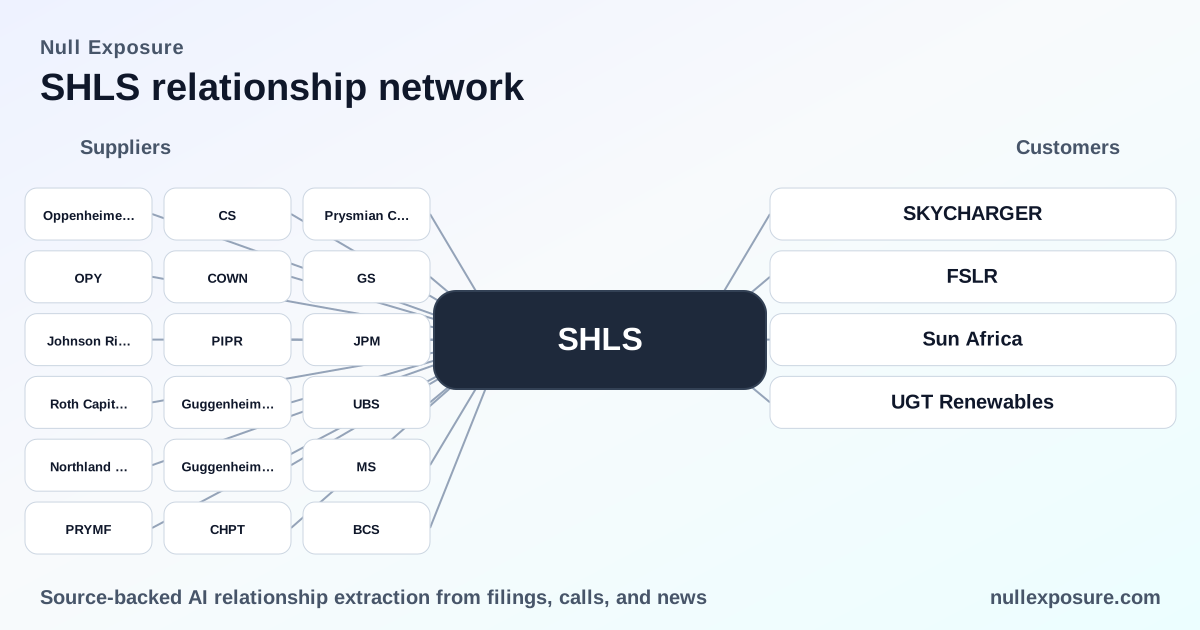
Shoals Technologies Group (SHLS): Customer Map and Commercial Implications
Shoals Technologies Group builds and sells electrical balance-of-system (EBOS) solutions — junction boxes, combiner systems, EV charging balance-of-system, and related OEM components — to the solar and energy-transition value chain. The company monetizes through product sales to EPCs, utilities, developers and OEMs, delivered either on a project-by-project basis or under master supply frameworks that support portfolios of projects; project-driven volume and a small number of large customers drive revenue concentration and working-capital dynamics. For investors and operators, Shoals’ growth is a function of renewable project pipelines and strategic OEM relationships that lift average order value and manufacturing throughput.
Learn more about how we surface these customer relationships at https://nullexposure.com/.
How Shoals operates in the market and why customer relationships matter
Shoals is a product-centric supplier whose revenue mix is dominated by a handful of large customers: one customer contributed roughly 26.4% of revenue in 2024 and the top five customers contributed about 54.3%. Shoals sells predominantly to EPCs that install projects on behalf of developers and owners, and it supplements project sales with OEM programs and battery energy storage system (BESS) solutions. This concentration creates revenue volatility tied to the timing and scale of a limited set of buyers, while framework agreements smooth supply for multi-project portfolios. Public financials show trailing twelve‑month revenue near $475 million and operating margin that supports mid-single-digit returns on equity; top-line growth is driven by a combination of U.S. project deployment and expanding international reach.
Customer relationships the record documents
Below are every customer relationship flagged in the public reporting and news coverage we indexed. Each entry is a concise, plain‑English summary with the source referenced.
SKYCHARGER — EV charging supply agreement (FY2021)
SKYCHARGER placed a purchase order for Shoals’ Fuel eMobility solutions to cover its 2022 pipeline, with initial shipments beginning in Q4 2021, signaling Shoals’ entry into EV charging balance-of-system markets beyond core solar EBOS. This was disclosed in a GlobeNewswire press release in November 2021. (GlobeNewswire, Nov 18, 2021)
First Solar, Inc. — custom junction-box supply (FY2025)
First Solar’s additional 3.5 GW manufacturing expansion in the U.S. is supported in part by Shoals’ custom junction boxes produced in Alabama, reflecting a manufacturing‑to‑manufacturer OEM relationship that leverages Shoals’ U.S. production footprint. The relationship was described in an AltEnergyMag article reporting on the continued partnership in March 2025. (AltEnergyMag, Mar 26, 2025)
FSLR — duplicate mention of First Solar supply (FY2025)
A second indexed mention captures the same commercial detail: Shoals manufactures custom junction boxes in Alabama that support First Solar’s expanded U.S. module capacity. This repetition appears in the same March 2025 coverage. (AltEnergyMag, Mar 26, 2025)
Sun Africa — project collaboration in Angola (FY2025)
Shoals and UGT Renewables’ sister company Sun Africa aligned to execute two energy‑diversification projects totaling 600 MW of solar PV in Angola’s southern provinces, indicating Shoals’ role as a supplier for large utility-scale projects in emerging markets. This collaboration was reported in a QuiverQuant news item covering the MOU and echoed in regional press. (QuiverQuant summary of FY2025 announcement)
UGT Renewables — MOU for up to 12 GW pipeline collaboration (FY2025)
Shoals signed a Memorandum of Understanding with UGT Renewables to collaborate on up to 12 GW of solar projects in UGT’s development pipeline, positioning Shoals as a potential long‑run EBOS supplier across a large global project book. The MOU was announced publicly and covered in March 2025 media. (QuiverQuant, Mar 2025)
Sun Africa — regional press confirmation of Angola projects (FY2025)
Regional reporting confirmed the Angola projects partnership: two landmark projects totaling 600 MW of solar PV with deployment scheduled later in the year, reinforcing the QuiverQuant disclosure and highlighting Shoals’ project-level execution in Africa. (TaiyangNews regional report, FY2025)
UGT Renewables — additional regional press on the MoU (FY2025)
A second press item reiterated the MoU between Shoals and UGT Renewables to collaborate on up to 12 GW of projects from UGT’s pipeline, underscoring consistent public messaging across outlets about a large-scale strategic sales channel. (TaiyangNews report, FY2025)
What the company-level constraints indicate about execution and risk
The public excerpts about Shoals’ contracting and customer mix translate into clear operational characteristics:
- Contracting posture: mix of master frameworks and short-term project sales. Shoals sells both project‑by‑project and under master supply agreements that support portfolios of projects, so revenue can oscillate between unpredictable lump-sum orders and steadier programmatic shipments.
- Geographic reach is global but U.S.-centric. Sales personnel in Spain and Australia support EMEA, Latin America, Africa and APAC, while the company historically derives the bulk of revenue from U.S. customers—this is consistent with current project activity and the First Solar OEM relationship.
- Concentration is material and a structural risk. One customer accounted for about 26.4% of revenue in 2024, and the top five customers made up roughly 54.3% of revenue, creating cash‑flow and bargaining‑power sensitivity to a small set of buyers.
- Customer role: Shoals is a seller to EPCs and OEMs. The firm’s primary channel is product sales to constructors and manufacturers rather than end‑user ownership, which concentrates exposure on procurement cycles and project timing.
- Segment focus: core EBOS and growth in BESS and eMobility. Shoals’ revenue is tied to core EBOS hardware but is diversifying into BESS and EV charging balance-of-system solutions, offering pathway to higher‑value product mixes.
- Spend band signal: large-order economics. Public excerpts and revenue shares imply that large customers account for significant spend buckets, consistent with $100M+ procurement relationships as a company-level signal.
Investment implications: what buyers and operators should watch
- Revenue concentration is the dominant risk. The loss or volume reduction from a top customer would materially affect results; investors must price for potentially lumpy quarterly throughput even as demand for solar grows.
- Framework agreements reduce but do not eliminate project timing volatility. Master supply agreements smooth order books for portfolios of projects but Shoals still recognizes substantial short-term, project-level sales.
- OEM and EV channel expansion is a strategic upside. Contracts with First Solar and SKYCHARGER demonstrate Shoals’ ability to win manufacturing and eMobility programs that diversify revenue away from pure EPC project cycles.
- International project partnerships scale addressable market but raise execution complexity. The UGT/Sun Africa MOU and Angola projects expand Shoals’ footprint into emerging markets where logistics and local content rules influence margins and working capital.
- Operational leverage is present but exposure to commodity and supply-chain dynamics remains. Manufacturing in Alabama supports domestic demand and near-shore supply security, while international sales rely on distributor and project logistics.
Bottom line
Shoals is a product-led supplier with significant revenue concentration and meaningful upside from OEM and international project channels. The disclosed relationships with First Solar, SKYCHARGER, UGT Renewables and Sun Africa illustrate both the company’s strategic customer wins and the project-based nature of its demand. Investors should balance growth expectations tied to large OEM and project pipelines against the structural risk of concentrated customers and project timing.
For deeper customer-mapping and relationship signals on Shoals and comparable suppliers, visit https://nullexposure.com/.