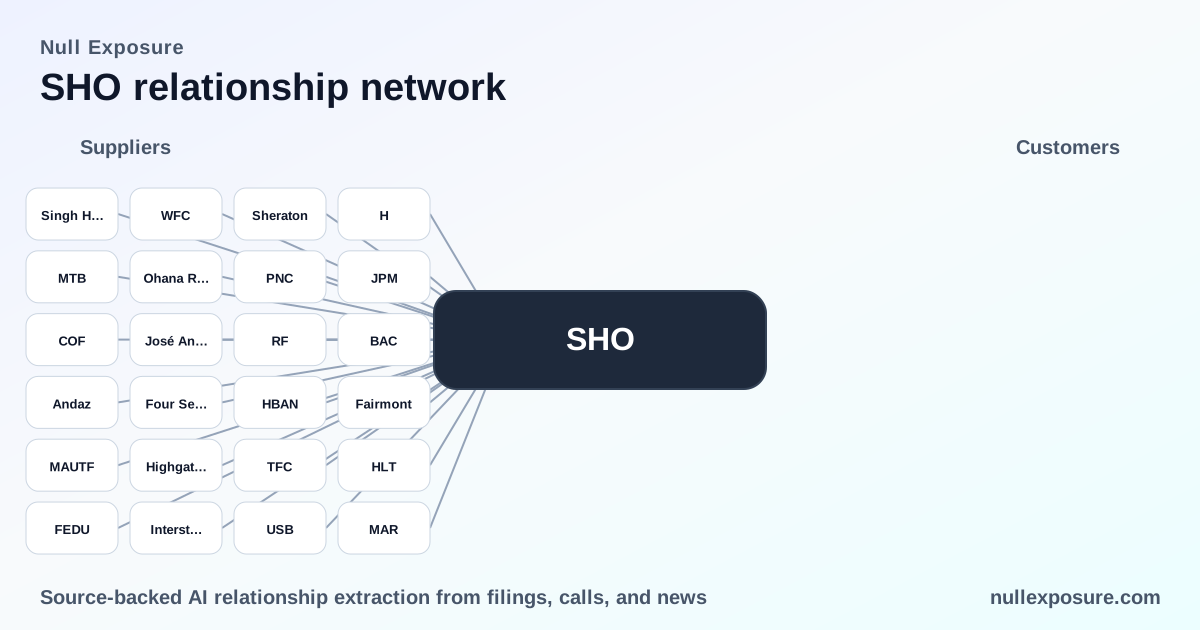
Sunstone Hotel Investors (SHO): Customer relationships and operational signals investors need to know
Sunstone Hotel Investors operates as a lodging REIT that owns and invests in full-service hotels and resorts and monetizes through hotel operating cash flow, asset management (dispositions and acquisitions), and fee income from management and franchise arrangements. The company reported roughly $960.1 million in trailing twelve‑month revenue with $210.2 million of EBITDA and a market capitalization near $1.84 billion, reflecting a portfolio that generates operating income while retaining the flexibility to realize value through asset sales and repositioning. For investors evaluating customer and service counterparty exposure, the core takeaways are simple: Sunstone is an operations-first hotel owner with geographically concentrated U.S. exposure and non-trivial service dependencies (e.g., third‑party laundry and property services). Learn more about NullExposure’s analysis and tools at https://nullexposure.com/.
How Sunstone actually makes money — the operating model, in one paragraph
Sunstone’s revenues are almost entirely generated by hotel operations: room revenue, food & beverage, and ancillary guest services drive cash flow; the REIT structure captures that cash through property ownership and related fees while allowing the company to harvest value via strategic dispositions. The corporate model blends asset-level operating risk with portfolio-level capital allocation: day-to-day performance depends on hotel-level occupancy and F&B capture, while long-term returns depend on cap rate management and selective asset sales. Fiscal metrics (revenue TTM $960.1M, EBITDA $210.2M) confirm an operating footprint that is material but not diversified globally — revenue concentration and operational interdependencies define the risk profile.
Portfolio geography and service exposure — what the constraints reveal
Company-level signals in our review show two meaningful operational constraints:
-
Geography: The hotel portfolio is concentrated in North America (United States), with major properties listed across California, Texas, Louisiana, Massachusetts and other states — Sunstone discloses a list of flagship assets as of December 31, 2024. This U.S.-centric footprint increases sensitivity to domestic leisure and corporate travel cycles and state-level demand drivers, and it concentrates counterparty and regulatory exposure in North America.
-
Segment: The company’s revenue mix is service-driven — room revenue, food & beverage, and ancillary hotel services make up substantially all revenue. That implies a contracting posture focused on operator and vendor relationships rather than product sales, and it elevates the importance of frontline service providers (housekeeping, laundry, F&B vendors) to the revenue stream.
These constraints inform operating characteristics: contracting posture is operator-heavy (management, franchise, vendor agreements), revenue concentration is regional and service-dependent, criticality is high for third-party service suppliers, and portfolio maturity is that of an established REIT with multi-year operating histories at many assets.
Customer relationships observed in public reporting and press
Below we list every relationship callout surfaced in our screening and what each implies for investors and operators.
Textile Care Services / Laundry relationship (linked to SHO‑P‑H)
Sunstone was identified in a transaction narrative where Textile Care Services was noted as handling daily laundry duties for Mayo Clinic, four hotels involved in a sale, and a number of other corporate customers; the press item described legal representation for Sunstone in connection with the sale of the properties. According to a Post‑Bulletin article covering the Kahler Grand and related hotel sales, Textile Care Services provided commercial laundry services to the hotels and to Mayo Clinic (Post‑Bulletin, March 10, 2026 — https://www.postbulletin.com/business/investors-confirm-sale-of-kahler-grand-other-hotels). This underscores that Sunstone’s operations rely on specialized third‑party service providers for critical back‑office functions such as laundry, which are operationally material to guest experience and cost structure.
Why that single relationship matters to portfolio and counterparty risk
The Textile Care Services mention is small in isolation, but it is illustrative: Sunstone’s service ecosystem includes third‑party providers that handle day‑to‑day guest-facing and back‑of‑house functions. For investors, this translates into two actionable points:
-
Operational sensitivity: Outsourced service providers can create concentrated operational risk if one supplier services multiple assets or important local customers (e.g., a hospital or regional operator). A disruption at a single supplier can have immediate guest‑experience and cost consequences across several properties.
-
Contracting leverage: Hotel owners typically manage vendor relationships via contracts that influence cost pass‑throughs and service levels — understanding the tenor and duration of those vendor contracts is essential to modeling short‑term margin volatility.
Financial and strategic implications for investors and operators
Combine the relationship signal with Sunstone’s financials and portfolio data and the picture becomes clear:
-
Revenue is service-driven and therefore operationally sensitive. With room and F&B revenue dominating top line, occupancy swings and supplier disruptions translate quickly to EBITDA (TTM EBITDA $210.2M).
-
Geographic concentration raises domestic cyclical risk. The portfolio’s U.S. focus creates exposure to regional demand patterns and state policy differences. Investors should weight exposure to leisure markets (e.g., California resorts) versus urban convention or corporate markets.
-
Vendor dependency is a non-trivial operational factor. Single-source service providers that handle essential functions (laundry, linen, specialized maintenance) introduce concentration risk at the operational level even when asset ownership is diversified.
-
Maturity and capital strategy are asset-driven. As a REIT with active dispositions and acquisitions, Sunstone’s cash generation supports both dividends and reinvestment; the company’s dividend yield (~3.64%) and capital metrics (Price/Book ~1.12; EV/EBITDA ~14.23) reflect a mature, income-focused equity with asset-liquidity optionality.
Risk checklist for investment due diligence
- Operational vendor concentration: Confirm whether critical services are single-sourced across multiple assets.
- Contract terms and renewal timing: Assess management and vendor contract durations that affect future margins.
- Geographic exposure: Stress-test portfolio cash flows under localized demand shocks.
- Asset disposition strategy: Evaluate the company’s track record converting operating assets to capital returns.
Where to go next
If you want a deeper mapping of Sunstone’s vendor and customer exposures and how those influence cash-flow stress scenarios, NullExposure provides integrated counterparty signal sets and narrative analysis. Visit https://nullexposure.com/ for case studies and extended relationship views.
Conclusion: Sunstone is an operations-centric lodging REIT with a service-driven revenue model, U.S.-focused portfolio, and operational reliance on third‑party service providers — the Textile Care Services mention is a concrete example of the type of vendor dependencies investors must incorporate into operational risk and valuation work.