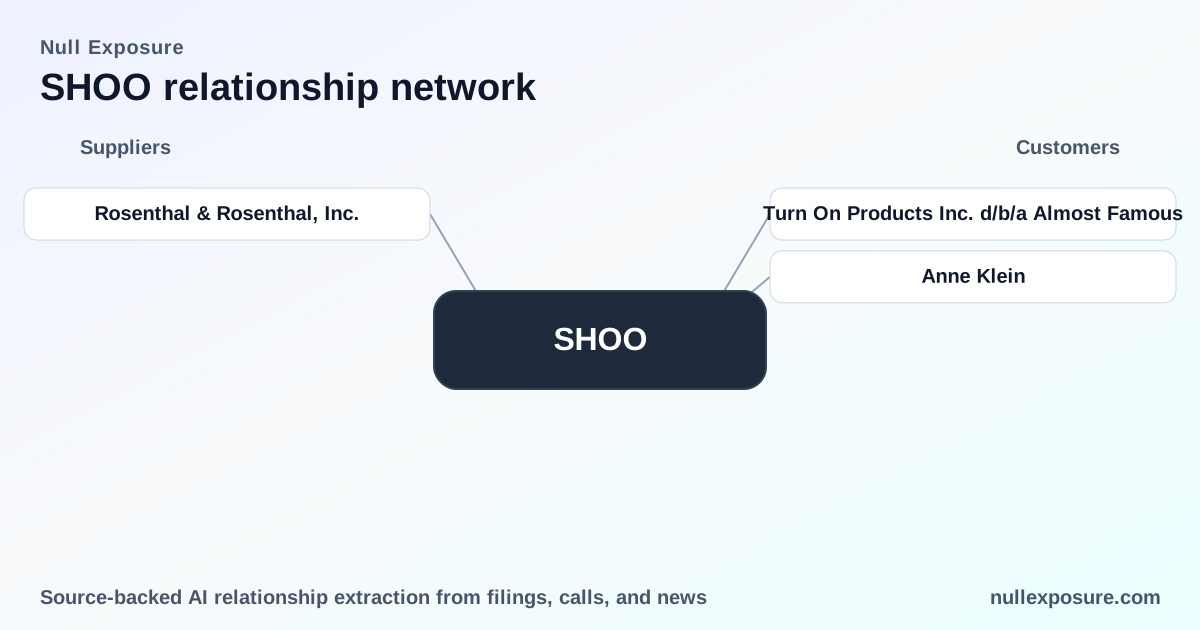
Steven Madden (SHOO): Customer relationships that drive revenue and shape risk
Steven Madden designs, sources, markets and sells footwear and accessories through a mix of wholesale and direct‑to‑consumer channels and supplements product sales with licensed royalty streams. The company monetizes primarily through wholesale distribution and owned direct channels, while licensing deals generate recurring royalties and advertising fees; management reported wholesale accounted for roughly three quarters of 2024 revenue, with direct channels contributing the remainder. For investors, the interplay of large wholesale accounts, licensing partners, and occasional receivables‑factoring arrangements defines revenue concentration, working capital dynamics, and near‑term earnings sensitivity. For continuous monitoring of these customer signals visit https://nullexposure.com/.
How the customer model actually works and what that means for returns
Steven Madden operates a dual revenue model: product sales through wholesale and direct channels, and fee‑based income from licensing. According to the company’s FY2024 disclosures, wholesale generated approximately $1,722,113 (about 75.4% of revenue) while Direct‑to‑Consumer represented roughly $550,153 (about 24.1%), and the company explicitly frames license agreements as royalty and advertising‑fee revenue based on the greater of minimum guarantees or a percentage of net sales.
This commercial posture creates a few structural characteristics investors should internalize as company‑level signals:
- Contracting posture: Licensing contracts are standard royalty/minimum structures and distribution relationships operate under multiyear framework agreements that include minimum store openings and sales thresholds—these are recurring, rights‑based revenue streams rather than one‑off purchases.
- Concentration and materiality: Management disclosed one customer accounted for 11.8% of total revenue for the year ended December 31, 2024, establishing a nontrivial single‑counterparty concentration.
- Geographic breadth and maturity: The company sells across North America, Europe, Latin America, Africa, the Middle East and parts of Asia, operating both directly and through joint ventures and special distribution arrangements—an international footprint that diversifies but also complicates execution risk.
- Relationship roles and criticality: The firm acts as seller to large retail buyers, and as licensor to brand partners; license agreements are contractual revenue engines with built‑in minimums, while wholesale buyers are critical for scale.
- Working capital and financing signals: The company’s filings reference factoring and notification riders tied to acquired assets, signaling active management of receivables and balance sheet liquidity.
Taken together, these characteristics imply revenue predictability through licensed minimums and framework agreements, balanced against earnings sensitivity to mass‑merchant order patterns and off‑price channel demand.
The partner roster — what matters to investors
Below I cover every customer relationship surfaced in the record and summarize the investor‑relevant fact set for each.
Turn On Products Inc. d/b/a Almost Famous
The FY2024 10‑K discloses a Notification Factoring Rider that allows certain receivables generated from assets DMFA acquired from Turn On Products Inc. (d/b/a Almost Famous) on October 20, 2023 to be included under the company’s Factoring Agreement, indicating receivables tied to that acquisition are being managed through external financing. According to the company’s FY2024 filing, this is a balance‑sheet level arrangement intended to manage working capital and cash flow.
Source: company FY2024 10‑K filing (Disclosure regarding Notification Factoring Rider and the October 20, 2023 DMFA asset acquisition).
Anne Klein
Steven Madden licenses footwear, handbags and other accessory categories for the Anne Klein brand, making Anne Klein a license relationship that generates royalty and advertising‑fee income rather than product resale revenue. Multiple March 2026 press reports and the company’s earnings materials list Anne Klein licensing as part of the brand portfolio.
Sources: company press materials and March 2026 coverage (Yahoo Finance and SG Bonline noted the licensing relationship in the company’s Q4/fiscal announcements).
Target (TGT)
Analyst commentary reported in May 2026 cited weakness in private‑label sales at mass merchants such as Target as a headwind to Steven Madden’s private label and wholesale performance, contributing to downward EPS guidance expectations for the period. This positions Target as a demand signal for SHOO’s private‑label wholesale channel rather than a licensing partner.
Source: Investing.com article, May 3, 2026, reporting analyst expectations and private‑label headwinds linked to mass merchants including Target.
Walmart (WMT)
Alongside Target, Walmart was identified by analysts as a mass‑merchant whose resistance to price increases is pressuring private‑label sales, amplifying headwinds in the wholesale channel and influencing near‑term EPS guidance considerations reported during the same May 2026 commentary cycle.
Source: Investing.com article, May 3, 2026, detailing analyst commentary about private‑label resistance at Walmart.
Key takeaways for investors
- Revenue mix is structurally skewed to wholesale. Wholesale accounted for ~75% of revenue in FY2024, giving major retail partners outsized influence on topline and inventory turnover. (Company FY2024 filing.)
- Licensing provides contractual downside protection. License agreements include minimum royalties and advertising fees, which create a floor for certain revenue lines even when wholesale demand softens.
- Concentration is real and monitorable. One customer represented 11.8% of 2024 revenue, a single‑counterparty concentration that requires active monitoring of contract renewals and payment performance.
- Working capital management is active. The factoring rider tied to assets acquired from Turn On Products indicates the company uses receivable financing as a tool to free up liquidity after acquisitions.
- Retail macro sensitivity is high. Analyst commentary in May 2026 linked potential EPS downside to private‑label setbacks at mass merchants (Walmart, Target) and slower off‑price channel sales—this is the proximate execution risk for the next few quarters.
What to watch next (operational signals that move the stock)
- License renewals and minimum guarantees: Any change to minimum royalty schedules materially shifts near‑term revenue visibility.
- Wholesale order cadence from major retailers: Purchase patterns at Walmart and Target will drive inventory digestion and gross margin volatility.
- Receivables and factoring activity: Additional notification riders or expanded factoring capacity will signal either strategic financing or cash‑flow pressure.
- SG&A trajectory: Management called out SG&A pressures in recent commentary; continued escalation would depress EPS relative to consensus.
Concluding recommendation: Weigh the defensive characteristics of licensed revenue and the breadth of the brand portfolio against concentration in wholesale accounts and cyclical exposure to mass‑merchant purchasing behavior. For ongoing monitoring of these customer relationships and automated alerts when material changes occur, visit https://nullexposure.com/.