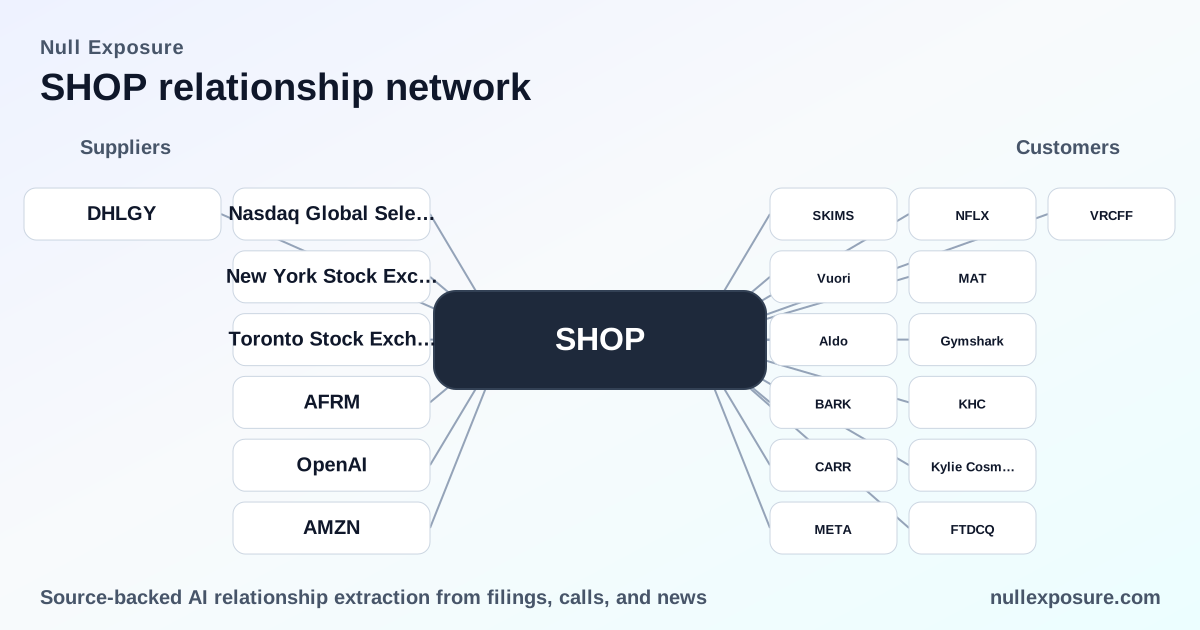
Shopify (SHOP) — What its customer roster reveals to investors
Shopify runs a two-sided commerce platform that generates recurring subscription revenue from merchants and captures variable merchant-solutions fees (payments, shipping, and value‑added services) tied to Gross Merchandise Volume (GMV). The company monetizes by selling tiered subscriptions (including annual, multi‑year enterprise contracts), transaction/processing fees through Shopify Payments, and services such as fulfillment and cross‑border tools—an asset-light infrastructure play that scales with merchant activity and GMV growth. For active investors, the customer list is the signal: global brand adoption plus millions of small merchants supports both stable recurring revenue and upside through take‑rate expansion. Visit https://nullexposure.com/ for further platform-level intelligence.
How Shopify’s commercial model constrains risk and opportunity
Shopify is built for both breadth and scale. Its contracts are primarily subscription-based, with enterprise customers on annual or multi‑year commitments and the broader base on monthly plans; the company also earns usage‑based fees where payments and currency conversion apply. These elements create a hybrid revenue profile: predictable recurring base plus cyclical upside as GMV expands.
- Contracting posture: enterprise commitments can be multi‑year and recognized ratably; most merchant plans are monthly with automatic renewal. This creates a stable deferred‑revenue runway at the top end while leaving a material portion of revenue sensitive to merchant activity.
- Concentration: Shopify discloses that no single merchant has ever represented more than 5% of revenue, making the customer base broadly diversified across verticals and sizes.
- Geographic footprint: Shopify operates truly globally — North America dominates but EMEA and APAC penetration matter for growth and payments adoption.
- Segments and roles: merchants are buyers of software and infrastructure; Shopify also sells services (payments, shipping, fulfillment) that increase customer stickiness and take rate.
- Maturity and criticality: the platform has progressed from SMB tools to enterprise-grade commerce infrastructure; for many brands and government customers Shopify now functions as critical commerce infrastructure rather than a simple storefront.
These constraints shape valuation sensitivity: subscription durability reduces downside, while GMV and take‑rate variability drive upside. For hands-on diligence, see the landing page at https://nullexposure.com/ for merchant-level signals and ecosystem mapping.
The customer roster, company by company
Below are plain‑English notes on every relationship surfaced in the collected results, with source context for each entry.
-
Vuori — Listed as one of the larger brands using Shopify in a Shopify investor press release; Vuori exemplifies direct‑to‑consumer apparel brands leaning on Shopify for scale. (Shopify investor press release, May 2026: https://www.shopify.com/investors/press-releases/automatic-securities-disposition-plans-adopted-shopify-chief)
-
BarkBox / Bark (BARK) — BarkBox is cited among brands operating on Shopify; industry commentary notes migration to Shopify to lower acquisition cost and improve conversion for D2C channels. (Shopify press release, May 2026; SimplyWall analysis, Mar 2026: https://finance.yahoo.com/news/fst-corp-joins-shopify-plus-120000864.html and https://simplywall.st/)
-
SKIMS — Named repeatedly in Shopify investor materials as a marquee merchant; SKIMS is representative of high‑profile fashion partners that use Shopify Plus and enterprise features. (TradingView / Shopify investor release, Mar 2026 / Feb 2025: https://www.tradingview.com/news/tmx_newsfile:c08903b31094b:0-automatic-securities-disposition-plans-adopted-by-shopify-chief-executive-officer/ and https://www.shopify.com/investors/press-releases/shopify-to-announce-fourth-quarter-and-full-year-2024-financial-results-february-11-2025)
-
Aldo — Cited by Shopify as a brand on the platform; Aldo signals use by established global footwear and accessory retailers. (TradingView / Shopify materials, Mar–May 2026: https://www.tradingview.com/news/tmx_newsfile:c08903b31094b:0-automatic-securities-disposition-plans-adopted-by-shopify-chief-executive-officer/)
-
LifeVantage (LFVN) — LifeVantage disclosed an agreement with Shopify to modernize its tech and marketing stack, indicating Shopify’s reach into network‑marketing and direct‑sales companies. (LifeVantage Q4 2025 earnings call transcript, Mar 2026: lfvn-2025q4-earnings-call)
-
Carrier (CARR) — Listed among enterprise customers in Shopify investor commentary; Carrier demonstrates Shopify’s traction beyond pure retail into broader branded commerce. (Shopify investor press release, May 2026)
-
Meta (META) — Referenced by Shopify as a partner/merchant in investor materials, underlining Shopify’s integration with major social platforms and social‑commerce flows. (TradingView / Shopify investor release, Mar–May 2026)
-
Netflix (NFLX) — Shopify lists Netflix among trusted brands, showing entertainment and media companies use Shopify for merchandise and commerce experiences. (Shopify investor press release, Feb 11, 2025: https://www.shopify.com/investors/press-releases/shopify-to-announce-fourth-quarter-and-full-year-2024-financial-results-february-11-2025)
-
FST Corp. (KBSX) — Announced an enterprise rollout of Shopify Plus to automate operations and expand markets, illustrating Shopify’s appeal to industrial/vertical manufacturers expanding D2C. (Yahoo Finance press, Mar 2026: https://finance.yahoo.com/news/fst-corp-joins-shopify-plus-120000864.html)
-
Colibri (CLBR) — Management cited launching a Shopify integration for payments, reflecting Shopify’s role in enabling third‑party payments and point‑of‑sale ecosystems. (CLBR Q1 2025 earnings call transcript, Mar 2026: clbr-2025q1-earnings-call)
-
Mattel (MAT) — Included in Shopify investor materials as a marquee brand, demonstrating toy and consumer goods merchants running at scale on Shopify. (Shopify investor press release, Feb 2025)
-
Grove Collaborative (GROV) — Public companies migrating to Shopify to enable personalization and to improve economics were noted in earnings transcripts and press coverage. (Investing.com / The Globe and Mail coverage, May 2026)
-
Manhattan Associates (MANH) — Manhattan made a connector app available in the Shopify App Store, signaling integrations between order management suites and Shopify. (TradingView / Alphastreet coverage, Mar 2026)
-
Boot Barn (BOOT) — Company commentary confirms sites built on Shopify for rapid deployment with low CapEx and development lift. (Bitget / InsiderMonkey coverage, Mar 2026)
-
Reitmans Canada Ltd. — Reitmans completed migration of three apparel banners (Reitmans, RW&CO., Penningtons) to Shopify, an example of national retailers shifting enterprise e‑commerce onto Shopify. (SahmCapital coverage, Apr 12, 2026)
-
Global‑e Online (GLBE) — Analysts and press note deepening partnerships with Shopify (Shop Pay integration, preferred partner agreements), which supports cross‑border commerce and GMV throughput. (SimplyWall / The Globe and Mail analyses, Mar 2026)
-
Transcosmos — Reported deeper integration with Shopify Plus and Shopify Markets to power localized multi‑country e‑commerce, highlighting partner ecosystem expansion in Asia. (SahmCapital commentary, Mar 2026)
-
Klaviyo — Cited for deeper integrations with Shopify to power CRM and localized experiences—evidence of growing third‑party SaaS interdependence. (SahmCapital, Mar 2026)
-
Wacoal — Named as a brand supported by integrations via partners like Transcosmos and Klaviyo on Shopify Plus, showing vertical localization use cases. (SahmCapital, Mar 2026)
-
AiChat (AIRE) — Announced a direct Shopify integration for conversational commerce and AI ticketing that links product, inventory and order data in real time. (Press via ManilaTimes / GlobeNewswire, May 2026)
-
Canopy Growth Corp. — Trading commentary reported that cannabis companies have signed deals with Shopify, showing the platform’s penetration into regulated retail verticals. (TradingView idea page, May 2026)
-
Hydropothecary Corp. — Reported to have chosen Shopify to sell medical cannabis online, reinforcing the regulated‑commerce use case. (TradingView idea page, May 2026)
-
Ontario Cannabis Retail Corp. (OCRC) — Coverage indicates that Ontario’s government retailer selected Shopify to process transactions and power in‑store digital kiosks — an example of public‑sector reliance on Shopify infrastructure. (TradingView coverage, May 2026)
-
BWMX — Management noted launching a new Shopify+ platform for Jafra Mexico, demonstrating Shopify’s use in enabling leader/consultant social selling. (BWMX Q4 2025 earnings call transcript, Mar 2026)
-
VRCFF / Supreme — Supreme is named among brands on Shopify in investor outreach and trading commentary; the presence of streetwear brands underscores Shopify’s role in high‑velocity product drops. (TradingView / Shopify press, Mar–May 2026)
-
FTD — Listed in Shopify materials as a merchant, reflecting use by floral and gift networks for merchant commerce. (Shopify investor press release, Feb 2025)
-
Gymshark — Cited as a trusted Shopify brand, representing digitally native athletic apparel merchants. (Shopify investor release, Feb 2025)
-
Heinz (KHC) — Included among enterprise customers in Shopify investor materials, showing legacy CPG ties to the platform for direct commerce. (Shopify investor release, Feb 2025)
-
Kylie Cosmetics — Named as a user in Shopify investor communications, a high‑profile D2C cosmetics brand on the platform. (Shopify investor release, Feb 2025)
-
Penningtons and RW&CO. — As part of Reitmans’ migration, these two banners now run e‑commerce on Shopify, illustrating multi‑brand rollouts for a single retailer. (SahmCapital, Apr 12, 2026)
-
EL (Estée Lauder / EL) — Analyst notes cited a new Shopify partnership supporting social commerce and digital distribution for major cosmetics players. (Zacks / TradingView coverage, Mar 2026)
Read for investors: what matters from this customer list
Two investor takeaways are clear. First, Shopify’s customer base spans millions of SMB merchants and a growing roster of enterprise and government customers, which diversifies revenue risk and deepens platform entrenchment. Second, the partner ecosystem—payments, logistics, CRM, and AI conversational vendors—amplifies Shopify’s product stickiness and helps protect take rates but also creates strategic interdependencies with third parties like Global‑e and DHL. Both factors support Shopify’s current premium multiple, while keeping the stock sensitive to GMV growth and competitive take‑rate pressure.
For deeper, merchant‑level signals and to track which brands are moving onto Shopify next, visit https://nullexposure.com/ — an investor resource focused on platform adoption and commercial health.