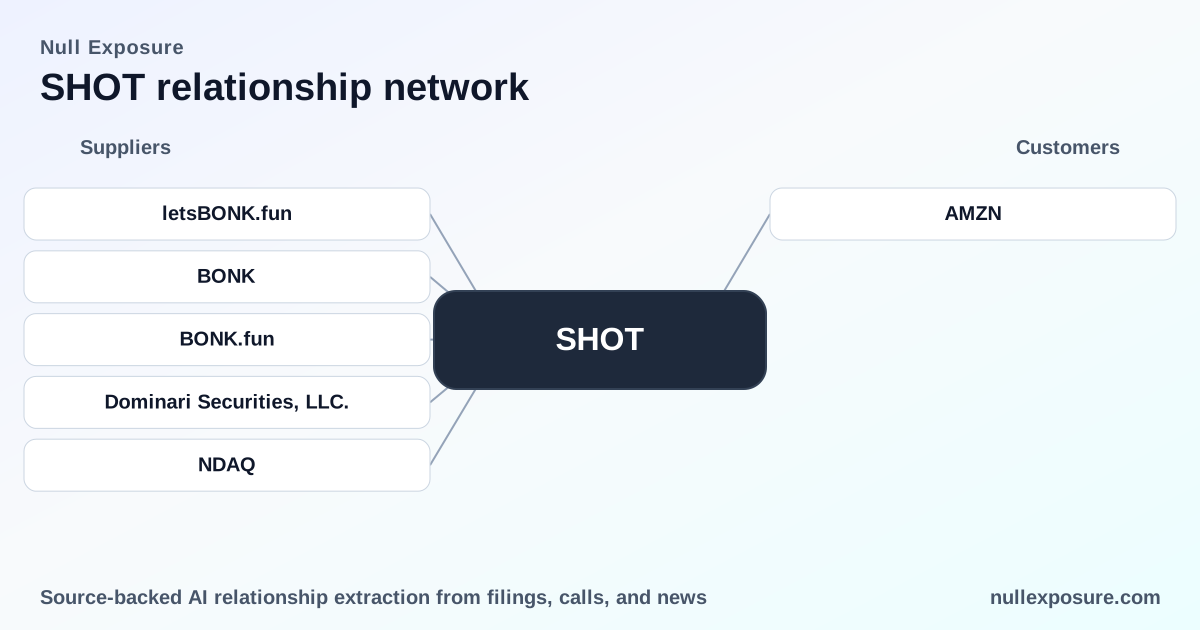
Safety Shot (SHOT) — Customer Relationships and Distribution Footprint
Safety Shot operates as a consumer wellness beverage company that monetizes primarily through product sales across direct-to-consumer channels and a growing set of retail and distributor partnerships. The company drives revenue by selling single-serve functional shots online and through national retail placements; its commercial model leverages e‑commerce reach plus wholesale distribution to scale shelf presence and frequency. For a concise view of partner exposure and implications for revenue cadence and margin dynamics, see Null Exposure’s homepage: https://nullexposure.com/.
How distribution drives value (and risk)
Safety Shot’s economics are governed by where consumers buy the product and who controls shelf and reorder mechanics. Direct sales through Amazon and DrinkSafetyShot.com capture higher gross margin per unit but depend on digital marketing and conversion; retail placements (7‑Eleven, pharmacies) accelerate velocity but compress margins through trade promotion and distributor fees. The presence of a national distributor also signals a move from boutique DTC fulfillment to broader retail logistics and inventory cycles.
Company-level signals relevant to underwriting and operations:
- Contracting posture: Retail and distributor relationships imply standard reseller and wholesale agreements rather than exclusive manufacturing partnerships; inventory and promotional commitments are likely the primary contractual levers.
- Concentration: Multiple channel types (e‑commerce, convenience stores, pharmacies, distributor-enabled retail) reduce single-channel risk but leave concentration exposure if a few partners account for a large share of reorder volume.
- Criticality: Distributor relationships are operationally critical because they determine shelf availability and replenishment economics; loss of a national distributor would have an outsized short-term revenue impact.
- Maturity: Product commercialization began in late 2023, placing Safety Shot in an early commercial-growth phase where distribution wins are the primary lead indicators for near-term revenue scaling.
Catalog of reported customer relationships
Amazon / Amazon.com (AMZN)
Safety Shot has been available for retail purchase on Amazon since the product’s initial retail rollout in December 2023, and the company lists Amazon among its primary e‑commerce platforms for sales and customer acquisition. This channel supports the brand’s DTC visibility and broad online reach (GlobeNewswire press release, Mar 18, 2024; TradingView coverage referencing FY2025 filings).
7‑Eleven
Safety Shot announced that its 4 oz. bottles will be sold in 7‑Eleven convenience stores in Chicago at a local price point ($5.99 each or $10 for two), positioning the product for impulse and convenience purchase occasions. The placement was disclosed in a FinancialContent press release covering FY2026 distribution plans (FinancialContent press release, FY2026).
Capital Drugs
Safety Shot entered a partnership to place its product in all 300 Capital Drugs pharmacies across the U.S., extending reach into community pharmacy channels and prescription-adjacent retail. The rollout to Capital Drugs was announced in the same FY2026 FinancialContent release that covered several new distribution agreements (FinancialContent press release, FY2026).
KeHE Distributors
Safety Shot announced a strategic partnership with KeHE Distributors, a major U.S. natural, organic and specialty foods distributor, to expand access to specialty and natural‑food retail accounts. Working with KeHE signals an intentional move into specialty retail and regional chain penetration rather than purely mainstream grocery placement (FinancialContent press release, FY2026).
What these relationships mean for revenue and execution
Each named distribution partner reflects a distinct commercialization ladder: Amazon accelerates reach and quick consumer buys; KeHE opens specialty and natural-channel racks; 7‑Eleven drives on‑the-go frequency; Capital Drugs accesses pharmacy traffic. From a unit economics perspective, DTC through Amazon will deliver cleaner margin profiles per unit, while retail and distributor channels will require slotting, promotions, and distributor fees that compress realized margins but offer scale.
Operationally, the company will need to balance inventory forecasting across direct shipments and distributor-managed replenishment, manage promotional cadence that aligns with retailer marketing calendars, and maintain digital conversion while supporting brick‑and‑mortar merchandising.
Operational and financial risks to monitor
- Promotional intensity and margin compression: National placements commonly require promotional allowances; watch reported gross margin trends and promotional expense line items in quarterly filings.
- Inventory and working capital: Distributor-led retail rollouts create multi-week lead times and potential channel stuffing; monitor receivables, inventory turnover, and days payable/receivable changes.
- Concentration risk: While multiple partners exist, a disproportionate share of revenue routed through a single retailer or distributor would increase vulnerability to renegotiation or delisting.
- Execution risk in retail execution: Shelf presence, in‑store merchandising, and reorder rates in convenience and pharmacy channels determine whether placements convert into repeat retail sales.
Practical takeaways for investors and operators
- Distribution breadth is the core growth lever: The set of partners reported—Amazon, KeHE, 7‑Eleven, Capital Drugs—creates complementary channels that, if executed, will materially accelerate top-line growth.
- Margins will be channel-dependent: Expect higher margins in e‑commerce and lower margins in distributor/retailer sales; margin disclosure in upcoming filings will indicate the balance between DTC and wholesale revenue.
- Operational discipline wins: Inventory management, promotional control, and distributor relationship governance are the proximate drivers of sustainable profitability.
For a concise, investor-focused snapshot of Safety Shot’s partner map and how it affects exposure and revenue risk, visit Null Exposure: https://nullexposure.com/.
Conclusion — what to watch next
Prioritize three metrics in the next two quarters: (1) the share of revenue attributable to Amazon versus retail/distributor channels; (2) gross margin trends as retail placements scale; and (3) working capital dynamics tied to KeHE and Capital Drugs rollouts. These indicators will determine whether Safety Shot can translate distribution wins into durable, profitable growth.
Sources referenced in this note include the company’s press releases and market coverage: a GlobeNewswire release detailing initial Amazon availability (Mar 18, 2024), multiple FinancialContent press releases announcing FY2026 retail and distributor agreements, and TradingView treatment of the company’s FY2025 filings referencing e‑commerce sales channels.