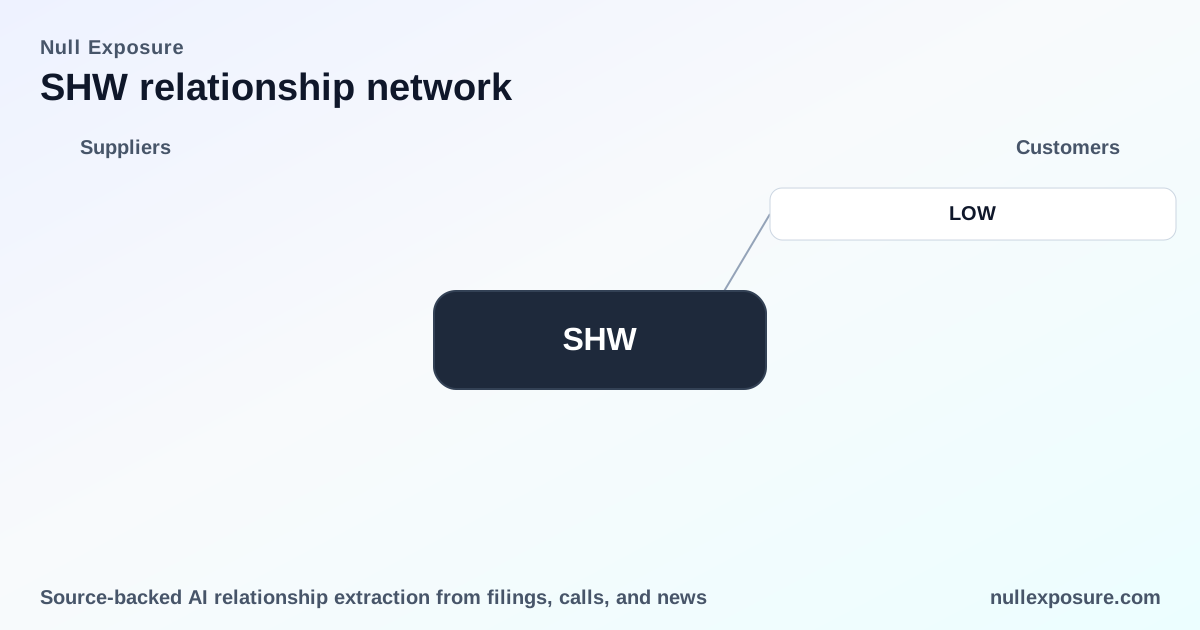
Sherwin‑Williams (SHW): Customer Relationships and Commercial Signals
Sherwin‑Williams manufactures, distributes and sells paints, coatings and related products through a mix of company‑operated paint stores, retail partners, distributors and licensing arrangements, monetizing primarily through product sales, branded licensing and value‑added coatings services. Revenue is driven by a diversified channel strategy—direct retail, national home‑center partners, and industrial OEM and contractor channels—supported by global licensing in performance coatings. For deeper coverage of commercial risk and counterparty profiles, visit https://nullexposure.com/.
How Sherwin actually sells — the commercial blueprint investors should read
Sherwin‑Williams operates a multi‑channel go‑to‑market model. The Paint Stores Group runs thousands of company‑operated specialty stores that capture professional and DIY customers; the Consumer Brands Group supplies national retailers and third‑party distributors; the Performance Coatings Group services industrial and OEM customers and licenses technology and trade names worldwide. According to the company’s disclosures, approximately 80% of net external sales occur in North America, with EMEAI and other regions composing the remainder. This geography split makes Sherwin predominantly a North American commercial story with expanding international industrial exposures.
The combination of company‑run retail, resale through national chains, and licensing creates a layered margin profile: higher gross and operating margins from branded stores and industrial coatings, and broad but lower‑margin volumes from retail partners and distributors. This mixed channel design reduces reliance on any single buyer at the corporate level: the 2024 filing notes no individual customer accounted for more than 10% of consolidated sales.
Contracting posture, counterparty types and what they mean for revenue stability
Sherwin’s sales fall into three contracting patterns that shape cash flow predictability:
- Point‑in‑time (spot) transactions dominate retail and many reseller sales, consistent with disclosures that a large portion of revenue is recognized when goods change hands.
- Long‑term supply agreements govern other flows—particularly industrial coatings and major distributor relationships—where purchase orders and contractual rebates define pricing and volume incentives.
- Licensing agreements—notably inside Performance Coatings—deliver recurring low‑touch royalties and enable third‑party distribution under Sherwin brand names globally.
These patterns imply solid topline diversification with pockets of contractually supported revenue (industrial & distributor agreements) layered on a broad base of transactional retail sales. The company’s role toggles between manufacturer, licensor and reseller partner depending on the end channel, supporting resilience but requiring active trade promotion and commercial execution.
Notable customer relationships on the record
Lowe’s (LOW)
Lowe’s operates an exclusive relationship with Sherwin‑Williams that traces back to Sherwin’s Valspar acquisition and subsequent arrangement: Valspar’s long‑standing tie to Lowe’s converted into an exclusive Sherwin relationship beginning in 2018, positioning Lowe’s as a major national retail partner for Sherwin’s consumer brands. According to a Morningstar company report (March 2026), that legacy partnership underpins Sherwin’s retail footprint inside the home‑center channel. During Lowe’s Q3 2025 earnings call, Lowe’s management specifically cited ProBlock Quick Dry Primer, “expertly manufactured by Sherwin‑Williams,” as part of its product roll‑out, confirming active product supply and co‑branded SKU launches into Lowe’s assortment (Lowe’s Q3 2025 earnings call transcript). A Lowe’s Q4 2026 transcript noted the retailer’s early adoption of Sherwin’s ProBlock primers in Q3, underscoring merchandising momentum (InsiderMonkey transcript, 2026).
Tri Pointe Homes (TPH)
Sherwin‑Williams serves as a founding sponsor for Tri Pointe’s LivingWell model home program, providing coatings and specification support for a next‑generation wellness‑focused home concept. GlobeNewswire reported Tri Pointe Homes’ LivingWell launch on March 26, 2026, listing Sherwin‑Williams among founding sponsors alongside Shaw, Weyerhaeuser and Builders FirstSource, signaling strategic builder partnerships in new‑home specification channels (GlobeNewswire, March 2026).
What these relationships reveal about Sherwin’s commercial exposure
Collectively, the documented relationships illustrate three investor‑relevant realities:
- Channel concentration is meaningful but controlled. National home‑center partners like Lowe’s are important distribution conduits for consumer brands, but corporate filings show no single customer exceeded 10% of sales in 2024, which limits counterparty concentration risk at the consolidated level.
- Product criticality varies by counterparty and segment. For retail partners, Sherwin is a supplier of branded SKUs and co‑branded innovations (e.g., ProBlock), while for homebuilders and industrial OEMs the company supplies specified coatings that can be more mission‑critical to project timelines.
- Contract maturity mixes spot and contractual flows. The company’s commercial book contains a large volume of point‑of‑sale transactions alongside long‑term supply and licensing agreements that stabilize industrial revenues and extend brand reach globally through licensing.
Operational constraints and business model signals investors should factor
The company disclosures yield explicit operating signals investors must price in:
- Contracting posture: A hybrid model—heavy point‑in‑time retail sales balanced by long‑term industrial supply contracts and licensing agreements—generates both volatility tied to housing and renovation cycles and recurring industrial revenue.
- Geographic concentration: North America accounts for roughly 80% of revenue, making U.S. housing and contractor demand a primary driver of topline performance.
- Customer materiality: On a consolidated basis customers are immaterial individually, but segment disclosures flag that the Consumer Brands Group can have significant customers whose performance affects segment profitability.
- Role diversity: Sherwin functions as manufacturer, distributor, licensor and seller, which reduces single‑channel risk but increases execution complexity across trade promotion, logistics and IP management.
- Maturity and brand strength: Long history and entrenched brands drive pricing power in many channels, supporting higher operating margins in store and industrial businesses relative to pure commodity paint suppliers.
Bottom line for investors
Sherwin‑Williams runs a diversified, multi‑channel commercial engine that monetizes through direct retail, national retail partnerships, distributor networks and licensing. Key positives are brand strength, margin mix and contractual industrial revenue; primary exposures are North American demand cycles and retail trade dynamics with a small set of large channel partners. For a full view of counterparty and commercial risk across portfolios, explore the Null Exposure coverage at https://nullexposure.com/.
Key takeaways:
- Diversified channels reduce single‑counterparty concentration at the corporate level.
- North America dominates revenue and remains the principal macro risk lever.
- Lowe’s represents a strategic national retail partnership with active co‑branded SKUs; Tri Pointe shows builder/specification engagement in new‑home channels.
- Contracting is a hybrid of spot transactions, long‑term supply agreements and licensing—each shaping predictability and margin differently.