SI‑BONE Customer Relationships: What Investors Need to Know
SI‑BONE develops and sells implantable titanium implants and the instruments used to place them for sacropelvic and pelvic trauma indications, and the company monetizes principally through hardware sales to hospitals, medical groups and distributors supported by a direct US sales force and third‑party resellers in international markets. With roughly $201 million in trailing revenue and a concentrated, hardware‑driven go‑to‑market, distribution partnerships and government channels are material levers for scaling adoption. For a concise competitive and commercial read on SIBN customer exposure, visit https://nullexposure.com/.
Big distribution move: Smith+Nephew brings iFuse TORQ to trauma centers
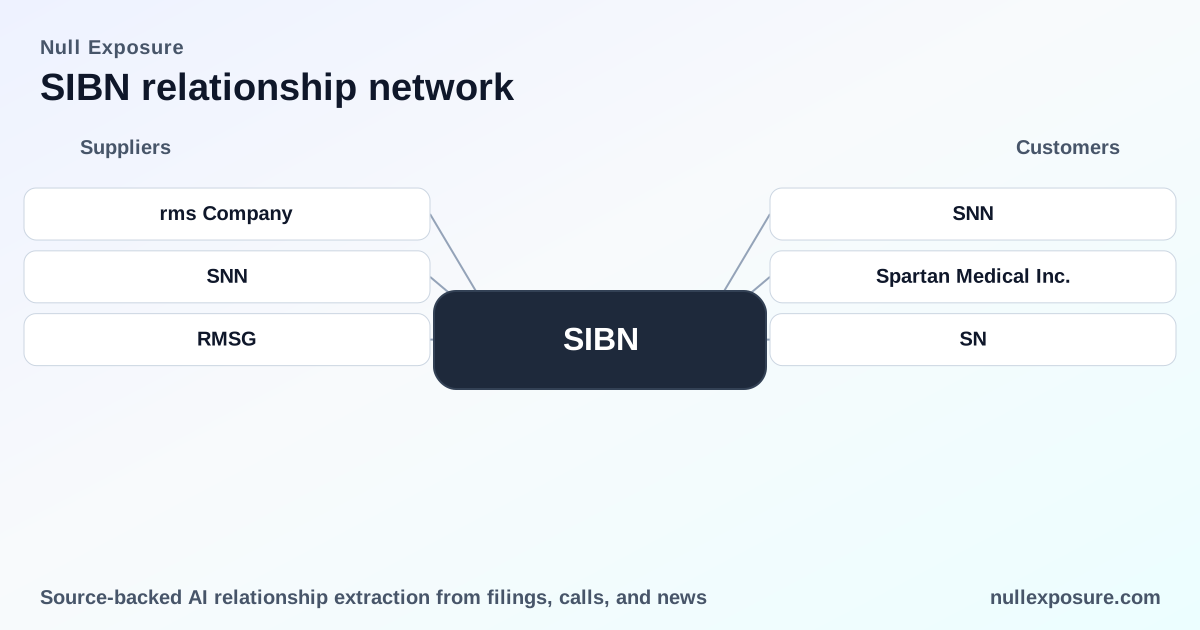
SI‑BONE announced a strategic distribution agreement with Smith+Nephew to commercialize the iFuse TORQ portfolio in trauma settings, targeting Level 1 and Level 2 trauma centers and accelerating access to pelvic fracture care. This relationship positions SI‑BONE to leverage Smith+Nephew’s national trauma channel and field infrastructure to expand penetration beyond its historical sacroiliac pain franchise. According to multiple press releases, Smith+Nephew signed a distribution agreement with SI‑BONE focused on the iFuse TORQ portfolio (Business Insider and BioSpace, March 10, 2026), and SI‑BONE’s own results commentary confirmed the strategic partnership to deploy the products across trauma centers (GlobeNewswire, March 3, 2026).
- Key takeaway: Partnering with a global orthopedics incumbent accelerates scale in acute care trauma channels, shifting some go‑to‑market effort from SI‑BONE’s smaller direct sales footprint to a major distributor network.
Sources: Business Insider press release on March 10, 2026; BioSpace press release March 10, 2026; SI‑BONE / GlobeNewswire investor release March 3, 2026.
A targeted government channel: Spartan Medical for veterans’ healthcare
SI‑BONE named Spartan Medical Inc. as an exclusive SDVOSB (Service‑Disabled Veteran‑Owned Small Business) distributor to expand access to its products within government healthcare systems serving veterans, with Spartan providing contract‑ready programs, clinical support and logistics. The arrangement explicitly targets government hospitals and other federal healthcare buyers where SDVOSB status and contract readiness are deciding procurement factors (EIN Presswire, March 2026).
- Key takeaway: This relationship creates a direct government procurement channel and reduces friction for VA and other federal system buying cycles by using a compliant, contract‑ready partner.
Source: EIN Presswire announcement, March 2026.
How these relationships show up in SI‑BONE’s operating model
The relationship signals and contractual constraints embedded in SI‑BONE’s disclosures frame a company that sells hardware with mixed go‑to‑market tactics and defined payment and distributor terms:
- SI‑BONE operates with formal framework agreements and approved price lists for some hospital and facility customers, which standardize pricing and terms across accounts and reduce transactional friction. Evidence indicates master services or approved price list arrangements are in place with certain hospitals.
- Standard commercial credit terms are short term (net 30 to 90 days), signaling predictable receivable timing for premium implants sold to hospitals and distributors.
- SI‑BONE’s international footprint is explicit: revenue derives from the United States and Europe, and the company reports sales in 38 other countries, so global regulatory and government procurement dynamics influence contract risk and compliance obligations.
- Outside the US, many customers are government‑sponsored healthcare systems, making anti‑bribery and public procurement compliance a material operational constraint.
- SI‑BONE sells through a direct sales force in the US and uses third‑party sales agents, resellers and distributors internationally, and its distributor agreements include standard payment obligations that are not contingent on resale or financing.
- The firm’s product set is hardware and implant focused, with patented titanium implants and instruments forming the core revenue stream.
These are company‑level signals drawn from SI‑BONE’s public commentary and filings; they are not assigned to any single counterparty unless the disclosure names that party.
Why the Smith+Nephew deal matters to investors
The Smith+Nephew relationship changes the commercialization geometry for SI‑BONE. By placing iFuse TORQ into Smith+Nephew’s trauma network, SI‑BONE converts a portion of go‑to‑market responsibility into a distribution leverage model that can accelerate adoption in acute care settings and reduce marginal selling costs per procedure. Press coverage and company statements in March 2026 document the explicit intent to distribute iFuse TORQ and its TNT variant across trauma centers nationwide (Business Insider; GlobeNewswire), which is directly aligned with SI‑BONE’s stated strategy to broaden clinical indications and grow procedure volume beyond elective SI joint cases.
- Financial implication: If adoption in trauma centers scales as intended, this distribution pact increases total addressable procedures without proportionally expanding SI‑BONE’s small direct sales organization, supporting operating leverage over time.
Sources: Business Insider and GlobeNewswire press coverage, March 2026.
Government channel dynamics and revenue quality
The Spartan Medical SDVOSB relationship demonstrates SI‑BONE’s tactical approach to public procurement channels: rather than direct government contracting, the company uses a compliant distributor to access VA and defense health systems. This structure improves contracting speed and compliance posture but concentrates counterparty risk into the government buyer base, where pricing and reimbursement dynamics differ from commercial hospitals.
- Commercial implication: Government sales tend to have longer procurement cycles but stronger contract durability once awarded; SI‑BONE’s use of an SDVOSB partner reduces procurement friction while keeping payment terms consistent with corporate policy.
Source: EIN Presswire announcement, March 2026.
Net takeaways for portfolio managers and operators
- Distribution partnerships (Smith+Nephew) accelerate scale into new clinical channels and are the primary near‑term commercial upside catalyst visible in public announcements. Investors should monitor adoption metrics at Level 1/2 trauma centers and product mix migration into acute trauma cases.
- Government channeling via SDVOSB partners (Spartan Medical) reduces procurement friction for federal systems and veteran care, improving access while exposing revenue to public procurement pricing regimes.
- Contracting posture is mixed but conservative: master agreements and standard distributor terms reduce bespoke credit risk; short payment terms preserve working capital discipline.
- Geographic revenue concentration in the United States and Europe, combined with global distribution, requires focused compliance and commercial risk management.
If you want a quick commercial exposure map for SI‑BONE’s partner network and how it connects to hospital channels, visit https://nullexposure.com/ for our investor‑grade relationship visualizations.
Closing: what to watch next
Monitor SI‑BONE’s next quarterly update for three metrics tied directly to these relationships: procedure growth in trauma centers, distributor‑channel revenue contribution, and time‑to‑contract/booking from government tenders. Those three indicators will determine whether distribution partnerships translate into sustainable operating leverage or simply accelerate unit volume without margin expansion.
Sources referenced in this note include SI‑BONE and partner press releases and investor communications in March 2026 (Business Insider, BioSpace, GlobeNewswire) and a government channel announcement via EIN Presswire (March 2026).