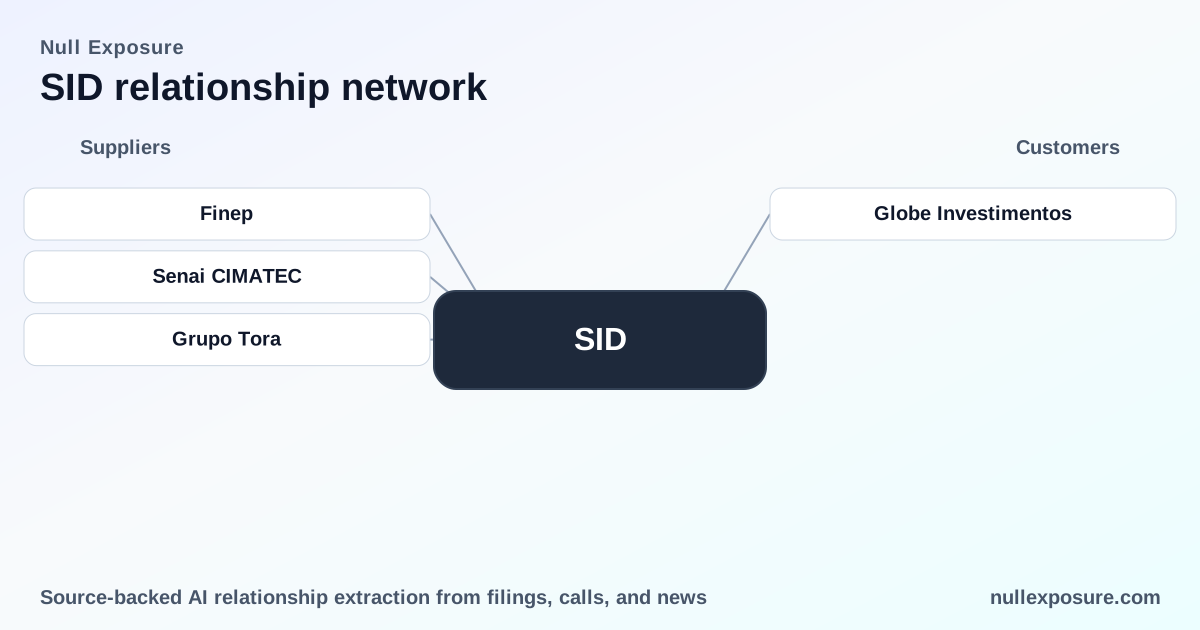
SID: How recent equity dispositions and partner moves reshape the customer lens
Companhia Siderúrgica Nacional (NYSE: SID) is an integrated Brazilian steel producer that monetizes through the sale of flat and long steel products to construction, automotive and industrial manufacturers, supplemented by asset-level portfolio management and selective M&A. The company’s operating cash flows are driven by volume and product mix across domestic and export channels, while balance-sheet moves — including equity disposals — are used to optimize capital allocation and competitive positioning. For investors and operators evaluating SID’s customer relationships, the recent sales of Usiminas shares to Globe Investimentos reveal strategic capital redeployment rather than a change in core commercial counterparty behavior.
Explore SID’s relationship signals and transaction detail at https://nullexposure.com/
Quick read: the transaction that matters to relationship watchers
SID executed a disposal of its stake in rival Usiminas during FY2025, transferring both ordinary and preferred shares to Globe Investimentos. This is a portfolio-management action that reduces cross-holdings in the Brazilian steel sector and clarifies competitive lines — an event with governance and capital implications rather than a direct shift in SID’s customer base.
Globe Investimentos — FinanceNews report (July 2025)
CSN sold 35,192,508 ordinary shares and 27,336,139 preferred shares of Usiminas to Globe Investimentos, cutting its combined direct and indirect participation to 7.92% of Usiminas’ total capital. According to FinanceNews (31 July 2025), the sale used the closing prices from the 29 July 2025 session and is recorded as executed in FY2025. Source: https://financenews.com.br/2025/07/csn-csna3-vende-351-milhoes-de-acoes-on-da-usiminas-e-273-milhoes-de-acoes-pn/
Globe Investimentos SA — Terra report (July 2025)
A parallel report from Terra confirms that SID sold a 4.99% stake in Usiminas to Globe Investimentos SA, reflecting the same FY2025 disposal and underscoring the entrance of external investors into Usiminas’ shareholder base. This transaction was publicly disclosed by CSN and covered in media outlets on 30–31 July 2025. Source: https://www.terra.com.br/economia/empresa-dos-irmaos-batista-donos-da-jbs-compra-fatia-da-csn-e-entra-no-capital-da-usiminas,f4740f9fa7a119f52338d16473e51899jvg0jfz8.html
Why these equity moves matter for customer-relationship analysis
The sale of Usiminas shares is a capital-allocation event that clarifies SID’s competitive footprint. For customers and downstream partners, the implications are:
- Commercial continuity: SID’s core customer contracts and supply relationships are unaffected by the share sale; steel supply lines to construction, automotive and industrial customers continue to be governed by commercial terms and production capacity rather than cross-shareholdings.
- Competitive clarity: Reducing cross-ownership in Usiminas tightens direct competition between major Brazilian producers, which can influence pricing dynamics and bargaining leverage in procurement and long-term supply agreements.
- Balance-sheet and governance focus: The transaction signals a preference to mobilize capital through disposals, which can free cash for operational improvements, deleveraging or targeted investments that support reliable supply to key customers.
Key takeaway: The Usiminas disposal is material to SID’s strategic positioning and capital profile, but it does not represent a change in the company’s customer contracting posture.
Operating-model constraints and what they imply for partners
There were no explicit relationship-level constraints disclosed in the dataset provided. At the company level, the following operational characteristics should guide investor and counterparty assessments:
- Contracting posture: SID operates as an integrated steelmaker supplying essential industrial inputs; contracts are typically volume-driven and tied to commodity cycles, with commercial terms reflecting product specification, delivery logistics, and price indexing.
- Concentration: Revenue is concentrated by sector exposure (construction, automotive, manufacturing) rather than by any single customer disclosed in the relationship data, so customer concentration risk is sectoral rather than idiosyncratic.
- Criticality: Steel is a strategic input for many downstream industries; SID’s reliability and production uptime are critical to customers who run just-in-time or large-scale projects.
- Maturity: The business is a mature commodity producer with established production assets and an emphasis on operational efficiency and sustainability to protect margins in volatile cycles.
These company-level signals frame how partners should assess commercial risk — prioritize supply continuity, contracted delivery terms, and counterparty credit rather than equity ownership patterns.
All relationships captured in the available records
- Globe Investimentos — FinanceNews (FY2025): CSN sold a package of Usiminas ordinary and preferred shares to Globe Investimentos, reducing its direct and indirect stake in Usiminas to 10.13% of ordinary shares, 5.08% of preferred shares, or 7.92% of total capital, per a July 2025 FinanceNews report (closing prices dated 29 July 2025). Source: https://financenews.com.br/2025/07/csn-csna3-vende-351-milhoes-de-acoes-on-da-usiminas-e-273-milhoes-de-acoes-pn/
- Globe Investimentos SA — Terra (FY2025): A Terra article records the sale as a 4.99% stake transfer from CSN to Globe Investimentos SA, highlighting the entrance of new investors into Usiminas’ capital structure during FY2025. Source: https://www.terra.com.br/economia/empresa-dos-irmaos-batista-donos-da-jbs-compra-fatia-da-csn-e-entra-no-capital-da-usiminas,f4740f9fa7a119f52338d16473e51899jvg0jfz8.html
Risk and opportunity implications for investors and operators
- Risk: competitive pricing pressure. By reducing cross-ownership with Usiminas, SID removes a corporate check that can soften competitive tensions; expect more direct price competition, particularly in commodity-grade segments.
- Opportunity: clearer capital allocation. The proceeds from equity sales create optionality for SID — investors should watch for redeployment into capacity, maintenance, or debt reduction that improves service reliability and margin durability for customers.
- Operational watch-points. For procurement teams and large buyers, prioritize contract terms around delivery windows, quality specs and penalty/bonus structures that protect project timelines in a potentially more competitive supply environment.
Bottom line and next steps
SID remains an integrated, cash-generating steel producer whose recent FY2025 equity disposals to Globe Investimentos refine its capital structure and competitive posture without disrupting customer contracts. For investors, the sale is a governance and capital-allocation signal; for customers and operators, the priority is continuity of supply and contract robustness.
For a structured view of SID’s relationship activity and comparable corporate disclosures, visit https://nullexposure.com/ to explore our coverage and source aggregation.