SIGA Technologies: Customer Relationships Drive a Specialized, Government-Backed Revenue Story
SIGA Technologies develops and sells TPOXX (tecovirimat), an approved antiviral for smallpox, and monetizes primarily through long-term government procurement contracts and selective international licensing. The company's economics are rooted in government stockpile purchases (not recurring retail demand), with international promotion agreements and targeted research collaborations supplementing revenue and strategic reach. For investors assessing counterparty concentration and contract risk, SIGA combines high margin product deliveries with outsized dependency on a small set of public-sector customers; more on that below. If you want a concise tracker of SIGA’s customer links and their investment implications, see our homepage: https://nullexposure.com/.
How SIGA actually makes money — a compact operating thesis
SIGA sells finished courses of TPOXX into government stockpiles and international markets. Revenue recognition is primarily point-in-time product delivery for procurement contracts, and the U.S. government — via BARDA and the Strategic National Stockpile — is the largest purchaser and strategic partner. International sales are meaningful but substantially smaller than U.S. stockpile deliveries: in 2024 SIGA reported $23.0 million in international deliveries across 13 countries versus more than $115 million in U.S. sales. This commercial profile produces high gross margins on product sales but concentrated counterparty exposure, which drives strong short-term cash flow when contracts are exercised and significant policy risk if stockpile commitments shift.
What the contract and business structure implies for investors
SIGA’s customer relationships are shaped by several structural constraints that define both upside and risk:
- Long-term contracting posture for its largest program. The 19C BARDA Contract contains options exercisable up to ten years from award, creating potential multi-year revenue visibility when options are used. This long-term construct supports planning and capital allocation but also concentrates risk in execution of a single program.
- Government counterparty profile increases policy and procurement sensitivity. A majority of SIGA’s meaningful sales flow to U.S. and other government purchasers; procurement cycles, appropriations, and stockpile priorities directly determine near-term revenue.
- Geographic diversification exists but is limited. SIGA reports sales across NA, EMEA and APAC; international deliveries are real but materiality remains concentrated in North America.
- Materiality of BARDA relationship. The company expressly notes that the bulk of potential revenue under the 19C BARDA Contract is option-driven and that the business is substantially dependent on U.S. stockpile commitments. That makes BARDA performance and contracting decisions the central investment variable.
- Active, high-value procurement profile. Public filings and investor commentary indicate substantial cumulative deliveries already made under the BARDA agreement and the contract contemplates payments in the high hundreds of millions.
These structural characteristics explain SIGA’s financial profile: relatively strong gross margins, cyclical recognition tied to deliveries, and the valuation implications of a single, dominant contracting relationship.
If you want to review SIGA’s commercial relationships alongside other specialty pharma supplier profiles, visit https://nullexposure.com/ for comparative research.
Customer relationships — each item in the public record, with what investors need to know
BARDA — GlobeNewswire press release, January 10, 2022 (referencing the 2018 contract)
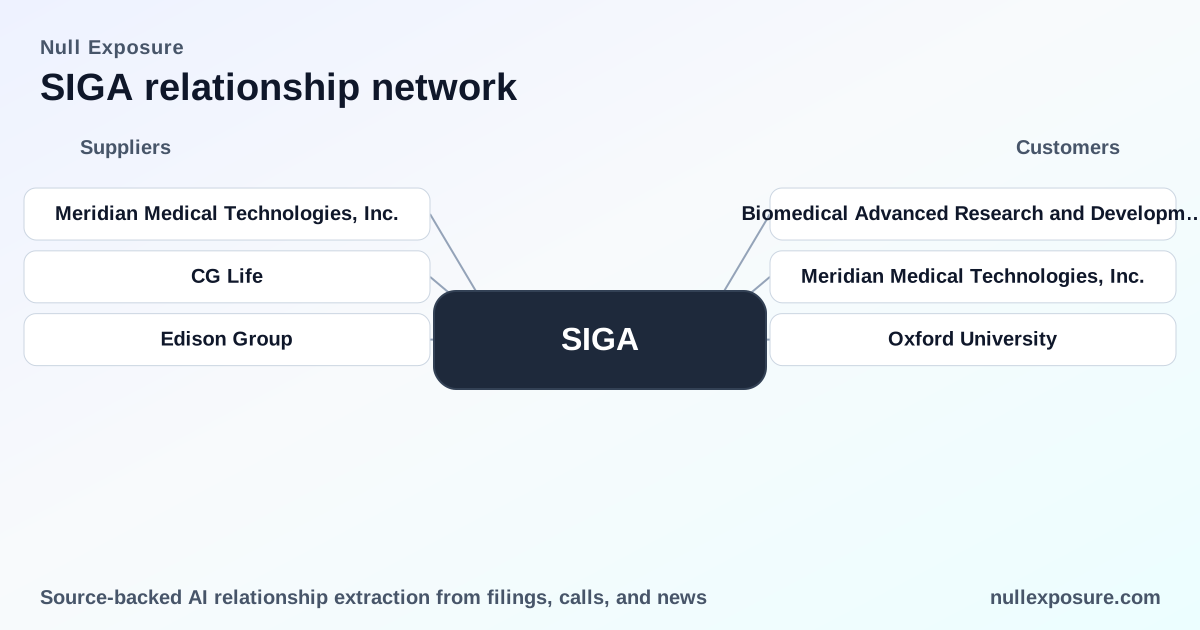
SIGA disclosed that in September 2018 it signed a contract with the Biomedical Advanced Research and Development Authority for additional procurement and development of both oral and intravenous formulations of TPOXX, formalizing BARDA as a key government procurement partner. According to the release, that contract underpins ongoing deliveries and product development activities in FY2022.
BARDA — GlobeNewswire press release, January 10, 2022 (duplicate entry)
The same GlobeNewswire communication reiterates the 2018 BARDA agreement and the company’s ongoing performance obligations tied to oral and IV tecovirimat development and procurement, reinforcing the company’s long-term relationship with BARDA.
Meridian Medical Technologies, Inc. — GlobeNewswire press release, January 10, 2022 (June 2019 agreement)
SIGA entered into an international promotion agreement with Meridian in June 2019 under which Meridian will promote oral TPOXX outside the United States while SIGA retains all product rights and intellectual property, creating an outsourced commercial channel for international markets. The GlobeNewswire release frames this as a way to scale international reach without divesting core IP.
U.S. Strategic National Stockpile — Investing.com earnings transcript, Q4 2025 / FY2026 commentary
Management stated product revenues of $88 million were primarily driven by deliveries to the Strategic National Stockpile under the 19C BARDA contract, confirming that SNS deliveries are the proximate revenue driver for FY2026 product sales.
BARDA — Investing.com earnings transcript, Q4 2025 / FY2026 commentary
Management disclosed that FY2026 deliveries under the current BARDA 19C contract included approximately $53 million of oral TPOXX and $26 million of IV TPOXX delivered to the SNS, plus $6 million from international oral sales, signaling how BARDA contract exercise translates directly to reported revenue.
U.S. government — Investing.com earnings transcript, Q4 2025 / FY2026 commentary
Management acknowledged that the U.S. government, as SIGA’s largest customer and development partner, receives the company’s lowest pricing for TPOXX, highlighting negotiated pricing dynamics and the strategic trade-off between program volume and per-unit revenue.
U.S. Government — GlobeNewswire press release, March 26, 2026 (special cash dividend filing)
In the company’s March 26, 2026 filing announcing a special dividend, SIGA disclosed risk language noting the possibility that it may not be able to enter into new contracts to supply TPOXX to the U.S. Government, underlining ongoing procurement dependency and the company’s explicit recognition of contract renewal risk.
U.S. Biomedical Advanced Research and Development Authority (BARDA) — GlobeNewswire press release, March 26, 2026 (special cash dividend filing)
The same March 26, 2026 release identifies the risk that SIGA may not complete performance under the 19C BARDA Contract on schedule or in accordance with contractual terms, making execution risk on the BARDA program an explicit corporate disclosure item.
BARDA — GlobeNewswire press release, July 29, 2021 (Oxford collaboration announcement referencing 2018 contract)
A July 29, 2021 GlobeNewswire announcement repeats that SIGA signed a contract with BARDA in September 2018 for procurement and development of oral and IV tecovirimat, reaffirming historical contract origins and BARDA’s centrality across multiple company communications.
Oxford University — GlobeNewswire press release, July 29, 2021 (collaboration)
SIGA committed up to 500 courses of TPOXX at no cost to an Oxford University-sponsored protocol in the Central African Republic, positioning SIGA’s product as part of targeted clinical and expanded access work while demonstrating non-commercial, research-oriented distribution.
U.S. Biomedical Advanced Research and Development Authority (BARDA) — GlobeNewswire press release, March 26, 2026 (duplicate)
A final entry duplicates the March 26, 2026 BARDA-related disclosure about contractual performance risk and the 19C Contract, underscoring the consistent emphasis in corporate filings on BARDA as both the principal revenue engine and the principal contract execution risk.
Investment implications — succinct takeaways
- Concentration risk is the central valuation lever: BARDA and U.S. stockpile purchases drive the majority of revenue capacity and cash flow, and SIGA’s near-term outlook depends on option exercise and contract performance.
- Execution and policy risk are explicit and material: Company filings and press releases highlight the potential for non-renewal or performance issues under the 19C BARDA Contract.
- International channels offer diversification but limited scale today: Meridian and targeted research collaborations expand reach without relinquishing IP, but international revenue remains a smaller share of total sales.
For investors who need a concise reference comparing SIGA’s procurement-based model to peers, our research hub is available at https://nullexposure.com/.
Bold decisions in portfolio construction require understanding both concentrated upside and concentrated policy risk; SIGA is a clear example of a high-margin, contract-dependent specialty pharma story where government procurement dictates the outcome.