Selective Insurance Group (SIGI): Customer Relationships and What They Mean for Investors
Selective Insurance Group sells property and casualty insurance through a network of independent agents and wholesale brokers and monetizes primarily via one‑year policy premiums, underwriting margins, and investment income on reserves. Revenue is generated from standardized short‑term policies sold across commercial, personal, and excess & surplus lines, with risk transfer augmented by multi‑year reinsurance programs. Learn more at https://nullexposure.com/.
How Selective actually operates and where the cash comes from
Selective is an insurance holding company that underwrites short‑term, renew‑annually insurance contracts across multiple operating subsidiaries. The firm writes Standard Commercial Lines to businesses, non‑profits and local government agencies (primarily in 36 states plus DC), Standard Personal Lines to individuals (in 15 states), and E&S products where underwriting flexibility is required. Monetization flows from per‑policy premiums (average 2025 premiums: ~$20.6k commercial, ~$4.1k personal, ~$6.0k E&S), underwriting profit or loss, and investment returns on float. These figures are drawn from Selective’s public filings for FY2025.
Contracts, concentration and what that implies for customer risk
Selective’s contracting posture is short‑term and renewal driven — nearly all sales are one‑year policies and the largest cost line is loss and loss expense for covered events, per company disclosures for FY2025. That structure creates predictable renewal cadence and a continual underwriting discipline: pricing and risk selection reset annually rather than locking in multiyear exposures.
Concentration is explicitly low: no single customer accounts for 10% or more of the company’s aggregate DPW, which signals diversified counterparty exposure across many small–to–medium buyers rather than dependence on a handful of large accounts. Counterparties are a mix of government agencies, businesses, non‑profits, and individuals — a product and client mix that limits single‑counterparty systemic risk while exposing the company to broad macro and catastrophe cycles across the U.S.
Geography is U.S.-only: Selective sells exclusively in the United States through independent agents and wholesale brokers, with commercial reach in 36 states and DC and personal coverage concentrated in 15 states. Reinsurance complements this footprint: the company reported a reinsurance agreement that provides up to $325 million of coverage for property catastrophe losses for the period December 9, 2023 through December 31, 2026, excluding California, Florida, Texas and Louisiana, according to the company’s FY2025 filings.
Every customer relationship in the public results (what investors need to know)
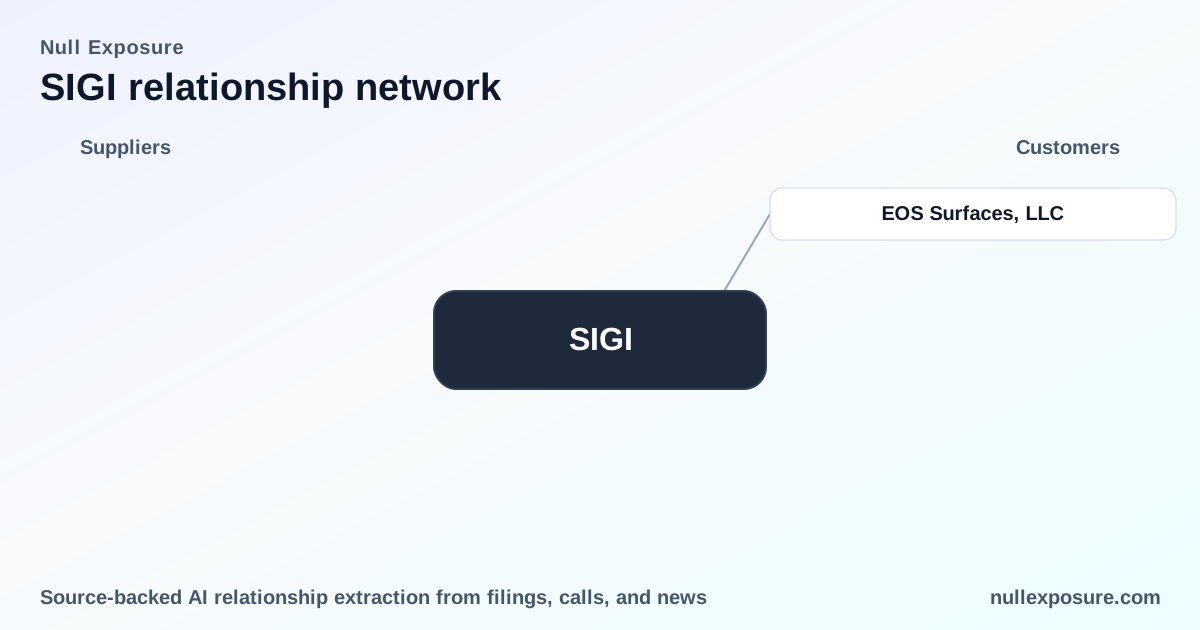
- EOS Surfaces, LLC — Selective Insurance Company of South Carolina has asked a court to declare it has no duty to defend or indemnify EOS Surfaces in a silica‑related claim, signaling an active coverage dispute between insurer and insured. This item was reported by Insurance Business Magazine on March 10, 2026 (Insurance Business, March 2026, https://www.insurancebusinessmag.com/us/news/risk-compliance-legal/selective-insurance-challenges-duty-to-cover-eos-surfaces-silica-claims-551126.aspx).
This legal action is a typical example of Selective enforcing policy terms and exclusions in the face of complex product liability or casualty claims. Investors should view such disputes as part of underwriting governance — they are important for near‑term litigation expense and reserve volatility, but not necessarily material to top‑line concentration given Selective’s disclosure that no single customer drives 10%+ of DPW.
Operating constraints that shape earnings and capital deployment
Selective’s public disclosures illustrate a handful of company‑level constraints that are central to valuation and risk assessment:
- Short‑term contract exposure: Nearly all policy sales are one‑year, producing recurring premium flows but leaving earnings sensitive to year‑over‑year underwriting cycles and rate adequacy (company filings, FY2025).
- Lower per‑policy revenue band: Average premiums indicate that most relationships are below the institutional large‑account spend bands — average Standard Commercial Lines premium per policyholder was roughly $20,600 in 2025, with personal lines ~ $4,100 and E&S ~ $6,000 — consistent with a high‑volume, modest‑ticket segment (company filings, FY2025).
- Diversified counterparty base: Sales to businesses, non‑profits, government agencies and individuals across many states reduce customer concentration and counterparty credit risk (company filings, FY2025).
- Mature underwriting platform: Incorporated in 1977 with ten domestic insurance subsidiaries, Selective has an established underwriting infrastructure and distribution network through independent agents and wholesale brokers (company disclosures).
- Reinsurance reliance for catastrophe management: The multi‑year reinsurance facility (up to $325M through Dec 31, 2026, with specified state exclusions) is a structural hedge against large property catastrophe losses and influences capital deployment and surplus calculations (company filings, FY2025).
- Immaterial single‑customer dependency: The firm states that no single insured accounts for 10%+ of DPW, signaling resilience but also implying underwriting exposure is widely dispersed (company filings, FY2025).
Interested in a structured view of Selective’s customer exposures? Visit https://nullexposure.com/ for a curated investor primer.
What those constraints mean for investors — risks and upside
Selective’s model is underwriting and distribution centric. The combination of short‑term renewals, diversified counterparties, modest per‑policy premiums and reinsurance protection yields a distinct risk profile:
- Upside drivers: Rate adequacy and improved loss ratios convert directly to earnings; low customer concentration preserves revenue stability; investment income on float enhances ROE during favorable market cycles. The company’s valuation metrics (Trailing P/E ~11, Forward P/E ~9.95) reflect a market that prices in the potential for cyclical underwriting improvement.
- Primary risks: Underwriting deterioration across commercial or E&S lines, unexpected catastrophe losses outside reinsurance scope (e.g., in excluded states), and adverse legal outcomes in coverage disputes (such as the EOS Surfaces matter) can pressure reserves and earnings volatility. Governance of claim adjudication and the cost of litigation remain active operational levers.
- Monitoring checklist for investors: watch renewal rate cadence, loss & LAE trends by segment, reinsurance renewals and attachment terms post‑2026, frequency and severity trends in E&S lines, and the progression/settlement of material coverage disputes.
Bottom line
Selective operates a low‑concentration, short‑term insurance business that monetizes via annual premiums and investment returns, backed by reinsurance for peak catastrophe exposures. Key investor themes are underwriting cycle management, reinsurance effectiveness through 2026, and legal reserve discipline. The EOS Surfaces dispute is a tactical coverage fight that underscores the importance of claims governance but does not change the fundamental company‑level signals of diversification and short‑term contracting posture. Monitor loss trends, reinsurance renewals, and legal outcomes as primary drivers of near‑term earnings and capital trajectory.