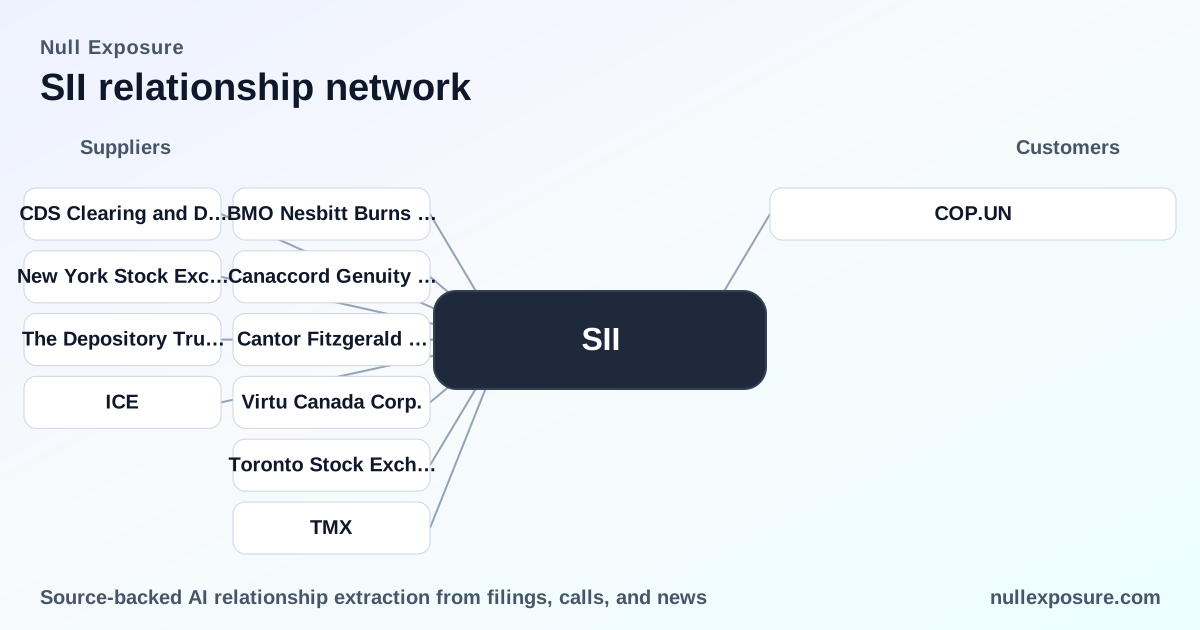
Sprott Inc. (SII): How customer relationships underpin fee-bearing commodity trust growth
Sprott Inc. operates as an asset manager that builds, sponsors and manages physically backed commodity trusts, monetizing primarily through management and advisory fees, trust sponsorship economics and periodic capital-raising activities tied to listed vehicles. The firm’s operating model centralizes investment management through Sprott Asset Management, leverages public listings for distribution and uses underwriting partners for episodic capital raises—creating a repeatable fee-generating engine that scales with investor demand for physical-asset exposure. For a deeper look at Sprott’s relationship intelligence and how it informs credit and revenue durability, visit https://nullexposure.com/.
What investors should read first
Sprott’s economic model is fee-centric and distribution-dependent: recurring management fees on assets under management drive steady margins, while growth is episodic and tied to new trust launches and secondary offerings. This makes counterparties who enable listing, underwriting and market access strategically important partners—relationships that influence both growth velocity and short-term liquidity for the trusts Sprott sponsors.
Detailed relationship map — every relationship in the dataset
COP.UN (ticker-level reference)
COP.UN is referenced as the ticker for the Sprott Physical Copper Trust and reflects the trust’s intended public market presence; Sprott Asset Management is named as the investment manager to this Trust, indicating Sprott’s role as both sponsor and manager. This detail comes from a GlobeNewswire release republished by The Manila Times on January 30, 2026 (https://www.manilatimes.net/2026/01/30/tmt-newswire/globenewswire/sprott-physical-copper-trust-announces-filing-to-list-on-nyse-arca/2268344).
Sprott Physical Copper Trust
The press release documents a filing and listing process for the Sprott Physical Copper Trust and confirms Sprott Asset Management is a wholly-owned subsidiary and the investment manager to the Trust, reinforcing the integrated sponsor-manager posture that captures management fees and governance control. Source: GlobeNewswire via The Manila Times, January 30, 2026 (https://www.manilatimes.net/2026/01/30/tmt-newswire/globenewswire/sprott-physical-copper-trust-announces-filing-to-list-on-nyse-arca/2268344).
Canaccord Genuity Corp. (underwriting relationship)
For the Sprott Physical Uranium Trust, Sprott amended an underwriting agreement with Canaccord Genuity Corp. under which Canaccord agreed to purchase 11,600,000 units at US$17.25 per unit for aggregate gross proceeds of US$200.1 million—an execution that demonstrates Sprott’s reliance on institutional underwriters to scale trust capital during windows of investor demand. Reporting on the upsized bought‑deal financing was published by Quantisnow on May 3, 2026 (https://quantisnow.com/insight/sprott-physical-uranium-trust-announces-upsized-us200-million-bought-deal-financing-6087464).
Operating-model constraints and company-level signals
Sprott’s publicly available indicators reveal a mature, concentrated asset-manager profile where a few structural features shape counterparty risk and commercial dynamics:
- Contracting posture: Centralized investment management is executed through Sprott Asset Management, which acts as the contracting counterparty for trust governance and fee agreements—this concentrates negotiation leverage and legal responsibility within a single subsidiary.
- Concentration: Revenue growth depends heavily on demand for commodity-backed trust products; asset- and product-level concentration raises sensitivity to commodity cycles and investor sentiment in precious metals and strategic commodities.
- Criticality: Distribution and capital-formation partners (exchanges and underwriters) are mission-critical—successful listings and bought-deal financings directly enable AUM growth and upfront fee capture.
- Maturity: Sprott is a publicly listed, established manager with margins and return metrics that suggest operational leverage: FY figures include revenue of roughly US$285m and an operating margin at scale, while institutional ownership sits at about 73%, indicating investor confidence and potential stability in capital access.
These signals together indicate a company that is structurally efficient at monetizing commodity interest but reliant on a narrow set of counterparties and episodic capital-raising activity for outsized growth.
What the relationships imply for revenue durability and risk
- Revenue durability is anchored by management fees, with the trust sponsor role providing a predictable fees-to-AUM stream; the COP.UN and Sprott Physical Copper Trust items underline Sprott’s integrated sponsor/manager model and fee capture. The FY2025 metrics show healthy profit margins and return on equity that reflect this fee leverage.
- Growth volatility is counterparty-driven: the Canaccord underwriting arrangement illustrates that large uplifts in AUM come from one-off financings that require willing underwriters and investor demand. When underwriting windows are active, Sprott can scale quickly; when markets close, growth slows.
- Concentration risk is real: product concentration in physical commodity trusts and reliance on exchange listings and underwriters make Sprott more sensitive to commodity price cycles, regulatory listing requirements and capital markets liquidity than a diversified asset manager.
- Institutional ownership and insider stakes provide governance alignment, with about 73% institutional ownership and 17% insider ownership, enhancing governance discipline but also tying stock performance to institutional sentiment.
Investment takeaways
- Buy-side thesis: Sprott is a high-quality, fee-biased manager in the niche of physical-asset trusts; its ability to originate and list new commodity trusts—coupled with effective underwriting partnerships—drives episodic growth and supports premium valuation multiples.
- Key risk to monitor: underwriting and exchange access, as demonstrated by the Canaccord finance and NYSE Arca listing activity, are operationally significant and materially influence near-term AUM growth.
- Operational strength: centralized management through Sprott Asset Management underwrites consistent fee capture and streamlined product governance—factors that support margin durability.
For a concise, comparable view of Sprott’s counterparty relationships and what they mean for revenue sensitivity and execution risk, see the research hub at https://nullexposure.com/.
Investors and operators evaluating Sprott should prioritize monitoring underwriter appetite, listing milestones for new trusts, and commodity-investor flows—these dynamics determine the cadence of AUM growth and the sustainability of fee revenue.