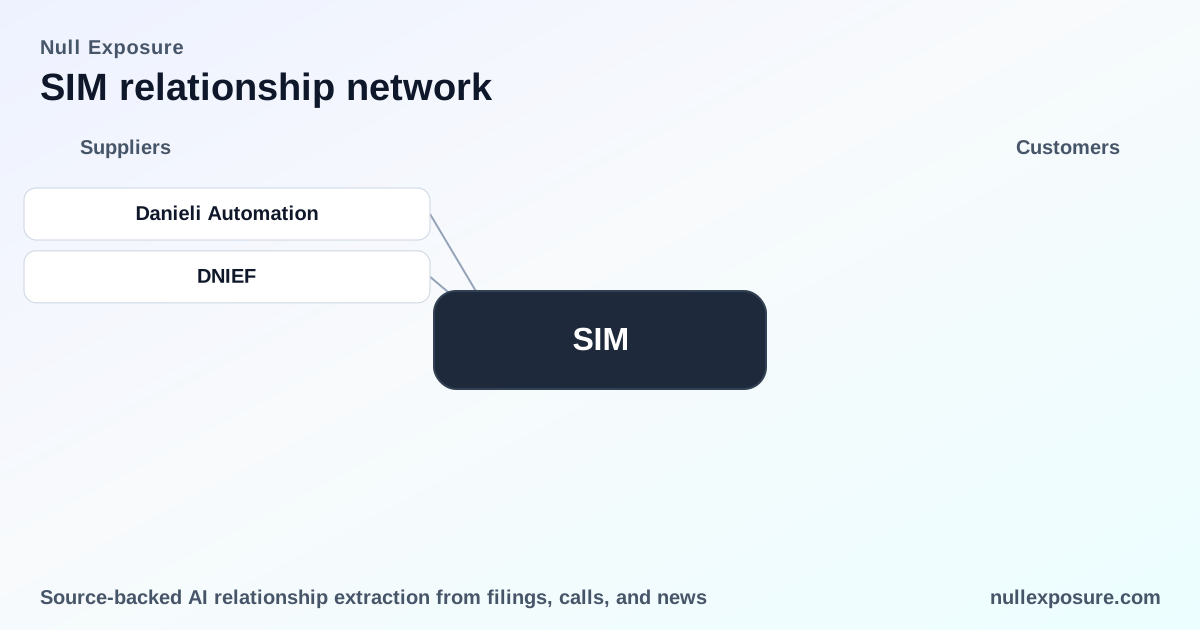
Grupo Simec (SIM): Customer Relationship Signals and What They Mean for Investors
Grupo Simec operates as a producer, processor and distributor of special-bar-quality (SBQ) steel across North and South America and internationally, monetizing through the sale of finished and semi-finished steel products to industrial customers, automotive suppliers and fabrication shops. Revenue derives from volume-driven steel sales and value-added processing, with margins tied to raw-material costs and capacity utilization. For a quick view of relationship intelligence and context, see https://nullexposure.com/.
How Grupo Simec makes money and how that shapes customer risk
Grupo Simec is a capital-intensive, commodity-exposed manufacturer whose commercial model is fundamentally B2B: large, transactional sales to industrial buyers, with pockets of recurring volume where long-term supplier agreements exist. The company’s operating profile is consistent with the steel sector: cyclical demand, material input-price sensitivity, and moderate margin variability. Market metrics from FY2025–FY2026 show a Market Capitalization around USD 4.3 billion and Revenue TTM of roughly USD 30.3 billion, supporting the classification of Simec as a sizable regional producer with low equity beta (0.12) and historically compressed valuation multiples (trailing P/E 7.7, EV/EBITDA ≈ 4.05), which reflects both cyclical exposure and steady near-term cash generation.
These characteristics imply several business-model signals investors must watch:
- Contracting posture: Predominantly transactional with selective multi-year supply arrangements; pricing power is constrained by spot steel market dynamics.
- Customer concentration: Industrial and OEM customers can create pockets of concentration risk when a few large buyers account for a meaningful share of volumes.
- Criticality: Simec’s products are critical inputs for downstream manufacturers, which supports stickiness once qualification and quality standards are met.
- Maturity and capital intensity: The business is mature and capital-intensive; incremental growth tends to require plant upgrades or capacity reconfiguration rather than low-cost market share gains.
What the relationship records in this review actually show
The collected relationship items linked to the SIM ticker return three named counterparties in the source feed. Read literally, these items do not document Grupo Simec customer wins; they reference other firms and product names that share the string “Sim” (notably a fintech product and SimCorp, an investment-technology vendor). Below I summarize each record and its source so investors can judge relevance.
-
Santander Brazil (BSBR) — A Santander press release describes a fintech product called “Sim” used for personal loans and other consumer services; this is a Santander Brazil ecosystem item rather than a commercial relationship with Grupo Simec (see Santander press release, July 2021: https://www.santander.com/en/press-room/press-releases/2021/07/sergio-rial-to-take-over-as-chairman-of-santander-brazils-board-of-directors-as-of-january-2022).
Source: Santander press release, FY2021. -
AllianceBernstein (AB) — Multiple news items report that AllianceBernstein selected the SimCorp One investment-technology platform as its core investment technology partner, including coverage in PlanSponsor and several filings/news outlets in early 2026 (for example, PlanSponsor reported the selection in FY2026: https://www.plansponsor.com/product-service-launches-021926/). These announcements refer to SimCorp’s software and are not evidence of a customer relationship between Simec and AllianceBernstein.
Sources: PlanSponsor and related news reports, FY2026 (examples: https://www.plansponsor.com/product-service-launches-021926/; supporting media references in March–May 2026). -
State Street (STT-P-G) — A press release from Globenewswire documents a 2020 intended business partnership between State Street and SimCorp to expand use of SimCorp Dimension in EMEA for insurers and outsourcing solutions (https://www.globenewswire.com/news-release/2020/10/12/2106616/0/en/State-Street-and-SimCorp-Announce-Intended-Business-Partnership-with-Front-to-Back-Investment-Outsourcing-Solution-for-EMEA-Insurers.html). This is an investment-technology partnership and not a Grupo Simec customer entry.
Source: Globenewswire announcement, FY2020.
Investor takeaway: the relationship feed for SIM in this review predominantly captures mentions of other firms/products that include the string “Sim” or the vendor SimCorp; these are name collisions rather than verified customers of Grupo Simec.
Why these name collisions matter for due diligence
Automated relationship signals can surface irrelevant matches when tickers or substrings overlap with unrelated corporate names and products. For a manufacturing investor evaluating SIM, this matters because it can create false positives that distract from the true commercial picture. Focus should remain on industrial buyers, OEMs and regional construction/energy customers when assessing Simec’s revenue quality.
Practical implications:
- Filter for domain relevance: prioritize primary-source confirmations such as supply agreements, customer disclosures, or trade-reference evidence from industrial buyers.
- Validate concentration risk directly: request or look for buyer-level revenue disclosure; given Simec’s scale and capital base, a few large industrial contracts can meaningfully move utilization and profit.
- Ignore unrelated tech/fintech matches unless a primary source explicitly ties the counterparty to physical-product purchases from Simec.
Risks and balance of strengths
Grupo Simec’s financials show meaningful revenue scale and low market volatility, but the company remains exposed to standard steel-sector hazards:
- cyclical end-market demand,
- input-cost swings (scrap, iron ore, energy),
- capex intensity that limits rapid margin expansion.
At the same time, Simec’s low beta and conservative valuation multiples can appeal to investors seeking industrial exposure with relatively muted equity volatility. The company’s low institutional ownership (≈16.4%) is a signal of potential analyst coverage gaps and lower free-float liquidity, which can amplify moves on headline news.
Bottom line and recommended next steps for investors
- Hard signal: The relationship feed in this review does not evidence new or material customers for Grupo Simec; the items relate to fintech (“Sim”) and the investment-software vendor SimCorp. Treat those as false positives.
- Actionable due diligence: request confirmed customer lists or revenue-by-customer disclosures, and evaluate contract terms where available; focus on industrial buyers and geographic mix. For relationship monitoring, use a provider that cross-checks entity identifiers beyond name substrings.
For a deeper, consolidated view of commercial signals and entity-level relationship monitoring, visit https://nullexposure.com/ — the platform aggregates, filters and presents contextual relationship intelligence for investors evaluating counterparties.
Key takeaway: Grupo Simec’s core commercial dynamics remain industrial and volume-driven; the pulled relationship items in this review are name-collision artifacts and should not influence assessments of Simec’s customer base or credit profile.