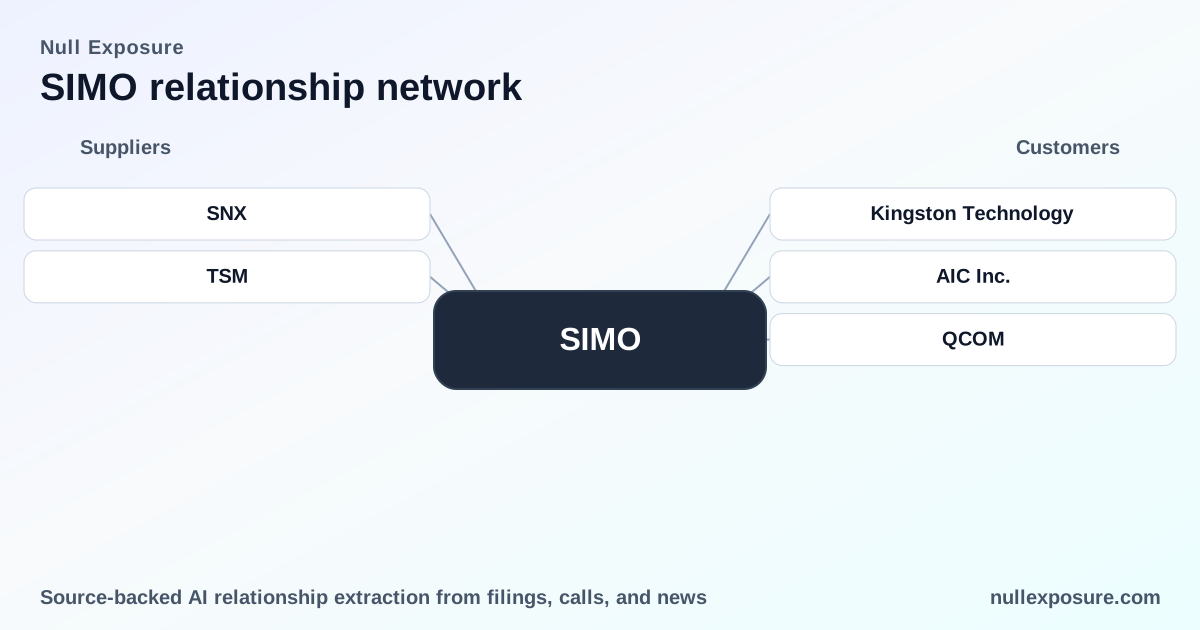
Silicon Motion (SIMO): Customer map and what it means for revenue durability
Silicon Motion designs and sells NAND flash controllers and related firmware that OEMs and storage module suppliers integrate into SSDs and embedded storage—its monetization is direct hardware and software sales plus validation/licensing with system vendors. Revenue comes from controller chip shipments and design wins with SSD makers and systems partners, and recent product launches (PCIe Gen5 controllers and UFS solutions) position Silicon Motion to capture upgrade cycles in enterprise, AI, and automotive storage. For a deeper signal feed on customer relationships, see https://nullexposure.com/.
Executive takeaway: growth driven by design wins, concentration risk is operational
Silicon Motion’s commercial model is winner-take-most in design cycles: a single controller selection by an OEM converts to multi-year shipments. That dynamic creates high leverage on individual design wins and therefore both strong revenue upside and concentration risk. The company’s FY2026 positioning (new SM8008 / SM8388 controllers and UFS validations) indicates strategic focus on enterprise/AI and automotive segments, while its financials show a mid-cap semiconductor profile—market cap ~ $7.7B and FY‑TTM revenue ~$886M—that supports continued R&D-led product cycles.
Visit https://nullexposure.com/ for the original crawl and relationship snapshots.
How customers translate to revenue: practical operating characteristics
- Contracting posture: Silicon Motion typically sells through OEM agreements and module partners rather than spot commodity sales; design wins create multi-year supply commitments and recurring revenue from controller shipments and software.
- Concentration: A small number of module and OEM customers drive a large share of shipments when a controller is adopted; that produces episodic revenue swings tied to product cycles.
- Criticality: Controllers are a critical component for SSD function; when chosen, they are hard to replace mid-cycle, which strengthens pricing and margin capture for Silicon Motion.
- Maturity and competitive position: The company is in an R&D-driven product maturity cycle—new PCIe Gen5 and UFS offerings are migration steps rather than radical platform shifts—so wins with enterprise and AI OEMs are growth accelerants rather than immediate profit transformers.
Customer relationships: line-by-line readout
Below I list every named customer relationship surfaced in the collected results, with a plain-English summary and source reference.
Kingston Technology
Kingston has designed Silicon Motion’s SM2320 controller into its new XS2000 external portable SSD, indicating a consumer-to-prosumer adoption for that controller family and placement in a high-volume retail channel. Source: Korea Herald coverage of the SM2320 inclusion (reported Mar 10, 2026).
Exascend
Exascend and Silicon Motion collaborated to jointly develop a high-performance PCIe Gen5 SSD tailored for AI servers, positioning Exascend as an early partner integrating the SM8008 for data-center AI workloads. Source: company and trade coverage around the SM8008 launch (PR Newswire and StorageNewsletter, May 2026).
AIC Inc.
AIC announced integration of SSDs powered by Silicon Motion’s MonTitan development platform into its AI server systems, signaling a systems-level relationship where SSD modules are bundled into server OEM solutions for training and inference workloads. Source: PR Newswire statement accompanying the SM8388 product announcement (Mar 2026).
ATP Electronics
ATP publicly stated it has adopted Silicon Motion’s SM8008 for its latest enterprise SSD platform, marking ATP as an enterprise storage OEM adopting the Gen5 controller for low-power and boot-drive applications. Source: TechPowerUp and related press coverage of the SM8008 launch (May 2026).
Qualcomm (QCOM)
Silicon Motion’s UFS solution completed compatibility validation with Qualcomm’s Snapdragon Cockpit SA8295P platform, which is a formal systems validation that enables module and infotainment suppliers to adopt Silicon Motion UFS controllers in automotive cockpit designs. Source: PR Newswire announcement of UFS compatibility testing (reported Mar 2026).
NVIDIA
Analyst and industry commentary referenced NVIDIA when comparing AI infrastructure demand to other verticals tied to Silicon Motion partners, implying NVIDIA’s AI ecosystem creates demand vectors for high-performance SSDs that use Silicon Motion controllers. This is a market-context mention rather than a direct customer announcement. Source: commentary on demand balance between auto and AI infrastructure (Simply Wall St, May 2026).
What the relationship list implies for revenue and risk
- Design-win orientation: Multiple partners—ATP, Exascend, AIC, Kingston—are early adopters of the SM8008/SM8388 and other controllers, which implies a pipeline of OEM shipments once server and module platforms ramp. Design wins are translating into short-term revenue lags that can become multi-quarter shipment streams.
- Channel breadth, limited public breadth: The named customers span consumer retail (Kingston), specialty enterprise OEMs (ATP, Exascend, AIC) and platform validation (Qualcomm). That breadth reduces single-channel dependency but does not eliminate the concentration risk inherent to controller wins because top module buyers can account for outsized volumes.
- Market signal for AI and automotive: Publicized validations with Qualcomm (automotive) and joint development with Exascend/AIC (AI servers) show targeted go-to-market moves toward high-growth verticals where controller performance and power efficiency command premiums.
Company-level signals and constraints on operating model
There are no explicit constraint documents in the relationship feed; therefore these are company-level signals inferred from the relationship set and financial profile:
- Revenue concentration risk is persistent: a handful of OEM relationships can drive material swings in quarterly shipments and reported revenue.
- Go-to-market is integration-intensive: silicon controllers require firmware, validation, and platform-level testing—Silicon Motion’s business is structured around engineering-led commercial cycles rather than purely transactional semiconductor sales.
- Maturity of product cycle: the company is moving from Gen4 to Gen5 and expanding UFS automotive compatibility—this is an evolutionary product roadmap that supports steady margin expansion if adoption accelerates.
- Institutional ownership is high (~82%), which indicates market attention and less retail-driven volatility but also potential for rapid re-rating on material wins or misses.
Investment implications and risk checklist
- Upside: Successful ramps of SM8008/SM8388 in AI server SSDs and validated UFS in automotive cockpits would convert design announcements into high-margin, repeatable sales. Product leadership in power-efficient Gen5 controllers is the primary growth lever.
- Risks: Revenue swings tied to OEM adoption timing and NAND supply cycles; any loss of a key design win or slower NAND availability would compress near-term revenue. Concentration and execution on ramp timelines are the principal downside vectors.
- Catalysts to watch: Quarterly reports confirming shipments against design wins, public volume commitments from major OEMs, and additional compatibility validations with Tier‑1 platforms.
Conclusion: what investors and operators should watch next
Silicon Motion’s recent public partner announcements map cleanly to two strategic plays: enterprise/AI storage performance and automotive UFS migration. For investors, the binary event set to monitor is the conversion of announced design wins into measurable shipment revenue across FY2026 and FY2027. For operators and partners, the company’s R&D cadence and validation throughput are the operational constraints that determine ramp speed.
For the relationship data and live tracking referenced here, visit https://nullexposure.com/ to interrogate the source records and monitor future updates.