SINTX Technologies: an investor’s view of customer relationships and revenue durability
SINTX Technologies manufactures and sells silicon nitride ceramic products and also contracts as a manufacturer for third-party medical-device vendors, monetizing through product sales and government grants. The company’s revenue base combines long-term manufacturing commitments (notably an exclusive arrangement with CTL Amedica) and transactional product shipments, producing a revenue profile that is concentrated, partially mission-critical to named partners, and supplemented by grant-driven receipts. For a concise commercial intelligence brief on SINTX customer exposure, visit https://nullexposure.com/.
Why this matters: SINTX’s customer mix directly shapes cashflow predictability, working-capital needs, and the risk profile associated with new technology adoption in spine and orthopedic markets. Below I map the firm’s operating model signals, then walk through every cited customer relationship from the public record.
How the business model translates into operational constraints
SINTX’s commercial posture blends an anchor manufacturing relationship with CTL/ Amedica and spot product sales to other customers and distributors. The company also derives revenue from governmental grants and contracts, which creates a mixed cashflow cadence.
- Contracting posture: SINTX holds a long-term exclusive manufacturing right with CTL Amedica that provides a predictable revenue runway for core spinal implants, while other sales are recognized at shipment and follow a point-in-time revenue model. According to the company’s disclosures, the firm recognizes product revenue when title and risk transfer at shipment, supporting transactional cash inflows in addition to contracted income.
- Concentration and criticality: SINTX reports that three commercial customers plus government agencies accounted for 54% of total revenues and 32% of accounts receivable for the year ended December 31, 2024, indicating material reliance on a small set of counterparties and on grant funding.
- Geography and market maturity: Silicon nitride implants from SINTX have been used clinically since 2008 across the U.S., Europe, South America and Asia, showing that the technology has commercial history in multiple regions even as product adoption remains selective.
- Role and segment focus: The company operates both as a manufacturer for named OEMs and as a seller of its own product lines, with product sales comprising the core revenue segment.
- Time horizon and runway: Where explicitly disclosed, long-term agreements (for example the CTL exclusive arrangement) have multi-year duration remaining, supplying a degree of revenue visibility for investors concerned with cashflow timing.
For deeper commercial due diligence on SINTX customer exposure, see https://nullexposure.com/ for analyst-focused data and signal summaries.
Customer relationships: what the public record discloses
Below I cover every relationship mentioned in SINTX’s customer-focused results. Each entry is a concise, plain-English summary with a direct source reference.
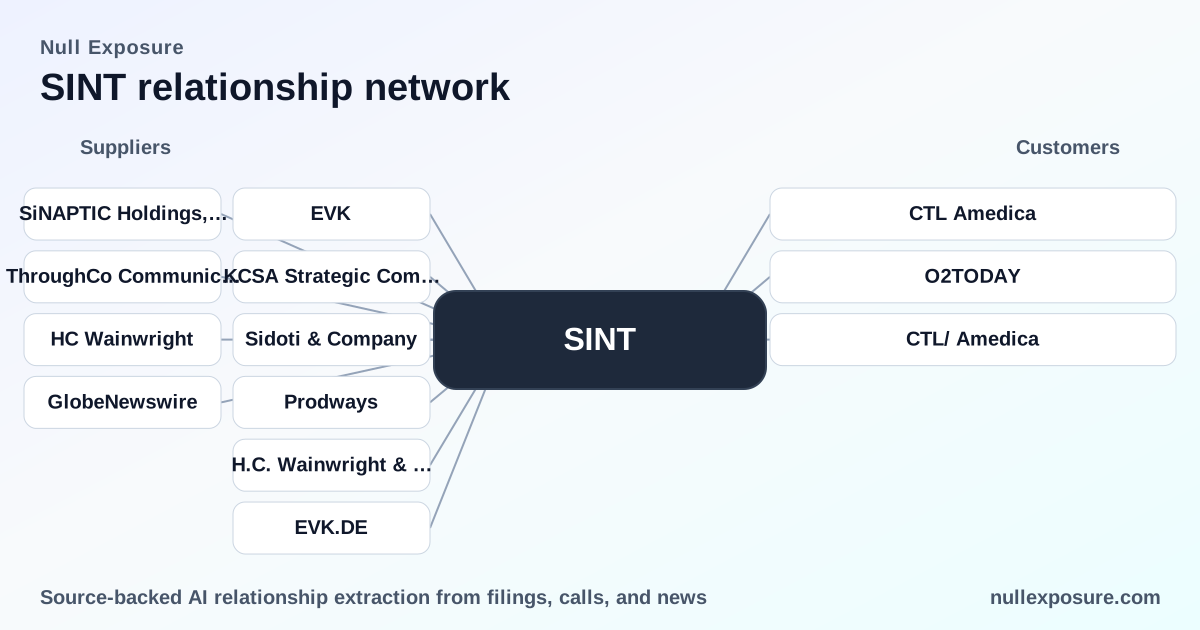
CTL Amedica — 10‑K disclosure (FY2024)
SINTX discloses that it manufactures interbody spinal fusion devices for CTL Amedica and retains approximately three years remaining on a 10‑year exclusive right to continue manufacturing those devices, making CTL Amedica an anchor customer and a central source of product revenue. This language is in SINTX’s FY2024 10‑K filing. (Source: SINTX 2024 Form 10‑K, fiscal year ended December 31, 2024.)
CTL/ Amedica — GlobeNewswire business update (FY2025)
In a business update, SINTX reiterated that it continues to provide spinal interbody devices to CTL/ Amedica, underscoring the ongoing, active nature of the relationship through FY2025 communications. (Source: GlobeNewswire release, SINTX business update, August 15, 2025.)
CTL/ Amedica — GlobeNewswire duplicate release (FY2025, alternate link)
A second GlobeNewswire posting of the same August 15, 2025 business update repeats that SINTX continues to supply spinal interbody devices to CTL/ Amedica, reflecting consistent external messaging about the contract’s persistence into FY2025. (Source: GlobeNewswire release re-post, August 15, 2025.)
CTL/ Amedica — PIM‑International reporting (FY2025)
Industry press coverage noted that SINTX’s relationship with CTL/ Amedica has resulted in over 50,000 devices successfully implanted to date, a commercial milestone tied to the firm’s implant manufacturing for CTL/ Amedica and confirming clinical deployment scale cited in trade coverage. (Source: PIM‑International coverage of SINTX acquisition and AM supply, reported March 10, 2026.)
O2TODAY — GlobeNewswire news (FY2021)
SINTX served as the supplier of FleX SN‑AP antipathogenic silicon nitride powder to O2TODAY, representing a product sale of specialty ceramic powder rather than a long-term manufacturing OEM contract. (Source: GlobeNewswire news release, June 30, 2021.)
Emplify Health — GlobeNewswire press release (FY2026)
In March 2026, SINTX announced that the first in‑human surgery using an FDA‑cleared SINAPTIC foot‑ankle implant was performed at Emplify Health in La Crosse, Wisconsin, indicating that SINTX products are entering clinical use through health‑system partners. (Source: GlobeNewswire release, March 19, 2026.)
Investment implications and risk framing
- Revenue visibility is bifurcated. The CTL/ Amedica exclusive manufacturing arrangement provides multi‑year revenue visibility and is a material, contractually anchored revenue source, while other customers and government awards create noisier, shipment‑timed revenue flows.
- Concentration risk is real and documented. With three commercial customers and government agencies accounting for more than half of revenue in 2024, SINTX is exposed to client concentration that can materially affect top-line performance if any large counterparty reduces purchases.
- Competitive and regulatory exposure exists but is mitigated by clinical track record. Silicon nitride implants have recorded clinical use since 2008 across multiple geographies; that history supports market acceptance, but continued adoption depends on OEM partnerships and regulatory clearances, as evidenced by the SINAPTIC foot‑ankle FDA clearance and first‑in‑human case.
- Government funding tempers but complicates cashflow. Grant revenue provides non-dilutive funding but introduces timing variability and project‑specific restrictions; the company explicitly derives grant and contract revenue from government agencies.
Bottom line for investors and operators
SINTX combines an anchor long‑term manufacturing relationship with CTL/ Amedica and a pipeline of product sales and clinical rollouts that together create material but concentrated revenue exposure. The company’s positioning as both OEM manufacturer and product seller gives it optionality, while the revenue mix requires active monitoring of customer health, grant timing, and the remaining duration of exclusive manufacturing rights.
For ongoing monitoring of SINTX’s counterparty exposures and real‑time signal capture, explore more investor-grade customer intelligence at https://nullexposure.com/.