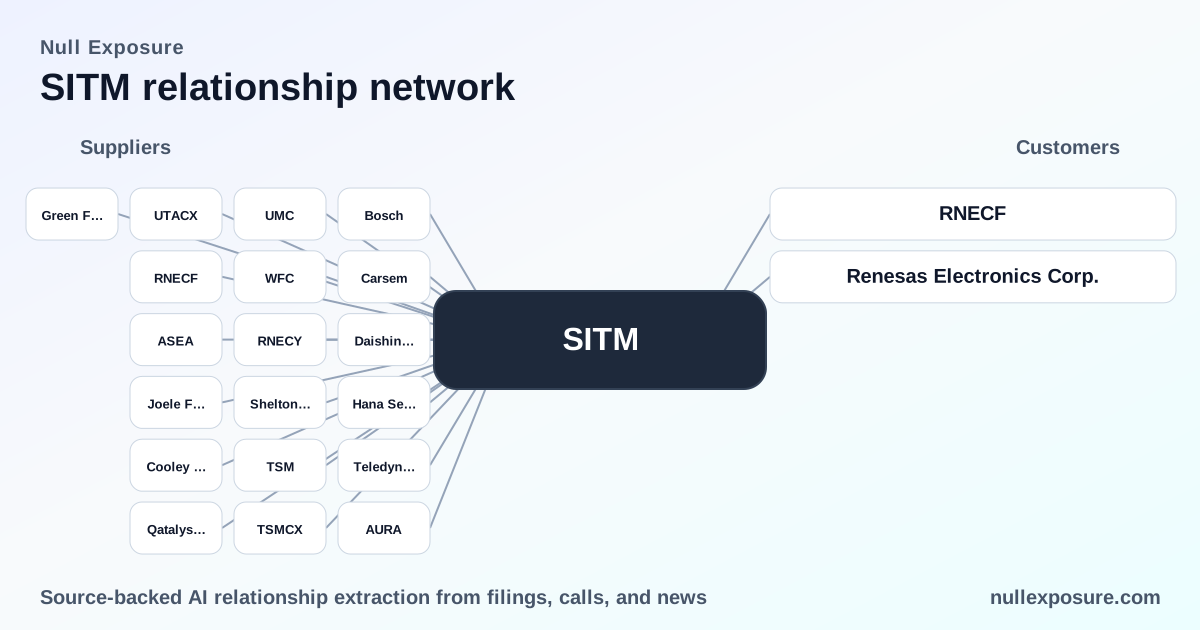
SiTime (SITM): How a timing-chip specialist monetizes design wins and distribution channels
SiTime designs and sells MEMS-based timing products and synchronization software to the global electronics industry, monetizing through component sales to distributors and select direct customers, plus nascent software licensing (TimeFabric). Revenue is transaction-driven, concentrated among a small set of large customers and distributors, and globally exposed, while recent strategic moves — including a transaction and partnership with Renesas — reframe growth optionality toward embedded timing inside large semiconductor platforms. Learn more at https://nullexposure.com/.
What the business model actually looks like for investors
SiTime sells silicon timing systems (MEMS resonators, oscillators and clocks) into consumer, communications, industrial and automotive end markets. Monetization is primarily per-unit component sales distributed through channel partners, supplemented by direct sales and a newly launched synchronization software suite (TimeFabric) introduced in June 2025. That combination creates a hybrid mix of transactional hardware revenue and early-stage software licensing upside.
The company’s operating characteristics drive investment risk and reward:
- Short-term contracting posture. SiTime’s sales run through standard purchase orders that can be cancelled or rescheduled with little or no penalty, which creates revenue volatility and sensitivity to end-market demand.
- Globalized revenue base. International ship-to locations comprised roughly 93% of net revenues in 2025, making SiTime a truly global supplier to OEMs and distributors.
- Concentration of demand. The largest end customer accounted for roughly 17–22% of revenue in recent years, and the top ten customers (including distributors) generated ~85% of sales in 2025 — a clear materiality signal that magnifies counterparty and product-cycle risk.
- Distribution-led go-to-market with direct accounts. The business primarily sells through distributors while maintaining some direct customer relationships, which concentrates downstream dependency but scales market coverage.
- Mature engineering relationships. SiTime describes long-term embedded design relationships as a source of product stickiness once timing technology is integrated into customer products.
- Emerging software revenue. The TimeFabric software suite introduces a higher-margin, recurring element to the model, but it is still early-stage relative to component sales.
All customer relationship mentions surfaced in coverage — line by line
Below are each of the relationship items surfaced in the provided coverage, reproduced with a plain-English summary and the original source.
-
GlobeNewswire (Feb 4, 2026) — RNECF
SiTime signed an MOU exploring integration of its MEMS resonators into Renesas’ embedded computing products, and announced an acquisition of Renesas’ timing business. Source: https://www.globenewswire.com/news-release/2026/02/04/3232503/0/en/SiTime-to-Acquire-Renesas-Timing-Business.html -
GlobeNewswire (Feb 4, 2026) — Renesas Electronics Corporation
The same GlobeNewswire release frames a strategic transaction between SiTime and Renesas, positioning SiTime products for deeper embedding in Renesas platforms. Source: https://www.globenewswire.com/news-release/2026/02/04/3232503/0/en/SiTime-to-Acquire-Renesas-Timing-Business.html -
EE-Asia (March 2026) — Renesas Electronics Corp.
EE-Asia reported the companies signed a partnership MOU to evaluate SiTime MEMS resonator integration into Renesas’ embedded computing product lines. Source: https://www.eetasia.com/sitime-to-acquire-renesas-timing-business/ -
TS2.Tech (March 2026) — RNECF
Coverage noted Renesas agreed to explore incorporating SiTime resonator technology into its chips, which could reduce the need for discrete timing components on customer boards. Source: https://ts2.tech/en/sitime-stock-jumps-premarket-as-3-2-billion-renesas-timing-deal-keeps-sitm-in-play/ -
TS2.Tech (March 2026) — Renesas Electronics
The TS2.Tech piece reiterated the potential for SiTime resonators to be integrated into Renesas embedded chips, emphasizing board-level simplification for customers. Source: https://ts2.tech/en/sitime-stock-jumps-premarket-as-3-2-billion-renesas-timing-deal-keeps-sitm-in-play/ -
Intellectia.ai (March 2026) — Renesas Electronics
Intellectia reported the transaction would bring Renesas’ CEO onto SiTime’s board and facilitate using SiTime resonators in automotive-suitable Renesas chips due to thermal stability benefits. Source: https://intellectia.ai/news/stock/sitime-in-talks-to-acquire-renesas-timing-business -
Intellectia.ai (March 2026) — RNECF
The same Intellectia summary referenced governance changes and integration plans tied to an acquisition and MOU with Renesas. Source: https://intellectia.ai/news/stock/sitime-in-talks-to-acquire-renesas-timing-business -
Finviz (March 2026) — Renesas
Finviz quoted the SiTime CEO saying SiTime technology could go into “billions” of Renesas chips, highlighting the scale potential of an embedded partnership. Source: https://finviz.com/news/296454/sitime-corporation-sitm-a-bull-case-theory -
Finviz (March 2026) — RNECF
A Finviz item reiterated the company CEO’s commentary on volume opportunity inside Renesas’ chip shipments following the deal disclosure. Source: https://finviz.com/news/296454/sitime-corporation-sitm-a-bull-case-theory -
Finviz (March 2026) — Renesas (earnings/coverage roundup)
Analyst-coverage articles on Finviz referenced the Renesas linkage as a driver for higher earnings estimates and growing Street optimism for SiTime. Source: https://finviz.com/news/306226/earnings-estimates-rising-for-sitime-sitm-will-it-gain -
Finviz (March 2026) — RNECF (Stifel coverage)
A Stifel note republished on Finviz tied SiTime’s opportunity to edge-AI platforms and large silicon partners such as Renesas. Source: https://finviz.com/news/284834/stifel-raises-sitime-sitm-pt-as-edge-ai-becomes-a-reality-for-2026-earnings -
Finviz (March 2026) — Renesas (analyst notes)
Additional Finviz items cite the potential for SiTime technology to be incorporated at scale by Renesas, feeding a bullish analyst narrative. Source: https://finviz.com/news/298481/analysts-continue-to-raise-sitime-corporations-sitm-target-price -
Finviz (March 2026) — RNECF (analyst lift)
Finviz repeated commentary that Renesas integration could translate into substantial volume adoption and rising analyst targets. Source: https://finviz.com/news/298481/analysts-continue-to-raise-sitime-corporations-sitm-target-price -
Finviz (March 2026) — Renesas (market recap)
Market recap pieces on Finviz referenced the Renesas link as a material narrative behind SiTime’s share performance in recent periods. Source: https://finviz.com/news/298998/sitime-corporation-sitm-rallied-more-than-90-in-2025 -
Finviz (March 2026) — RNECF (market recap)
A companion Finviz recap tied the Renesas MOU/acquisition news to SiTime’s rally and valuation re-rating. Source: https://finviz.com/news/298998/sitime-corporation-sitm-rallied-more-than-90-in-2025 -
Finviz (March 2026) — RNECF (repeat Stifel reference)
Additional republishing on Finviz reiterated Stifel’s thesis that SiTime can penetrate large silicon customers including Renesas. Source: https://finviz.com/news/284834/stifel-raises-sitime-sitm-pt-as-edge-ai-becomes-a-reality-for-2026-earnings -
Finviz (March 2026) — RNECF (earnings estimates)
Finviz’s earnings-estimate pieces linked upward revisions to the potential volume pathway through Renesas and similar OEMs. Source: https://finviz.com/news/306226/earnings-estimates-rising-for-sitime-sitm-will-it-gain
What investors should take away now
- Strategic inflection from Renesas: The MOU and timing-business acquisition position SiTime to convert a pure-component supplier into a supplier-of-record inside large semiconductor platforms; that is a structural shift for addressable volume. (Sources: GlobeNewswire, EE-Asia, Intellectia, Finviz.)
- Concentration and contract risk remain material. Short-term purchase orders and a heavy top-10 customer concentration expose revenue to demand swings despite long-term engineering relationships.
- Valuation and expectation disconnects are visible. SiTime trades at elevated multiples (high P/S and EV/Revenue) while EPS remains negative; the market is pricing significant embedded adoption. Company and analyst commentary cited in March 2026 underpins that re-rating. (Company filings and market coverage through 2025–2026.)
- Software is a diversifier, not a full offset. TimeFabric adds a routing to higher-margin, recurring revenue, but hardware remains dominant today.
If you want a compact risk/relationship map and a data-driven investor brief on how the Renesas transaction reshapes revenue sensitivity, review the full analysis at https://nullexposure.com/.
Conclusion: SiTime combines an industry-leading MEMS timing position with a distribution-centric go-to-market, but ultimate upside depends on successful integration into large silicon platforms (notably Renesas) and on converting one-off design wins into volume-embedded production. Investors should weigh the transformative potential against short-term order volatility and concentrated customer exposure.