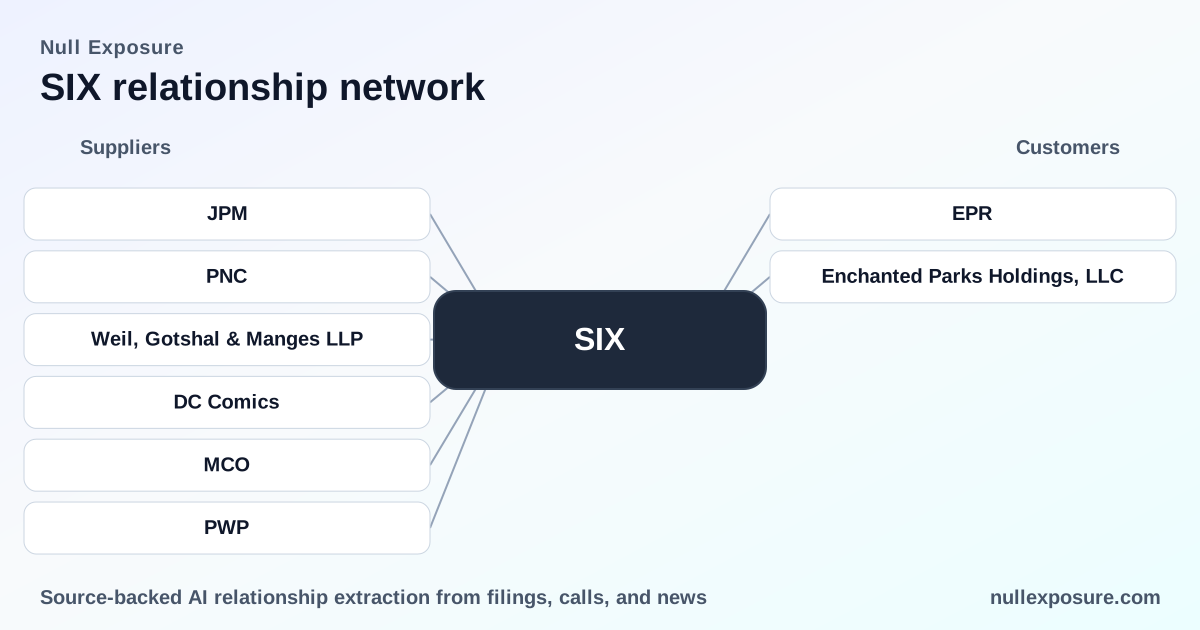
Six Flags’ Counterparty Map after a Major Portfolio Sale — What Investors Need to Know
Six Flags Entertainment Corporation operates regional amusement and water parks across North America and monetizes through admissions, season passes, F&B, sponsorships and ancillary on-site revenue, while periodically using portfolio transactions to manage liquidity and strategic focus. In 2026 the company executed a deliberate portfolio divestiture of seven parks to a single institutional buyer, reshaping counterparty concentration and short-term cash flow dynamics while preserving an asset-lite operating runway for the core business. This note maps the transactional counterparties, explains how the sale alters Six Flags’ operating posture, and highlights the investor implications.
If you want a concise, machine-readable view of these relationships and primary sources, visit NullExposure for structured coverage: https://nullexposure.com/
The headline transaction in plain language
Six Flags agreed to sell seven parks (six U.S. parks closed; La Ronde in Montreal expected to close separately) to EPR Properties, an experiential real-estate REIT, for roughly $315–342 million in gross transactional value, with press releases and local reporting framing the moves as portfolio sharpening and liquidity enhancement. (See ReBusinessOnline and Pulse2 reporting, March–May 2026: https://rebusinessonline.com/six-flags-to-sell-seven-theme-parks-to-epr-properties-for-331m/; https://pulse2.com/epr-properties-315-million-acquisition-completed-for-six-flags-regional-parks-portfolio/)
Why the buyer matters
EPR is an institutional owner focused on “experiential” real estate—movie theaters, recreation and amusement properties—and will operate these parks as income-producing assets under new ownership, creating a structural shift in landlord/operator roles relative to Six Flags’ historical model. (EPR closing announcement and analysis: https://citybiz.co/article/828896/six-flags-completes-sale-of-six-u-s-parks-to-epr-properties/)
How the sale changes Six Flags’ operating model and risk profile
- Contracting posture: The transaction moves Six Flags incrementally toward a more asset-light profile for the sold locations, converting fixed assets into cash and reducing capital intensity for those specific parks.
- Concentration and counterparty exposure: Selling multiple parks to a single institutional buyer concentrates transactional counterparty exposure on EPR, but reduces operational concentration on assets where Six Flags will no longer be owner-operator.
- Criticality and maturity: The divestiture is a capital-management move consistent with a company in a maturity phase that leverages selective asset sales to strengthen liquidity and fund core operations or deleveraging.
- Execution and timing: The deal closed in phases (six U.S. parks closed early April; La Ronde subject to later closing), which reflects staged execution designed to protect operating continuity and manage proceeds recognition.
These are company-level operating signals drawn from the transaction narrative and public coverage; they are not assigned to any single counterparty unless explicitly stated in source material.
Counterparty summaries — every relationship in the public results
EPR Properties (EPR) — institutional buyer of multiple parks
EPR Properties completed the acquisition of six U.S. Six Flags parks as part of a broader seven-park portfolio purchase that the parties sized at roughly $315–342 million gross transactional value, positioning EPR to expand its experiential real-estate footprint. (Coverage and closing notices: ReBusinessOnline, CityBiz, Marketscreener, March–May 2026; see https://rebusinessonline.com/six-flags-to-sell-seven-theme-parks-to-epr-properties-for-331m/ and https://citybiz.co/article/828896/six-flags-completes-sale-of-six-u-s-parks-to-epr-properties/)
EPR Properties — preferred-class mentions (EPR-P-E)
Market reports and secondary coverage referring to EPR’s preferred security tickers noted the completed acquisition of Six Flags parks and the implications for EPR’s experiential portfolio and investment guidance; these references contextualize how market participants priced the acquisition into EPR equity and preferred instruments. (Analyst and news coverage: Pulse2, Yahoo Finance, Marketscreener, May 2026; see https://pulse2.com/epr-properties-315-million-acquisition-completed-for-six-flags-regional-parks-portfolio/ and https://finance.yahoo.com/markets/stocks/articles/epr-properties-expands-experiential-focus-060708704.html)
Enchanted Parks Holdings, LLC — trademark/filing signal for transferred properties
A separate, smaller signal surfaced in early January filings where an entity named Enchanted Parks Holdings, LLC registered trademarks for several properties linked to Six Flags, indicating the use of intermediate or special-purpose entities in branding or title transitions for properties being sold. (Trademark filing coverage: InsideTheMagic, reporting January–March 2026; see https://insidethemagic.net/2026/01/six-flags-appears-to-have-sold-off-at-least-five-of-its-properties-according-to-a-recent-patent-filing-rl1/)
Strategic and financial implications for investors
- Liquidity and balance sheet: The proceeds from these sales produce a near-term cash inflow that improves Six Flags’ liquidity profile and gives management optionality to reduce leverage, invest in higher-return parts of the network, or fund seasonal working capital. Local press and Six Flags’ announcement framed the move as liquidity enhancement (CBS6 and News-Leader March–May 2026; see https://cbs6albany.com/news/local/six-flags-to-sell-seven-parks-to-epr-properties-in-331-million-deal-new-york-minneapolis-michigans-adventure-schlitterbahn-waterpark-texas-st-louis-great-escape-in-queensbury-ebitda-ceo-john-reilly-perella-weinberg-cbs6-wrgb and https://www.news-leader.com/story/news/local/missouri/2026/03/06/six-flags-st-louis-sold-worlds-of-fun-epr-properties/89016260007/).
- Revenue mix shift: Removing owner responsibilities at sold parks reduces capex volatility and operating leverage tied to those assets, while also lowering reported revenue tied to asset ownership if Six Flags does not retain operating contracts.
- Counterparty concentration trade-offs: Giving a single REIT control of multiple previously operator-owned parks simplifies transaction execution but creates a concentrated counterparty relationship that investors should monitor for leaseback, management contract, or shared services exposure.
- Market signaling: Analysts and market outlets incorporated the sale into valuations and guidance for EPR and commented on valuation implications for experiential real estate; that external re-rating can affect how investors view Six Flags’ residual assets and strategic direction (Marketscreener, SimplyWallSt, April–May 2026; see https://simplywall.st/stocks/us/real-estate/nyse-epr/epr-properties/news/epr-properties-epr-expands-six-flags-park-portfolio-what-doe).
What to watch next
- Execution and timing of the La Ronde closing and any transitional arrangements for branding, operations or IP licensing with Enchanted Parks or other SPVs. (La Ronde reporting: Fasken and local outlets, May 2026; see https://www.fasken.com/en/experience/2026/03/la-ronde)
- How Six Flags redeploys cash — debt reduction versus capex/marketing spend — since that decision will determine whether this is a defensive liquidity play or a strategic reallocation.
- Any leaseback, management or operating contracts that would maintain Six Flags’ operating involvement in sold parks; those terms change recurring revenue and margin profiles.
Bottom line for investors
The sale to EPR Properties is a clear, executed liquidity and portfolio optimization move that reduces asset ownership risk while concentrating counterparty exposure with a single institutional owner. Investors should value the improved near-term balance sheet flexibility but monitor the commercial terms that govern operations after sale, plus any SPV or trademark filings that signal longer-term rights transfers.
For a compact, source-linked compilation of these counterparties and primary press coverage, see NullExposure’s Six Flags customer relationship page: https://nullexposure.com/
Key takeaways: portfolio sale strengthens liquidity, shifts operating leverage away from sold parks, and replaces dispersed ownership risk with concentrated counterparty exposure to EPR.