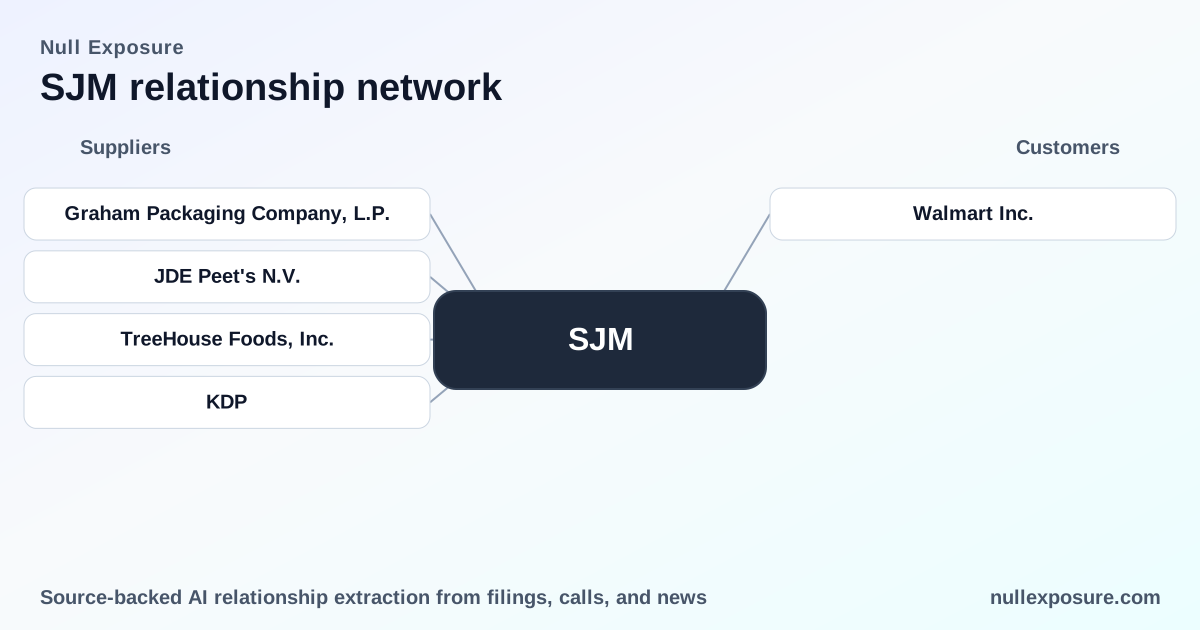
SJM customer map: concentration, channel power and what investors should price in
The J.M. Smucker Company monetizes a portfolio of branded food and beverage products sold primarily through retail and foodservice channels; the company manufactures and sells to large retailers, club and discount chains, online merchants and distributors, monetizing via branded product sales and strategic divestitures of non-core/value brands. For investors, the key operating lever is channel concentration — a small set of large customers account for the majority of revenue, which amplifies margin and cash-flow sensitivity to retail negotiations. For additional context on customer exposures and comparable corporate relationship analytics, visit https://nullexposure.com/.
The business at a glance — retail-first, branded portfolio, and concentrated counterparties
Smucker operates as a branded consumer-packaged goods manufacturer with distribution through both direct sales and intermediated channels. Revenue is generated through shelf and private-label placements, licensing arrangements, and targeted divestitures of non-core lines.
- The company reports the majority of its revenue comes from North American retail channels, sold through a mix of direct accounts, brokers and distributors. According to the FY2025 filing, branded product sales are “primarily through retail outlets in North America,” and regional disclosures show U.S. sales dominating reported totals.
- Top-ten customer concentration is high: management discloses that the top 10 customers collectively represented approximately 60 percent of consolidated net sales in 2025, signaling substantial counterparty concentration and retailer negotiating leverage.
These structural facts underpin Smucker’s commercial posture: large buyers have disproportionate pricing and placement power, while Smucker’s branded portfolio and occasional divestitures give the company levers to reallocate capital and simplify channel exposure.
What the constraints tell us about operating risk
Smucker’s relationship-level data and mapped constraints reveal several company-level operating characteristics:
- Concentration: The business is highly concentrated with a handful of very large customers driving a material portion of revenue, which increases sensitivity to renegotiation on price, promotion and slotting.
- Contracting posture: Sales are transacted through a mix of direct contracts and distributor/reseller arrangements, implying standard trade terms, promotional funding commitments and seasonal inventory cycles.
- Criticality: For very large retailers, Smucker’s assortment is important but replaceable; retail buyers can shift private-label or adjacent brands, so Smucker’s bargaining power is functionally constrained by category dynamics.
- Geographic maturity: Operations are North America–centric with global reporting language, indicating mature, lower-growth end markets relative to emerging geographies; this supports predictable cash flows but caps organic revenue upside.
These are company-level signals derived from multiple excerpts in the FY2025 disclosure and related press coverage rather than single-relationship anecdotes.
Customer relationships you need on your model
Below I cover each customer relationship cited in public disclosures and news coverage; each entry is concise and sourced so investors can evaluate counterparty risk and strategic fit.
Walmart Inc.
Smucker reports Walmart and subsidiaries accounted for 33% of net sales in FY2025, unchanged from FY2024 and only marginally lower than the 34% reported in FY2023 — a concentrated, material retail exposure that creates outsized commercial risk if the relationship changes. According to SJM’s FY2025 10‑K (filed April 30, 2025), changes with significant customers, particularly the loss of its largest customer, would materially impact results of operations.
JTM Foods, LLC (divestiture counterparty)
Smucker completed the sale of certain value brands — notably Cloverhill and Big Texas and some private-label lines — to JTM Foods, LLC, reflecting a portfolio rationalization strategy to monetize lower-margin or non-core assets. The company announced the closing of this transaction on March 3, 2025 via a PR Newswire release; Simply Wall St. also reported the completion on May 3, 2026, confirming the divestiture as a finalized strategic step to sharpen Smucker’s core brand mix.
FATAV (Johnny Rockets / Hostess partnership mention)
Smucker cited a marketing partnership involving the Hostess brand and Johnny Rockets in public coverage, with Smucker’s marketing lead commenting on delivering “moments of joy” through the partnership; this signals brand-extension and foodservice activation as part of go-to-market tactics. The exchange was covered in a news release on May 2, 2026 by Yahoo Finance Singapore, where Lee Lust, Senior Director of Marketing at Smucker, is quoted describing the initiative.
How these relationships translate into financial and strategic risk
Investors should treat these customer relationships through three pragmatic lenses:
- Revenue concentration risk: With Walmart representing one-third of sales, a modeling stress on Walmart volume or a pricing concession materially affects EBITDA and free cash flow. That exposure is amplified by the fact the top 10 customers combined are about 60% of consolidated net sales (FY2025).
- Channel mix and margin pressure: Sales through mass merchandisers, club stores and discount outlets typically involve deeper promotions and slotting fees; Smucker’s channel mix — sold via direct accounts, brokers, and distributors — makes margins vulnerable to trade funding demands.
- Portfolio management as a lever: The sale of Cloverhill and Big Texas to JTM Foods demonstrates management’s willingness to divest value brands to concentrate capital on higher-margin properties; this is a positive strategic tool that reduces complexity but also reduces scale in low-margin segments.
Practical checklist for modeling and engagement
Use these points when valuing Smucker or engaging management:
- Stress-test revenue with a -10% to -25% scenario on Walmart volumes and model incremental promotional spend to retain shelf share.
- Incorporate assumptions for continued divestiture activity: further trimming of non-core brands reduces revenue but improves margin mix and capital allocation.
- Evaluate trade receivable and working capital implications from a channel with heavy promotional cycles and distributor intermediation.
- Monitor for new large retail contracts or losses; any variation among the top 10 customers should be treated as a binary tail risk to near-term EBITDA.
For a deeper look at customer-level exposures and comparable corporate relationship analytics, explore research at https://nullexposure.com/.
Bottom line
Smucker operates a mature, branded consumer business that converts shelf presence into reliable cash flow, but it is exposed to concentrated retail counterparty power — notably Walmart at roughly one-third of sales. The company’s strategy of portfolio pruning (e.g., selling Cloverhill and Big Texas) improves margin focus, but investors must price in retailer negotiating dynamics and the potential volatility from promotions and slotting. Keep concentration and trade terms at the center of any valuation or credit assessment.