Skillsoft (SKIL): Customer relationships and what the SumTotal sale signals for investors
Skillsoft monetizes a global learning platform through subscription-based SaaS access, supplemented by short-duration professional services and instructor-led training. The company serves large enterprises, government agencies, and individual learners via two principal go-to-market segments (enterprise-grade TDS delivered on Percipio, and GK services & training), generating recurring revenue recognized on a straight-line basis over fixed terms while capturing one-off revenue from short professional engagements and spot instructor-led events. For investors, Skillsoft’s cash flows are driven by subscription retention and enterprise renewals, with capital allocation and balance-sheet metrics increasingly shaped by portfolio rationalization such as the recent divestiture of SumTotal. Learn more at https://nullexposure.com/.
The investment thesis in one paragraph
Skillsoft is a subscription-first learning franchise with a large installed base among global enterprises and governments, generating predictable recurring revenue but with margin pressure from legacy assets and mixed product maturity across segments. The company’s strategic levers are subscription retention, enterprise upsell, and rationalizing non-core assets to fund growth in Percipio and enterprise services. Recent portfolio moves reduce complexity and redeploy cash, which is a positive for capital returns and focused product investment.
How Skillsoft sells and where revenue comes from
Skillsoft’s core commercial posture is contractual and recurring. Public disclosures describe:
- Subscription contracts as the dominant contract form, with revenue recognized on a straight-line basis over the contract term.
- Professional services that are generally short in duration and recognized over time.
- Non-subscription, instructor-led training booked as spot events, with revenue realized at delivery.
These contracting characteristics mean Skillsoft’s revenue base is subscription-heavy and renewal-driven, while growth and margin improvements depend on expanding digital seat penetration and optimizing professional services economics. According to company disclosures and segment commentary, Skillsoft serves more than 95 million learners worldwide and counts 60% of the Fortune 100 among customers, indicating a concentration toward very large enterprise clients.
Geographic footprint and customer mix
Skillsoft’s revenue mix is global with meaningful regional concentration in North America, EMEA, and APAC. The company reports direct sales coverage in North America and Europe and dedicated teams in India, Australia/New Zealand, and Singapore. Business lines map to:
- TDS (software/platform): enterprise-grade Percipio, mobile-first and cloud-based.
- GK (services and training): virtual, in-classroom and on-demand professional education.
This structure creates both scale advantages and operational complexity: global enterprise contracts drive scale and predictable ARR, while localized services and instructor-led offerings require operational coordination and create spot revenue volatility.
Constraints and operating signals investors should weight
Skillsoft’s disclosures convey several company-level constraints that affect forecasting, contract risk, and valuation:
- Contracting posture: Predominantly subscription contracts with straight-line revenue recognition; professional services are short-duration and spot ILT recognized upon delivery. This drives predictable revenue recognition but requires continuous renewal activity.
- Concentration and criticality: Heavy exposure to very large enterprises and government customers; as a U.S. government contractor, Skillsoft faces regulatory and compliance considerations that increase operational overhead.
- Geographic scale: Global delivery creates growth opportunity but elevates go-to-market and content-localization cost.
- Segment maturity: Percipio and cloud offerings show product maturity and scale, while professional services and instructor-led segments are more commoditized and margin-sensitive.
These are company-level signals drawn from Skillsoft’s public disclosures and segment narratives; they are important inputs when modeling churn, gross margins, and capital allocation.
What happened with SumTotal — the customer/asset transaction(s)
Skillsoft sold its SumTotal business, which historically provided learning management and human capital management capabilities for regulated industries. The transaction is a cash sale to Cornerstone for approximately $200 million, a move that materially reduces Skillsoft’s exposure to legacy HCM/LMS product complexity and concentrates the company on the Percipio platform and professional services.
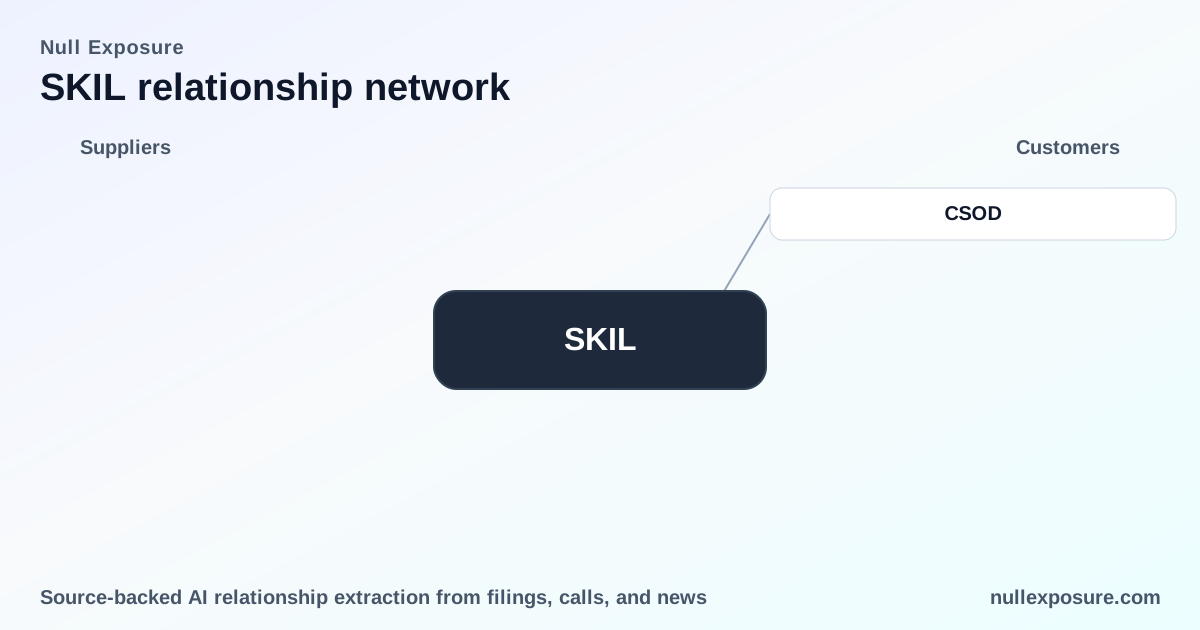
- Cornerstone OnDemand, Inc (CSOD) — Skillsoft agreed to sell SumTotal to Cornerstone for roughly $200 million in cash, transferring an LMS/HCM business focused on regulated industries to a specialist buyer; the deal was reported in March 2026. According to an HR-focused report in The Economic Times (March 10, 2026), the transaction was presented as a definitive agreement to divest SumTotal to Cornerstone OnDemand for approximately $200 million in cash.
- CSOD (inferred symbol) — The same Economic Times HR item identified Cornerstone’s ticker as CSOD and repeated the headline terms: acquisition of SumTotal from Skillsoft for around $200 million in cash (reported March 10, 2026). The press coverage reiterates the strategic nature of the sale and the cash consideration.
Both relationship entries in the public feed reference the same March 2026 Economic Times HR report announcing the SumTotal sale to Cornerstone; the duplication underscores that the buyer relationship and the buyer’s market identity were both captured by monitoring.
Why the SumTotal sale matters for customer/contract risk and valuation
- Simplifies product portfolio: Divesting SumTotal reduces legacy on-premise/HCM complexity and allows management to concentrate R&D and sales efforts on Percipio and enterprise services, improving go-forward margin potential.
- Immediate liquidity: The ~$200 million cash proceeds strengthen the balance sheet and give optionality for buybacks, debt paydown, or reinvestment in product and content. Skillsoft’s reported trailing revenue of $512.7M and gross profit of $378.0M (TTM) suggest the company can redeploy proceeds strategically.
- Customer continuity considerations: SumTotal’s customer base included regulated-industry accounts; transferring those relationships to Cornerstone transfers the service relationship and any associated renewal/capture risk away from Skillsoft, reducing concentration but removing a specific revenue stream tied to regulated-compliance offerings.
Key takeaway: The SumTotal divestiture is a clear portfolio-sharpening move that reduces legacy product exposure while delivering immediate cash — a net positive for execution risk and strategic focus.
Relationship-level wrap: every relationship captured in the feed
- Cornerstone OnDemand, Inc — A definitive agreement was reached for Cornerstone to acquire SumTotal from Skillsoft for approximately $200 million in cash; reported in HR-focused coverage on March 10, 2026 by The Economic Times. This transfer moves regulated-industry LMS/HCM business to Cornerstone and converts that asset into cash for Skillsoft.
- CSOD — The buyer’s market identity and ticker (CSOD) were similarly recorded in the same March 10, 2026 Economic Times HR report, which restated the $200 million cash consideration and buyer rationale.
What investors should watch next
- Renewal trends and net retention on Percipio seats after the portfolio simplification.
- How Skillsoft redeploys the ~$200 million cash — debt reduction and targeted product investment are preferable to short-term shareholder distributions if execution is still improving.
- Margin trajectory in services and the degree to which professional services can be scaled or outsourced to improve operating leverage.
If you want a concise risk/return memo or a modeled sensitivity showing the SumTotal proceeds’ impact on leverage and free cash flow, see our coverage at https://nullexposure.com/ for detailed operator-level analysis and scenarios.
Bold final takeaways: Skillsoft is a subscription-first learning platform with high enterprise exposure; the SumTotal sale reduces portfolio complexity and injects cash, improving strategic focus and optionality for investors.