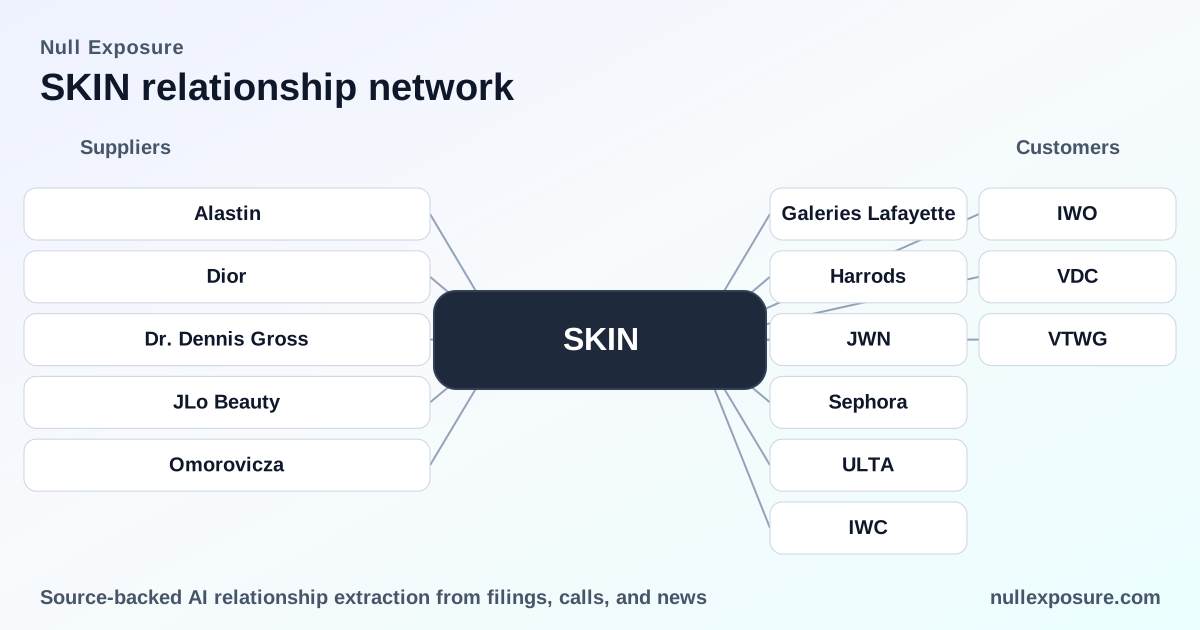
Beauty Health Co (SKIN): Customer relationships, channel footprint, and commercial constraints investors should price in
Beauty Health Co sells aesthetic medical devices (Delivery Systems) and recurring consumables (Boosters and serums) through a mix of professional provider channels, prestige retail partners, and direct-to-consumer e‑commerce. The business monetizes by selling capital equipment to providers and generating higher-margin, recurring revenue from consumables, while extending reach through distributor agreements and selective retail placements. For a concise view of relationship intelligence and commercial signals, visit https://nullexposure.com/.
Retail validation: premium placement that supports treatment adoption
The company is executing a dual strategy: place treatment-capable devices with professional providers and put consumer-facing products and experiences into prestige retail to accelerate demand for in-clinic treatments. ChiefMarketer’s profile of the company (March 2026) documented a series of high-profile retail pilots and rollouts that serve as distribution and marketing channels for Hydrafacial and related services.
Galeries Lafayette — a branding win on Europe’s wellness floor
Galeries Lafayette hosted Beauty Health’s presence on its Paris wellness floor, which the retailer bills as the largest wellness space in Europe; that placement underscores a luxury, experiential positioning in France. (ChiefMarketer, March 2026)
Harrods — pilot completed in London
Beauty Health completed a successful pilot at Harrods in London, signaling acceptance of in-store treatment concepts in a globally known luxury department store. (ChiefMarketer, March 2026)
Nordstrom — department-store access in the U.S.
Beauty Health’s products and services are present at Nordstrom, which gives the company access to an upper-end U.S. department-store customer base and premium foot traffic. (ChiefMarketer, March 2026)
Sephora — broad international retail footprint
Sephora carries the company’s offering on three continents and reaches “every door in North America,” providing extensive consumer exposure and lean channels for product awareness. (ChiefMarketer, March 2026)
Ulta — mass-premium retail distribution in the U.S.
Ulta is named alongside Nordstrom as an important retail partner, supplying broad national coverage for consumer access to products and driving demand into professional treatment providers. (ChiefMarketer, March 2026)
ULT A (duplicate mention) — same-channel confirmation
The dataset includes a second instance of Ulta’s mention from the same ChiefMarketer piece, reinforcing that Ulta is part of the company’s retail channel mix. (ChiefMarketer, March 2026)
Institutional visibility: small but diversified passive holders
TradingView’s holdings snapshot (FY2025) lists several ETFs that hold SKIN shares. ETF placements are modest in absolute dollars but indicate passive indices and thematic funds have included the stock.
iShares Microcap ETF (IWC)
TradingView reports IWC holds approximately $360.06K of SKIN, representing a microcap passive exposure to the company. (TradingView holdings, FY2025)
iShares Russell 2000 Growth Fund (IWO)
IWO’s holdings include roughly $954.93K of SKIN, showing the stock’s presence in small-cap growth exposure. (TradingView holdings, FY2025)
IWC (duplicate entry)
A second IWC entry appears in the holdings list, matching the same TradingView snapshot and reinforcing IWC’s reported position. (TradingView holdings, FY2025)
IWO (duplicate entry)
A duplicate IWO entry in the source confirms the Russell 2000 Growth exposure recorded in the FY2025 snapshot. (TradingView holdings, FY2025)
Vanguard Consumer Staples ETF (VDC)
TradingView lists VDC holding about $1.4M of SKIN, indicating inclusion in a consumer-staples-focused ETF bucket at the time of the snapshot. (TradingView holdings, FY2025)
Vanguard Russell 2000 Growth ETF (VTWG)
VTWG is recorded with a smaller holding (~$131.32K) of SKIN, signaling cross‑index inclusion in small‑cap growth universes. (TradingView holdings, FY2025)
VDC (duplicate entry)
A second VDC entry duplicates the consumer-staples ETF holding shown in the same TradingView page. (TradingView holdings, FY2025)
VTWG (duplicate entry)
A duplicate VTWG entry in the snapshot reiterates the Vanguard Russell 2000 Growth positioning from FY2025. (TradingView holdings, FY2025)
What the relationship and disclosure constraints tell investors about operating risk
The company-level disclosures and constraint signals define how customer relationships function and what that implies for revenue durability and concentration.
- Contracting posture: primarily spot sales for equipment. Beauty Health sells Delivery Systems largely through discrete sales orders rather than long-term purchase commitments, which creates cyclical capital equipment revenue patterns and exposure to provider capex cycles.
- Consumables deliver recurring revenue: Boosters and serums follow a usage-based replenishment pattern, creating predictable follow-on spend from providers once devices are installed.
- Counterparty mix includes individual consumers through e‑commerce, which acts as a marketing amplifier for brand and provider discovery.
- Geographic footprint is global but concentrated in the Americas: Approximately 70% of Delivery Systems and Consumables are sold into the United States and Canada, with meaningful Asia‑Pacific and EMEA contributions and EU distribution run from the U.K.
- No single customer concentration: No individual customer represented 10% or more of net sales in fiscal 2024, which limits client-concentration risk at present.
- Channel roles combine direct selling, distributor relationships in the EU, and active provider partnerships; classifying the company as a hardware seller with attached consumables is accurate.
These constraints translate into an operating profile of capital equipment sales that drive installed-base economics, augmented by recurring consumables revenue and amplified by retail and direct channels that support demand generation and consumer adoption.
For more granular relationship mapping and to see how these commercial levers play out in supply chains, visit https://nullexposure.com/.
Investment takeaways for operators and allocators
- Growth lever: Installed base expansion plus consumable repurchase cycles are the clearest route to margin improvement—investors should watch Delivery System placements and consumables attach rates.
- Channel validation: Placement in Sephora, Ulta, Nordstrom, Harrods, and Galeries Lafayette provides both marketing reach and premium positioning that accelerate consumer-driven demand for treatments.
- Revenue mix and risk: The company reports roughly $300.8M revenue TTM with negative EPS, meaning growth must convert to margin improvement to justify current multiples. Institutional passive holdings are present but modest in scale.
- Execution sensitive: Spot-equipment sales create lumpy top-line outcomes; recurring consumables reduce volatility over time but require continued provider success and retail consumer pull.
Bold operational signals—global distribution, recurring consumables, and retail partnerships—create a defensible commercial model if the company sustains device placements and grows attach rates. The primary risks are sales cadence and path to consistent profitability; operators should prioritize installed-base growth and consumable penetration metrics that convert retail exposure into in-clinic demand.
Bold decisions are required in capital allocation by both management and investors: doubling down on consumables marketing and provider training converts retail visibility into predictable revenue, while underinvesting risks commoditization of hardware sales.