Skillz’s customer map: concentration, contracts and the Tether haircut
Skillz Platform Inc operates a mobile gaming monetization platform that licenses SDKs and monetization software to game developers, runs an in-house advertising demand-side business (Aarki) and takes a cut of in-game monetization and tournament activity. The company earns revenue from usage-based advertising impressions, revenue-share licensing agreements with developers, and recurring maintenance/subscription style fees, and its financial profile is heavily influenced by a small number of large developer partners. For investors, the central question is simple: can Skillz replace outsized partners and sustain ad demand while preserving gross margins on a usage-based model?
For a deeper vendor-risk view, see https://nullexposure.com/.
Why the customer relationships matter for valuation
Skillz is fundamentally a platform business with a service-provider posture: it supplies developers with a monetization stack (SDK + DSP capabilities) and acts as an agent in sourcing ad inventory and placing ads. That position creates three durable characteristics for the revenue stream:
- Usage sensitivity — a large portion of revenue is recognized over time as impressions are served, so top-line moves with engagement and ad pricing.
- Concentration risk — a handful of developers have historically driven a large share of revenue, making the company vulnerable to partner contract changes.
- Hybrid contract maturity — Skillz uses a mix of long-dated developer protections and short-term ad billing cycles, producing cash-flow volatility when large partners exit.
Skillz’s public filings and market commentary make these dynamics explicit; investors need to weight both the growth leverage of a high-beta ad/engagement model and the downside of partner concentration.
What the filings and press reveal about how Skillz contracts
The company’s public disclosures and recent press produce a clear set of operating constraints and contract features that drive commercial behavior:
- Usage-based monetization is central. Skillz recognizes advertising revenue over time based on impressions, indicating revenue scales directly with engagement and ad fill rates. (Evidence: company disclosure on advertising impression recognition.)
- Long-term developer protections exist alongside exit clauses. Negotiated agreements limit removal of games from the platform for at least 12 months and, in specific cases, developers cannot terminate without Skillz approval for up to 18 months. These are structural frictions that slow churn but can lock the company into underperforming titles. (Evidence: contractual excerpts.)
- There is a subscription/maintenance element. Player inactivity triggers a monthly maintenance fee after six months, creating a small recurring floor to revenue from dormant users. (Evidence: maintenance fee language.)
- Ad relationships operate on short commercial cycles. Advertising customers receive 30-day payment terms and historically no single advertising customer accounted for more than 5% of advertising revenue in 2023–2024, indicating ad revenues are broadly distributed even if platform-level concentration exists. (Evidence: advertising payment terms and concentration note.)
- Geographic reach is global. The company processes millions of ad requests per second across over 10 billion devices, implying exposure to global ad markets and corresponding currency/market risk. (Evidence: global ad footprint.)
- Service-provider role and maturity. Skillz positions itself as a service provider to developers via SDKs and DSP services; it reports an active developer community using the platform. (Evidence: SDK and platform disclosures.)
A critical company-level signal: for the year ended December 31, 2024, Tether accounted for 45% of Skillz’s revenue and Big Run accounted for 26% of revenue—a concentration profile that elevates counterparty risk materially for investors. (Evidence: 2024 revenue concentration disclosure.)
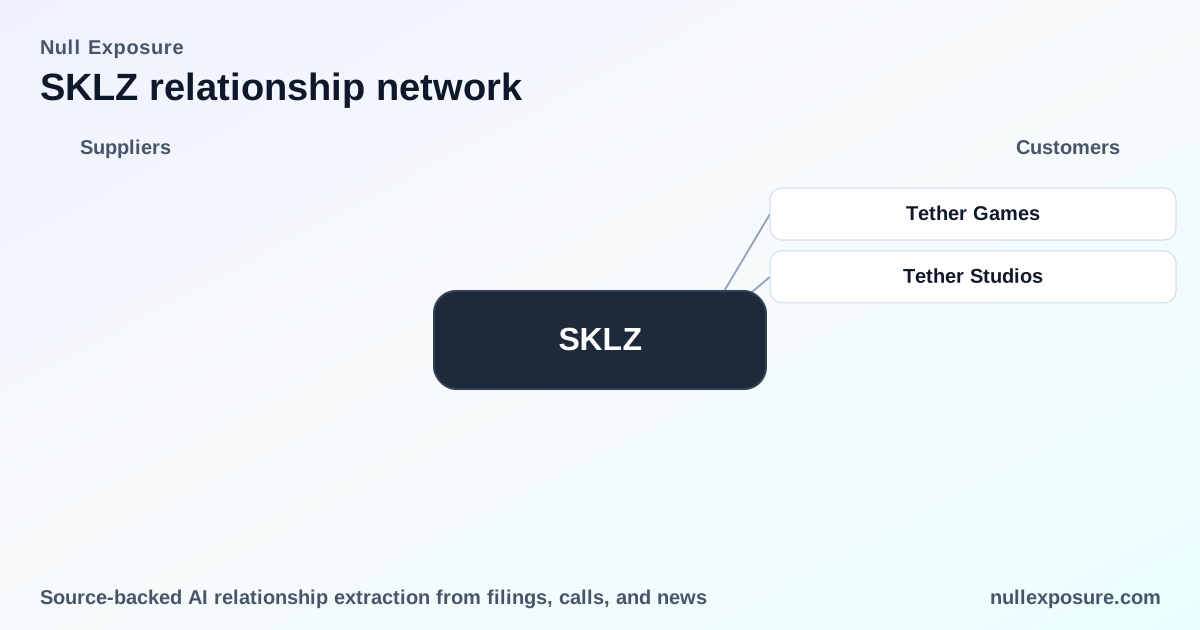
Customer roster: Tether Studios and Tether Games
Tether Studios
Skillz licensed software to Tether Studios in exchange for revenue sharing that supported monetization of Tether’s games, making Tether a major developer partner in 2024. This relationship was widely reported in investor-alert and legal-news coverage in March 2026. (Source: NatLawReview press release and PR Newswire coverage, March 2026.)
Tether Games
Tether Games operated as an affiliate partner to Tether Studios and used Skillz’s licensed software to monetize its titles; together the two Tether entities were a single commercial counterparty for revenue concentration purposes. Skillz disclosed in an SEC filing that Tether Studios and Tether Games planned to terminate all agreements with Skillz effective September 1, 2025, a development highlighted in PR Newswire coverage in May 2026. (Source: PR Newswire reporting on Skillz SEC filing, disclosure dated September 2, 2025, reported May 3, 2026.)
What the Tether break means in plain terms
Tether’s exit is a high-impact event. Given Tether accounted for 45% of 2024 revenue, the termination of Tether’s agreements (effective September 1, 2025) represents an abrupt revenue gap that cannot be covered by short-cycle ad customers alone. The contract language that prevents easy removal of games for 12–18 months suggests Skillz previously secured long-run commercial terms, but those protections no longer hedge against a partner-initiated termination.
Operationally, Skillz faces three immediate pressures:
- Replace the lost monetization volume from Tether with either new developer partnerships or higher ad fill/pricing.
- Preserve platform economics while scaling back a concentration risk (ad rates can be volatile; usage-based revenue magnifies shortfalls).
- Manage working capital impacts from ad payment cycles even as large developer revenue evaporates.
Key investor takeaways
- Concentration risk is the principal valuation lever. With Tether at ~45% of 2024 revenue, a single partner’s departure materially reduces revenue and can compress EV/Revenue multiple unless replaced.
- Revenue is elastic and tied to engagement. The usage-based advertising model amplifies upside when engagement recovers, but creates downside in periods of partner attrition or ad-rate weakness.
- Contracts provide mixed protection. Long-term clauses limit game removal in some cases, but they do not prevent partner contract terminations and therefore do not fully mitigate counterparty risk.
- Advertising customers are broadly distributed. Individual ad buyers historically were small relative to platform revenue, which softens one channel of concentration risk but does not offset a developer concentration problem.
Consider tracking Skillz’s post-2025 revenue composition and ad-impression metrics as the primary signals of recovery.
What to monitor next (actionable signals)
- Quarterly disclosures that show revenue by counterparty and the pace of replacement deals signed after September 2025.
- Ad-impression volumes and Aarki performance metrics that indicate whether global demand is filling the gap left by large developers.
- Legal or investor-litigation developments tied to the Tether exit that could produce unexpected liabilities.
- Retention and onboarding rates for mid-sized developers and whether Skillz can expand non-Tether customers into material top-line contributors.
For a focused vendor-risk and customer-concentration briefing, visit https://nullexposure.com/.
Skillz is a classic high-beta platform: high operational leverage and pronounced counterparty concentration. The Tether developments crystallize both the upside (scalable ad revenue) and the downside (partner exits). Investors should treat near-term headline risk as a deterministic input to valuation until replacement revenue proves durable.