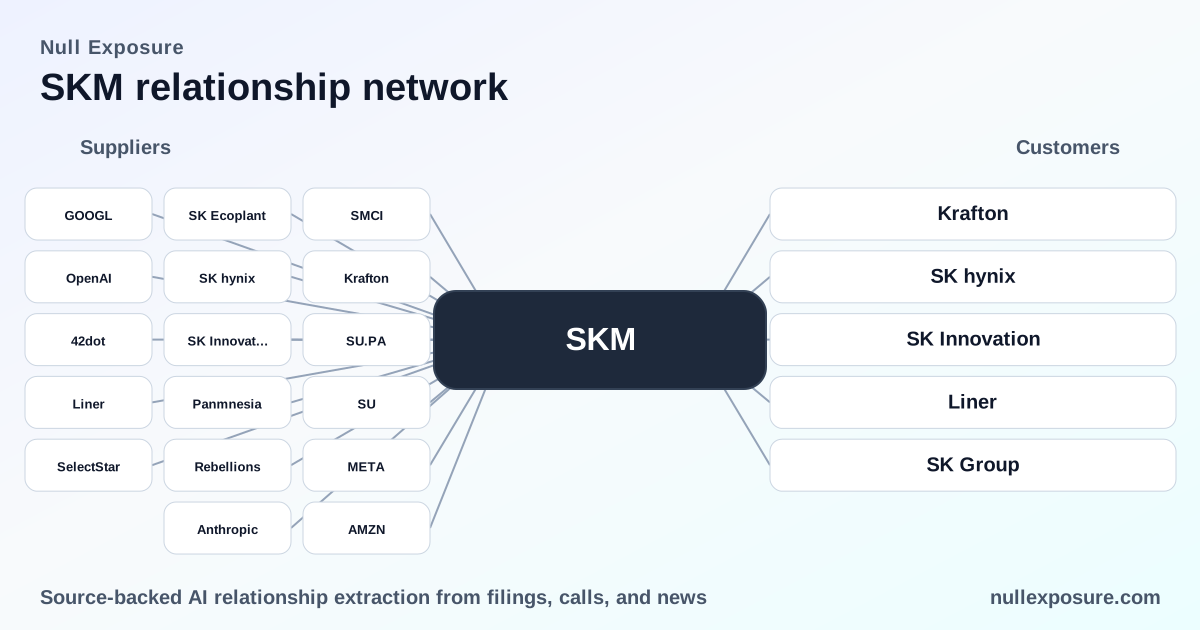
SK Telecom’s customer playbook: selling AI into its own group and select external partners
SK Telecom generates its core cash flows from telecom services but is executing a clear monetization pivot: packaging its proprietary large-model effort (A.X K1 / A. Biz) as an enterprise productivity and platform product for internal SK Group affiliates and a small set of external partners. The company intends to monetize through enterprise licensing, productivity subscriptions, and integrated deployments that cross-sell to its telecom and cloud customers, a strategy that leverages scale in infrastructure and captive demand inside the SK conglomerate. For a concise investor view, this is a revenue-adjacent diversification designed to lift margins via high-value B2B engagements rather than a consumer mass-market bet.
Explore the broader signal set at https://nullexposure.com/ for comparative customer analytics.
How SK is commercializing A.X K1 and A. Biz — a pragmatic, captive-first rollout
SK Telecom has moved from R&D into commercial pilots and first-wave rollouts, prioritizing internal SK Group adoption to build references and operational experience. That contracting posture — internal-first, then selective external scaling — reduces initial sales friction and concentrates early value capture inside related affiliates. The company is using these pilot deployments to prove critical productivity use-cases (real-time meeting minutes, intelligent search, AI report generation) and to secure manufacturing and enterprise test commitments that support later licensing conversations.
A company press release and contemporaneous reporting show the program progressed from lab to real-world testing across FY2025–FY2026. Investors should view this as an early commercialization phase with concentrated customer exposure but high potential upside if external adoption follows. For background on how SK is positioning A. Biz within the group, see SK Telecom’s corporate announcement on its site (FY2026).
The relationships in the record — who’s using SK’s models and why they matter
Krafton — gaming integration and character AI (FY2025)
SK Telecom’s A.X K1 is being positioned to enable interactive, self-governing characters inside Krafton titles and to support humanoid AI features, signaling game-engine and content-layer integrations that can create differentiated IP for game publishers. This linkage was described in a Sahm Capital write-up on the A.X K1 rollout dated December 29, 2025.
SK hynix — manufacturing and productivity models (FY2026)
During the company’s Q4 2025 earnings call transcript, SK Telecom said it will add the model to A. Biz for work productivity and provide it to manufacturing affiliates such as SK hynix to strengthen competitiveness, indicating a direct enterprise deployment aimed at operational efficiency for chip manufacture and related functions (InsiderMonkey transcript, Q4 2025 / FY2026 commentary).
SK Innovation — manufacturing affiliate testing and competitiveness (FY2026)
SK Telecom stated in the same earnings call that SK Innovation is a recipient of A. Biz model deployments to enhance work productivity across manufacturing activities, representing internal cross-subsidized product adoption aimed at lifting affiliate margins and operational capability (InsiderMonkey transcript, Q4 2025 / FY2026).
SK Innovation — early testing commitments inside FY2025 rollout
Earlier coverage of the A.X K1 rollout reported that SK Innovation was among over 20 institutions committed to real-world testing during FY2025, reinforcing the narrative that the company prioritized internal and closely related affiliates for first-phase validation (Sahm Capital, Dec 29, 2025).
Liner — search relevance uplift for 11 million users (FY2025)
A Sahm Capital article reported that SK’s model is expected to significantly upgrade the accuracy of Liner’s global search engine for its roughly 11 million users, demonstrating SK Telecom’s willingness to commercialize AI services to standalone internet-products beyond SK Group (Sahm Capital, Dec 29, 2025).
SK hynix — part of the FY2025 testing cohort
Sahm Capital also listed SK hynix among the more than 20 institutions that committed to test A.X K1 in FY2025, which complements the FY2026 earnings commentary and confirms continuity of collaboration from test-phase into operational adoption (Sahm Capital, Dec 29, 2025).
SK Group — internal-first deployment of A. Biz productivity tools (FY2026)
SK Telecom’s corporate news release describes A. Biz being implemented first across the SK Group to create reference cases in real-time meeting minutes, intelligent internal searches, news curation, and AI report generation, underscoring a deliberate internal commercial strategy to create use-case proof points before broader market expansion (SK Telecom press release, FY2026).
What these customer ties imply about SK Telecom’s operating model
- Contracting posture: internal-first and bilateral agreements. SK is prioritizing affiliate adoption to create referenceable outcomes, which reduces early commercial risk and shortens procurement cycles. This is a company-level signal drawn from multiple statements about group-wide rollouts.
- Concentration: high in the short run. Early customer mix is skewed toward SK affiliates and a handful of selected external partners (Liner, Krafton), implying revenue and execution concentration risk until external sales scale.
- Criticality: operational and strategic for early customers. Deployments target productivity and manufacturing competitiveness, making these relationships more than marketing pilots — they are operational engagements that can materially affect affiliate performance.
- Maturity: pilot-to-early-commercial. Coverage spans FY2025 test commitments and FY2026 internal rollouts, indicating the program is in the early commercialization window, not yet a broad-market revenue engine.
No additional contractual constraints or external procurement limitations were recorded in the materials reviewed; treat the above as the observable company-level operating posture.
Key investment takeaways and risk checklist
- Positive structural upside: If SK converts internal use-cases into paid external licenses at scale, the revenue mix will tilt toward higher-margin B2B services that leverage existing network and cloud assets.
- Concentration risk is real: Early revenue and reference cases are heavily concentrated within SK Group; external market validation beyond affiliates is the inflection point investors should prioritize.
- Execution cadence matters: Watch FY2026 commercial wins outside the group, the timing of third-party contracts, and evidence of recurring revenue economics (subscriptions/licensing).
- Competitive and regulatory headwinds: Competing global AI providers and Korean data/regulatory policy will shape go-to-market speed and addressable market size.
Where to monitor next and how to act
Track three windows closely: (1) formal third-party commercial contracts beyond the SK Group, (2) recurring revenue disclosures tied to A. Biz or model licensing in upcoming quarterly reports, and (3) case-study outcomes from SK affiliates that quantify productivity gains. For a quick read on relationship-level signals and to compare SK Telecom’s customer disclosures against peers, visit https://nullexposure.com/.
Conclusion: SK Telecom has shifted from proof-of-concept to controlled commercial rollout with an ordered, captive-first strategy designed to build enterprise credibility before broad market expansion. For investors, the core question is not whether SK can build models, but whether it can convert internal validation into scalable external contracts that meaningfully alter its revenue mix and margins.