Skyward Specialty Insurance Group (SKWD): Customer Relationships That Signal Where Underwriting Muscle Meets Distribution
Skyward Specialty Insurance Group underwrites commercial property and casualty risks in the United States and monetizes primarily through earned premiums, underwriting margins and investment income on its float. The company operates across admitted and excess & surplus markets, uses a managing general agent (Skyward Underwriters Agency) to distribute specialty products, and supplements underwriting with selective partnerships that embed pricing expertise into large accounts. Investors should view Skyward as a specialist P&C underwriter whose revenue is renewal-driven, highly exposed to one-year policy cycles, and amplified by bespoke enterprise relationships. For a quick primer on how we source and track counterparty signals, visit https://nullexposure.com/.
Why these customer links matter to underwriting strategy
Skyward’s disclosed customer relationships are not vanity references: they illustrate how the company converts underwriting skill into commercial scale. Two relationships surfaced in public materials in early 2026 provide direct evidence of the firm’s go-to-market approach:
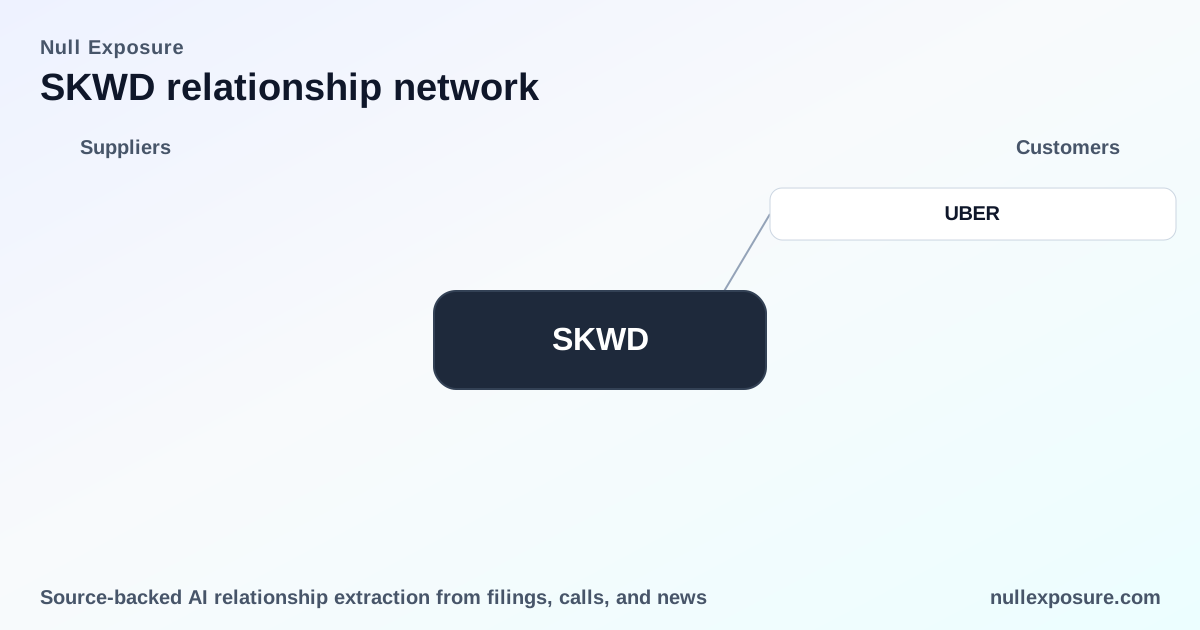
Uber — a strategic pricing and program relationship (Q4 2025 / March 2026)
Skyward describes a partnership with Uber in its Q4 2025 earnings commentary that integrates Skyward’s underwriting expertise into Uber’s pricing framework, positioning the relationship as a distinctive commercial advantage for the company. The earnings call transcript (March 2026) and subsequent coverage note that the collaboration was a deliberate outcome of Skyward’s combination with Apollo and is framed as a market-leading initiative. (Source: SKWD Q4 2025 earnings call, March 2026; transcript coverage via InsiderMonkey, March 2026.)
USA Rugby — exclusive insurance partner and front-of-jersey sponsor (FY2026 / May 2026)
In May 2026 Skyward was announced as the Exclusive Insurance Partner and Official Front-of-Jersey sponsor for all USA Rugby National Teams, a branding and distribution move that ties Skyward to a national sports franchise and expands visibility among niche commercial segments. The announcement positions Skyward as the designated insurer for that organization’s teams. (Source: USA Rugby announcement published on eagles.rugby, May 3, 2026.)
How each disclosed relationship actually reads for investors
- The Uber collaboration demonstrates platform-level underwriting integration: Skyward is not just selling standalone policies, it is embedding pricing expertise into a large enterprise’s risk program, which supports premium scale and underwriting control for complex exposures (SKWD Q4 2025 earnings call; InsiderMonkey coverage, March 2026).
- The USA Rugby arrangement is strategic marketing plus product placement: an exclusive partner/sponsorship deal that serves distribution, brand awareness, and bespoke program underwriting for a defined counterparty cohort (eagles.rugby announcement, May 2026).
Constraints that shape the operating model (and what they imply)
Public disclosures and company filings surface a consistent set of operating constraints that explain how Skyward runs its book and how durable its customer cash flows will be:
- Short-term contract posture (one-year policy terms). Policies are generally annual and premiums are earned pro rata over the policy term. This creates a renewal-driven revenue profile where growth depends on continuous client retention and yearly repricing power, which translates to high sensitivity to underwriting cycles and rate adequacy (company filing language regarding net earned premiums and policy terms).
- Large-enterprise counterparty focus in pockets. Skyward’s Global Property unit targets large, multi-jurisdictional entities with complex exposures, indicating the firm pursues higher-premium, higher-touch accounts that require tailored solutions. This elevates the importance of enterprise relationships like Uber that lock in scale and pricing influence (Global Property underwriting disclosure).
- Geographic concentration in North America. The business operates predominantly in the United States on both admitted and E&S bases, so macroeconomic, regulatory and catastrophe exposure is largely U.S.-centric; country-level concentration is a persistent business risk and a source of underwriting homogeneity (company segment disclosures).
- Dual role as seller and service provider via an MGA. Skyward Underwriters Agency (SUA), a named subsidiary, functions as a managing general agent and reinsurance broker in specialty niches, indicating Skyward controls distribution and underwriting authority for targeted markets while leveraging third-party placements where appropriate; this raises margins where MGA scale can be captured, but also creates execution dependency on agency operations (SUA disclosure).
- Services-oriented segment focus. The company defines itself as a services provider delivering tailored underwriting and claims capabilities, reinforcing that capability and bespoke product design are the firm’s competitive levers rather than commoditized pricing alone.
Together these constraints imply a business model that is customer-intimate, renewal-centric, and distribution-driven, with concentrated U.S. exposure and meaningful reliance on enterprise-grade relationships to scale specialty lines.
Concentration and criticality — what to watch on the next few quarters
Investors should track three high-impact variables tied to these relationships and constraints:
- Renewal rates and loss ratio trends on one-year programs; short-term contracts put earnings volatility front and center.
- Depth of integration and exclusivity in enterprise programs like Uber; embedded pricing and carrier status for platform risk materially affect premium volume and loss control.
- Geographic exposure to U.S. catastrophe seasons and changing admitted/E&S regulatory environments that can compress capacity or shift margin profiles.
Key risk items to monitor:
- Dependence on a handful of large enterprise arrangements for premium growth and the operational strain of complex programs.
- Brand and reputation risk from public partnerships (for example, a sponsor relationship that becomes a liability).
- Execution risk in scaling the MGA model without diluting underwriting discipline.
Competitive advantage and downside protections
Skyward’s advantages derive from specialized underwriting expertise, MGA distribution control, and targeted enterprise partnerships that create higher barriers to entry in niche markets. Counterbalancing these are short contract terms and U.S.-centric concentration. The firm’s financial metrics (noted revenue and profitability) show a functioning underwriting platform, but the business is structurally exposed to the annual renewal cycle and the insurance pricing cycle.
Bottom line for investors
Skyward is a specialty P&C underwriter that converts technical underwriting skill into commercially meaningful scale through enterprise partnerships and an MGA distribution model. Uber represents a programmatic, pricing-integrated customer that signals Skyward’s ability to design embedded solutions for large platforms; USA Rugby shows a complementary brand-and-distribution tactic that extends reach into niche commercial segments. Both relationships underscore a strategy centered on tailored products and renewal-led monetization.
For deeper signals and ongoing tracking of Skyward’s counterparty relationships and how they influence underwriting outcomes, visit https://nullexposure.com/ for continuous coverage and relationship-level insight.