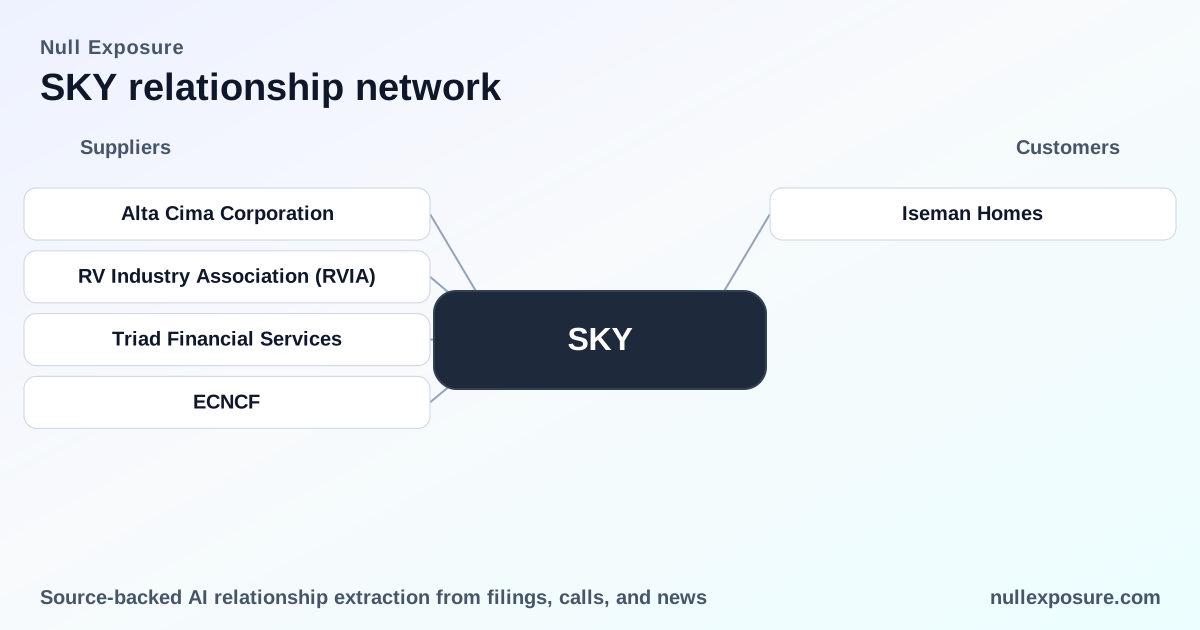
Skyline Champion (SKY) — customer relationships and operating constraints investors need to know
Skyline Champion Corporation is a North American factory-built housing manufacturer that monetizes through the production and sale of manufactured and modular homes via a mix of independent retailers and company-owned sales centers, plus ancillary services including repurchase arrangements and long-form product guarantees. Revenue is driven by high-throughput manufacturing, a broad retail footprint, and financing/repurchase mechanics that convert inventory into sustained cash flow. Explore detailed customer ties and the company-level constraints that shape revenue stability and liability exposure. For more on source aggregation and relationship signals, visit https://nullexposure.com/.
How Skyline actually sells houses and earns the margin
Skyline constructs homes in indoor assembly-line facilities and distributes them through a network that includes 72 retail sales centers, independent retailers, community operators, builder/developers, and government buyers. Product economics are unit-driven (average selling prices around $93k in the U.S. in fiscal 2025), supported by manufacturing scale (43 U.S. plants, 5 in western Canada) and warranty/repurchase frameworks that shift certain credit and inventory risks. Fiscal 2025 net sales were approximately $2.5 billion and gross profit was $702 million; the business trades at roughly a mid-teens EV/EBITDA multiple on the latest reported figures.
Customer relationships surfaced in public coverage
BETR — a strategic capital and ecosystem tie (FY2026)
BETR is reported to be integrating into a Sky-backed ecosystem through Obex, an incubator administered by Framework Ventures, with a $2.5 billion commitment from Sky to back Sky-focused initiatives. A HousingWire report described capital flowing directly from the Sky ecosystem to Better, rather than through traditional warehouse or securitization channels, positioning the Sky commitment as a strategic financing construct rather than a simple supplier or buyer relationship. — HousingWire / ADVFN coverage, March 2026 (https://www.housingwire.com/articles/better-sky-stablecoin-credit/; https://mx.advfn.com/bolsa-de-valores/NASDAQ/BETR/noticias/97895618/better-and-framework-ventures-announce-strategic-p).
Iseman Homes — an incremental retail volume opportunity (FY2025)
Management cited Iseman Homes among key customers and characterized an estimated $40 million opportunity as incremental volume that Skyline expects to convert over time from competitors, highlighting active commercial upsell within existing customer relationships. This signals repeatable retail conversion potential rather than one-off demand. — Q4 2025 earnings call transcript coverage, InsiderMonkey, March 2026 (https://www.insidermonkey.com/blog/skyline-champion-corporation-nysesky-q4-2025-earnings-call-transcript-1542436/).
Evergreen Recreational Vehicles LLC — historical brand production link (FY2022)
Public reporting notes that Skyline produced certain towable RV brands (Nomad, Layton, Aljo, WeekEnder) before those assets were sold in 2014 to Evergreen Recreational Vehicles LLC, a now-defunct northern Indiana firm; this relationship is historical and reflects prior product-line diversification. The Evergreen tie is legacy and not a current revenue driver. — Local industry reporting, RVBusiness, May 2026 (https://rvbusiness.com/elkhart-community-holds-celebration-of-life-for-art-decio/).
Contracting posture and business-model constraints you must price
Skyline’s commercial model blends short-cycle order flow with long-tail contractual liabilities:
- Contract duration and cancellation: Orders are typically cancellable up to production start and are generally filled within ~90 days in normal demand environments, which creates short-term revenue variability but limits long-dated order commitments. This short-cycle posture supports inventory turnover and responsiveness to demand swings.
- Long-term warranty exposure: The company offers product guarantees that provide contractual liability for proven construction defects up to 12 years, establishing a long-tailed warranty exposure that investors must reserve for and monitor.
- Counterparty mix: The retail footprint and sales-center network indicate a significant portion of customers are individual consumers through company-owned and independent channels, which increases revenue granularity but also ties sales to consumer credit and housing demand cycles.
- Geographic concentration: Skyline is a North America-focused business: U.S. sales dominate and Canadian operations represented roughly 4–6% of consolidated sales in recent years, concentrating macro and policy risk regionally.
- Materiality of repurchases: Historically, losses on home repurchases were immaterial, while the company discloses a contingent repurchase obligation estimated at $241.9 million (excluding resale value) and a related loss reserve of $1.6 million at March 29, 2025 — a capital consideration for downside scenarios.
- Segment and operational maturity: Manufacturing is the core segment with established production footprints and standard assembly-line staffing profiles; the business shows mature industrial characteristics with steady margins and mid-single-digit operating leverage benefits.
- Spend bands: Unit economics show meaningful per-transaction value (US ASP about $93,300), implying that customer-level churn has a material P&L impact even if individual customers are consumers rather than large enterprises.
These constraints combine into a contracting posture that is transactional for new orders, but contractual and long-dated for liability (warranty/repurchase) — a dynamic that shapes working capital, reserve policy, and cash cycle management.
For a consolidated view of relationship signals and constraints relevant to counterparty assessment, see more at https://nullexposure.com/.
Investment implications — concentration, criticality, and risk profile
- Concentration: Revenue depends on many small consumer purchases plus a set of independent retailers and community operators; no single listed customer dominates, but retail channel performance is critical to topline stability.
- Criticality: Manufacturing capacity and dealer relationships are operationally critical; supply-chain or plant disruptions would compress revenue quickly given the short order-to-production cycle.
- Maturity: The core manufacturing business is mature and capital-intense, with predictable unit economics and an established warranty tail that requires steady reserve discipline.
- Valuation context: Market capitalization sits around $4.04 billion vs. fiscal 2025 revenue near $2.6 billion; EV/EBITDA of ~11.2 and a trailing P/E around 20.5 reflect investor expectations of steady, cyclical performance rather than hyper-growth.
Bottom line
Skyline Champion operates a scale manufacturing business with unit-driven revenue, short order cycles, and long-term warranty obligations that together govern cash flow durability and downside risk. The customer relationships documented in recent coverage range from strategic ecosystem funding links (BETR) to incremental retail conversion opportunities (Iseman Homes) and historical brand production ties (Evergreen RV) — each offering a distinct signal for revenue pathways or legacy exposure. For analysts building counterparty risk profiles or modeling warranty liabilities, the mix of short-term cancellable orders and 12-year defect guarantees is the critical structural feature to model.
If you want a tailored rundown of how these customer relationships map to counterparty credit risk and expected cash flow volatility, visit https://nullexposure.com/ for subscription access to linked source material and relationship dashboards.