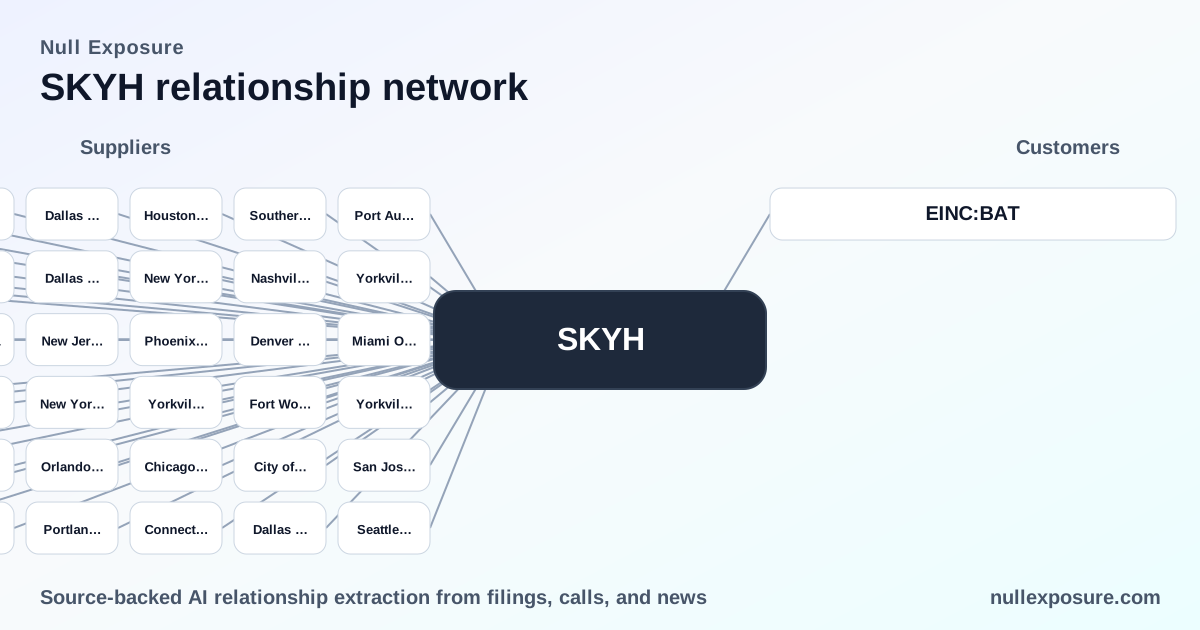
Sky Harbour (SKYH): Customer Relationships and What They Signal for Investors
Sky Harbour builds, owns and operates commercial aviation hangars and monetizes primarily through long-term lease contracts and ancillary services at U.S. airports. The business model centers on developing concentrated, high-margin infrastructure—home-basing hangars—where revenue is generated from predictable rental streams, ancillary fees and selective ramp-space monetization. For investors evaluating customer relationships, the mix of tenant types, geographic concentration and periodic capital transactions to support liquidity are the primary drivers of credit and growth outlooks. For further corporate relationship intelligence, visit https://nullexposure.com/.
Quick take: concentrated cash flows, infrastructure economics, and capital-period behavior
Sky Harbour’s economics are driven by lease-backed, infrastructure-oriented revenue rather than transaction-level aviation services. That creates forward visibility in cash flow but also tenant concentration risk: the company disclosed that its two largest tenants generated roughly 30% of revenue in 2023. Sky Harbour is a U.S.-focused operator with active campuses showing high occupancy, yet the firm supplements balance-sheet liquidity with equity issuances when required. These dynamics frame how each customer and counterparty interaction affects valuation and operational risk.
Customer and counterparty relationships observed in recent reporting
NBAA — short-term event tenancy and operational marketing
Sky Harbour referenced renting an empty lot in Miami to the National Business Aviation Association (NBAA) for regional conferences and receiving conference passes in kind as part of that arrangement. This indicates Sky Harbour uses occasional event and temporary-space rentals as a complementary revenue and marketing channel, rather than a core recurring lease relationship. The comment was made in an earnings call transcript published May 2026 on Investing.com.
Yorkville — direct equity placement counterparty (December 2025)
Sky Harbour issued 50,000 shares of Class A common stock to Yorkville on December 15, 2025 as part of a registered direct offering described in a company release carried by The Globe and Mail in March 2026. That issuance is a capital-market relationship used to enhance liquidity and support corporate operations rather than a tenant relationship; it is material to how management manages funding for development and operations.
Yorkville — subsequent equity issuance (February 2026)
A second reference shows Sky Harbour issued 40,000 shares of Class A common stock to Yorkville on February 3, 2026, reported by TradingView. This follow-on issuance underscores an ongoing liquidity and financing relationship with Yorkville across the 2025–2026 period and suggests management’s willingness to use equity placements to shore up capital resources during development and occupancy ramp phases.
EINC:BAT — related reported counterparty for the December 2025 issuance
One report attributes the December 15, 2025 share issuance to a counterparty labeled EINC:BAT (as presented in media coverage), which corresponds to the same registered direct offering described in the Globe and Mail press release. The entry highlights that Sky Harbour used registered direct share issuances to institutional counterparties in the second half of FY2025 to enhance liquidity.
What these relationships collectively reveal about Sky Harbour’s operating model
- Contracting posture: long-term lease orientation. The company states tenant lease terms generally run 1–10 years with staggered maturities, which produces revenue predictability but creates sensitivity to occupancy rates and the market for large, long-duration leases.
- Geographic concentration: U.S.-centric exposure. Management derives all revenue from U.S. tenants, which simplifies regulatory and market exposure but concentrates macro and regional airport risk within the U.S. aviation ecosystem.
- Tenant mix and counterparty types: diversified by tenant class, not by geography. Tenants include individual owners, charter operators, flight schools, corporate fleets and government entities, producing a spectrum of tenant credit profiles and payment behaviors.
- Materiality and concentration risk: meaningful single-counterparty exposure. The disclosure that two tenants contributed about 30% of revenue in 2023 is a structural concentration that increases earnings volatility if one large tenant vacates or renegotiates terms.
- Relationship stage and utilization: active and revenue-generating. Management reports economic occupancy greater than 100% at many campuses through semi-exclusive arrangements and ramp-space optimization, indicating efficient short-term utilization of space.
- Segment orientation: infrastructure-first with ancillary services. Sky Harbour defines itself as an aviation infrastructure developer, with ancillary services and products supplementing lease revenues.
These are company-level signals drawn from public filings and investor materials; they are not assigned to any single relationship unless a specific excerpt names the counterparty.
Implications for investors and operators
- Stability with concentration risk: The long-term lease model provides stable cash flows when occupancy is sustained, but tenant concentration is the dominant downside risk. Underwriting and covenant protections for large tenants deserve scrutiny.
- Capital cadence is important: The equity placements to Yorkville across Dec 2025–Feb 2026 are direct evidence management will access public and private capital markets to support liquidity and development; investors should monitor dilution risk and timing of further capital raises. (See The Globe and Mail, March 2026 and TradingView, February 2026.)
- Operational execution matters more than cyclical demand: Because revenue depends on physical hangar development and leasing execution, construction timelines and permit risk at target airports are as material as broader business aviation demand cycles.
- U.S.-only revenue creates concentrated macro exposure: Any regulatory, tax or regional demand shift in key U.S. hangar markets will directly affect top-line performance.
Valuation context and investor checklist
Sky Harbour’s public metrics reflect growth-stage infrastructure economics: market capitalization roughly $785M vs. revenue of ~$27.5M TTM, with elevated valuation multiples (P/S ~28.5, EV/Revenue ~25.6). These multiples price high growth and execution; investors must weigh that premium against occupancy, tenant concentration and the company’s negative consolidated gross profit history reported in recent financials. Review lease maturity schedules, tenant credit profiles, and planned development financing before underwriting upside.
Bottom line and next steps
Sky Harbour operates a lease-centric aviation infrastructure business that offers highly visible revenue streams but real concentration and financing sensitivities. The company’s use of direct share issuances to Yorkville in late 2025 and early 2026 highlights active balance-sheet management to support growth and liquidity. For deeper relationship intelligence and ongoing monitoring of counterparties and capital actions, see https://nullexposure.com/.
Key sources referenced above include the Sky Harbour earnings call transcript (Investing.com, May 2026), press releases covered by The Globe and Mail (reported March 2026) and TradingView reporting from February 2026.