Sky Quarry (SKYQ): customer relationships, operational posture, and what investors should price in
Sky Quarry is a small-cap integrated oil and remediation operator that earns revenue by refining and selling petroleum products and offering remediation services. The company’s monetization is straightforward: refined products (diesel, vacuum gas oil, naphtha and asphalt/paving liquids) are produced at operating facilities and sold to wholesale, bulk and retail customers under a mix of spot purchases, short-term and long-term contracts; revenues are recognized at a point in time when product title transfers. For investors, the commercial profile combines commodity-like volatility from spot sales with discrete counterparty concentration risk from its largest customers. For additional context on this sector and comparable customer analyses, visit Null Exposure.
Operational and financial context Sky Quarry reports modest revenues (Revenue TTM ~$12.5m) and negative margins and EBITDA, reflecting a business still wrestling with scale and profitability. The company’s core cash generation comes from Foreland Refinery operations, while other facilities such as PR Spring are currently not producing. Insider ownership is meaningful relative to float, and institutional ownership is low—factors that influence liquidity and governance outcomes.
How Sky Quarry sells and who pays Company disclosures and operational descriptions make a clear case for a mixed contracting posture: product is sold under purchase orders, master services agreements or similar framework arrangements, and the company actively sells through both short-term and long-term contracts as well as on the spot market. That mix creates revenue flexibility but also price and volume volatility, and the filing for the year ended December 31, 2024 highlights meaningful customer concentration that is material to results.
Customer relationships on the public record
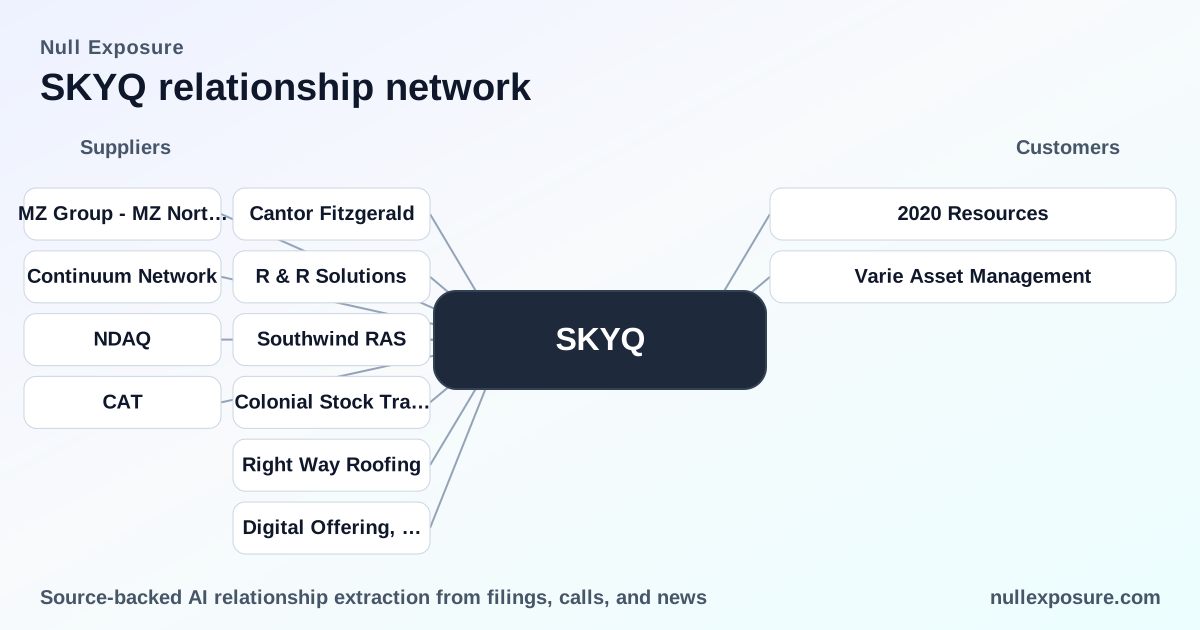
2020 Resources — exploratory discussions on technology deployment According to a Utah Business profile published February 27, 2025, 2020 Resources, a private energy company focused on environmentally sustainable oil production, approached Sky Quarry to explore implementing Sky Quarry’s technology at its facility, indicating potential facility-level collaboration or pilot work on remediation or processing capabilities (Utah Business, Feb 27, 2025). https://www.utahbusiness.com/entrepreneurship/2025/02/27/david-sealock-co-founded-sky-quarry/
Varie Asset Management — equity purchase facility and termination A TradingView report in March 2026 noted that Sky Quarry had an equity purchase facility with Varie Asset Management that allowed Sky Quarry to require Varie to buy up to $8,125,000 of common stock, and Varie received 366,260 shares as a commitment fee; Sky Quarry later terminated the equity purchase agreement, reflecting a financing attempt that reached documentation and consideration stages but did not result in an ongoing funding commitment (TradingView, Mar 2026). https://www.tradingview.com/news/tradingview:8f2650730bc79:0-sky-quarry-terminates-equity-purchase-agreement-with-varie-asset-management/
What the relationship map implies for valuation and risk
- Contracting posture drives revenue volatility. The company sells into the spot market as well as under short- and long-term contracts and occasional framework agreements (MSAs), which means revenue can swing with product pricing and spot demand while some cash flows remain predictable from contracted customers.
- Customer concentration is a material business risk. For the year ended December 31, 2024, three customers accounted for approximately 35%, 23% and 22% of net sales respectively; those customers lack ongoing purchase commitments in many cases, and the loss or sustained reduced demand from any one could have a substantial adverse effect. This is a company-level signal that should be priced into any cash-flow forecast.
- Geographic concentration in North America increases regional exposure. Refined products are distributed primarily across Nevada, Utah and California and other North American jurisdictions, concentrating exposure to regional demand cycles, environmental rules and transport logistics.
- Seller-centric performance model. Sky Quarry’s revenues are derived from product sales recognized at transfer of title — a classic seller role rather than a service-subscription model — which emphasizes inventory, working capital, and logistics as the operational levers.
- Operations and maturity. Foreland Refinery is the only operating source of revenues at present; PR Spring is not in operation. That centralization of assets increases the operational criticality of a single facility and elevates uptime and maintenance risk.
Key takeaways for investors
- Revenue fragility and concentration require premium risk-adjusted returns. With three customers accounting for the majority of sales in 2024 and without guaranteed purchase commitments, investors should assume a heightened probability of revenue shocks absent new long-term contracts or a broader customer base.
- Financing attempts show capital needs but also execution limits. The equity purchase facility with Varie Asset Management and its subsequent termination demonstrate active attempts to secure growth capital or liquidity, but also the reality that not all financings complete or persist. Monitor any new committed financing or equity facilities as immediate liquidity signals.
- Operational leverage to refining economics matters more than product innovation. The company’s core product segment is refined crude oil; margin improvement will come mostly from throughput, yield and logistics efficiencies rather than repeated technology sales. Pilots or collaborations—like the outreach from 2020 Resources—are meaningful only if they convert to recurring feedstock or remediation contracts.
What to watch next
- New long-term off-take or framework agreements that reduce customer concentration.
- Operational updates from Foreland Refinery and any progress toward bringing PR Spring online.
- Any fresh committed financing that replaces or supplements the terminated Varie facility.
- Execution of collaborations with counterparties such as 2020 Resources that convert exploratory talks into operating contracts.
Actionable monitoring checklist
- Confirm whether the company signs multi-year MSAs or long-term off-take contracts with key buyers.
- Track quarterly revenue segmentation to see if the top three customers’ shares decline from the 2024 levels cited in company filings.
- Watch cash position and any filings related to equity facilities or debt instruments.
Conclusion Sky Quarry is a small, operationally concentrated refined-products seller whose near-term outlook hinges on stabilizing cash flow via longer-term customer commitments or securing dependable financing. The public relationship record — exploratory technical discussions with 2020 Resources and a terminated equity facility with Varie Asset Management — tells a clear story: management is pursuing growth and liquidity, but execution and contract conversion are the immediate risk vectors investors must monitor closely. For an ongoing feed of customer-relationship intelligence and structured investor research, visit Null Exposure.