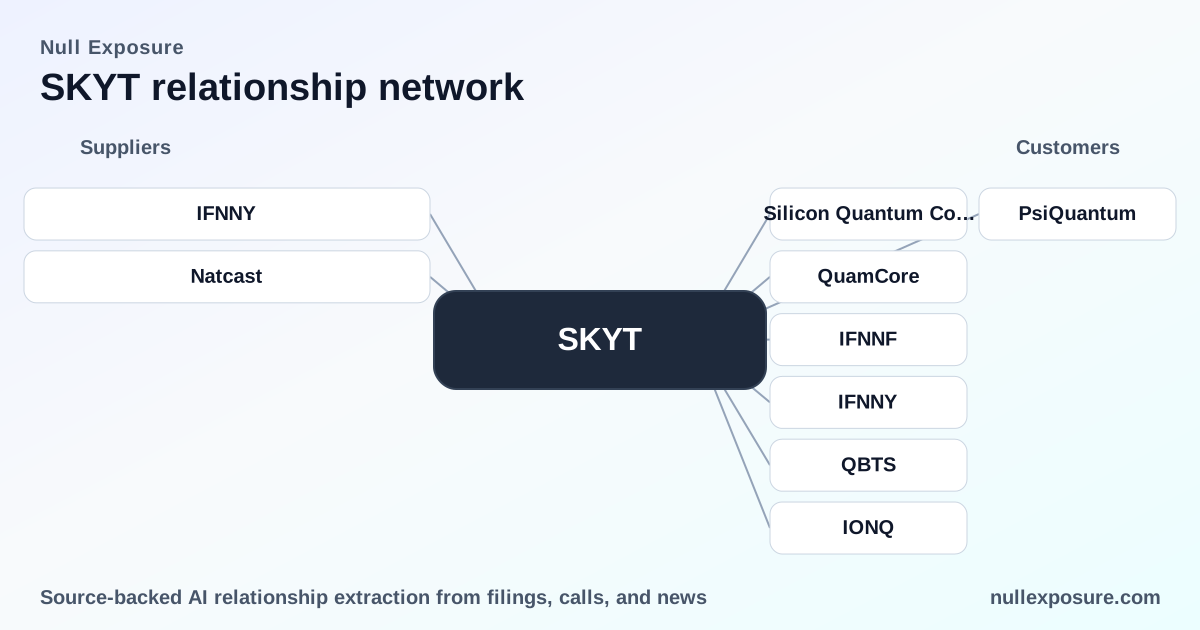
SkyWater (SKYT) — Customer Map and Strategic Implications for Investors
SkyWater is a U.S.-based pure-play semiconductor foundry that monetizes through wafer fabrication, advanced packaging and a Technology-as-a-Service (TaaS) model that co-develops process IP with customers. The company generates revenue from a mix of volume wafer services, consumption-based ATS engagements, and multi-year government and commercial contracts; recent partnership activity and an Infineon-backed Fab 25 transaction materially increase revenue visibility while concentrating strategic exposure in a handful of large counterparties. For a consolidated view of SkyWater’s customer footprint and commercial posture, visit the NullExposure index hub: nullexposure.com.
Why customers determine valuation more than the fab itself
SkyWater’s business model combines capital-intensive manufacturing with service-led customer relationships. That combination creates four investor-relevant dynamics: contract heterogeneity (usage-based, fixed-price milestones, and occasional operating leases), customer concentration (a few large accounts drive material revenue), U.S.-centric criticality for defense and secure-supply programs, and revenue visibility that improves with multi-year supply agreements and strategic fab acquisitions. These characteristics mean upward valuation surprise comes from large, long-term supply contracts and capacity expansion, while downside risk concentrates around lost large customers or shifts in strategic ownership of the foundry.
Before we walk the roster, note that SkyWater’s 2024 revenue base ($342.3M recognized in the U.S. vs $342.3M total in FY2024) and FY2024 disclosures show three customers account for a significant portion of sales, a concentration investors must weigh when modelling downside scenarios.
Operating constraints and what they imply for investors
- SkyWater contracts range from short-term, order-by-order arrangements (the company states it generally does not obtain firm long-term purchase commitments) to longer-term instruments and operating leases (the company has recognized deferred revenue tied to an operating lease with a multi-year term). These mixed contracting postures create both upside from short-term demand capture and downside from forecast error.
- The firm serves government counterparty programs and lists significant USG contracts, which enhances revenue durability but also introduces program-specific compliance and execution risk.
- Geography is predominantly North American, with the company positioning itself as a U.S.-based secure foundry, while also competing internationally; expect contract flows to be weighted to domestic customers for national-security sensitive work.
- Materiality of large accounts and $100M+ program scale (DoD-related awards cited in filings imply multi-year awards in the tens to hundreds of millions) means a small set of clients will move top-line forecasts materially.
- SkyWater’s commercial posture is active and manufacturing-led, supported by TaaS co-development services that create stickiness via process IP collaboration.
If you want a navigable dossier of SkyWater’s customers and related citations, NullExposure maintains the investor-grade relationship register at nullexposure.com (explore the SkyWater customer map there).
Relationship register: every cited customer and what it means
-
QuamCore — SkyWater named QuamCore as one of four new quantum customers on its 2025 Q3 earnings call, signaling an explicit push into quantum foundry services. Source: SkyWater 2025 Q3 earnings call (first seen Mar 2026).
-
Silicon Quantum Computing (SQC) — SQC was also disclosed as a new quantum customer on the same 2025 Q3 earnings call, reinforcing SkyWater’s role as a leading quantum foundry partner. Source: SkyWater 2025 Q3 earnings call (2025 Q3).
-
IFNNF (Infineon-related filing) — SkyWater’s FY2024 10‑K reports Infineon accounted for 7% of revenue in FY2024 and notes a Membership Interest Purchase Agreement with a Spansion affiliate, indicating a material commercial and transactional relationship. Source: SkyWater 2024 Form 10‑K (FY2024).
-
Infineon Technologies AG — The FY2024 filing details a Purchase Agreement with an Infineon affiliate, evidencing a strategic legal and commercial linkage between SkyWater and Infineon. Source: SkyWater 2024 Form 10‑K (filed Dec 2024).
-
IONQ (news commentary) — Market commentary frames IonQ’s planned SkyWater acquisition as a move to secure domestic supply and accelerate product iteration, which would vertically integrate IonQ’s quantum stack with SkyWater’s fabs. Source: TradingView/Zacks coverage on IonQ and SkyWater (FY2026 commentary).
-
D-Wave Quantum Inc. — FinancialContent analysis warns that D-Wave and similar firms historically relied on SkyWater as a neutral third-party foundry and could face competitive risk if ownership changes; this highlights strategic vulnerability for legacy customers. Source: MarketMinute on IonQ’s SkyWater deal (Feb–Mar 2026).
-
QBTS (D‑Wave ticker references) — Media coverage repeats the concern that D‑Wave’s primary fabrication partner being acquired by a rival introduces execution and competitive risk for D‑Wave’s supply chain. Source: MarketMinute and BlockchainReporter commentary (FY2026).
-
IFNNY (Infineon commentary on Fab 25) — Analyst and investor notes describe an Infineon-backed multi-year $1B supply agreement tied to the Fab 25 acquisition that materially expands domestic 200mm capacity and revenue visibility for SkyWater. Source: SimplyWall.St coverage of Fab 25 and Infineon agreement (FY2026).
-
IonQ (analyst expectations) — Coverage states analysts project the first SkyWater-produced IonQ chips by 2027, with integrated microwave and cryo-CMOS elements intended to scale qubit counts—this underlines the transaction’s product-level ambitions. Source: FinancialContent/Market commentary on IonQ-SkyWater (FY2026).
-
QBTS (BlockchainReporter) — Analysts and bloggers flagged that IonQ’s acquisition of SkyWater represents unpriced competitive risk to D‑Wave, reinforcing asymmetric market reaction in quantum peers. Source: BlockchainReporter analysis (May 2026).
-
QBTS (TechI / Insider commentary) — D‑Wave executives have said SkyWater fabricates wiring for annealing devices but not the most IP-sensitive Josephson junctions; this nuance changes how critical SkyWater is to some superconducting designs. Source: D‑Wave Q4 2025 comments and TechI summaries (FY2026).
-
PsiQuantum — Market commentaries list PsiQuantum alongside D‑Wave as historically relying on SkyWater as a neutral foundry, placing them in a sensitive position if SkyWater changes ownership or strategic posture. Source: MarketMinute and industry pieces on IonQ’s acquisition (FY2026).
-
IONQ (TelecomTV) — Press reporting describes IonQ’s $1.8B cash-and-stock deal to internalize semiconductor fabrication and create a vertically integrated quantum platform, positioning SkyWater as core to IonQ’s strategy. Source: TelecomTV coverage of IonQ’s acquisition (Mar 2026).
-
IONQ (IonQ earnings commentary) — In IonQ’s 2025 Q4 remarks, executives described SkyWater as the leading commercial quantum foundry supporting IonQ and multiple Department of Defense programs, validating SkyWater’s role across both commercial and government work. Source: IonQ 2025 Q4 earnings call (2025 Q4).
-
IONQ (247WallStreet) — Equity commentary frames the SkyWater acquisition as part of IonQ’s vertical integration to create a full-stack platform, an argument used in bullish investment narratives. Source: 247WallStreet coverage (Apr 2026).
-
IONQ (ts2.tech) — Industry reporting quotes IonQ management saying buying SkyWater secures a fully scalable domestic supply chain, emphasizing national-security and supply-resilience themes. Source: TS2 Tech analysis of regulatory and strategic context (May 2026).
-
QBTS (InsiderMonkey transcript) — D‑Wave’s earnings transcript clarifies SkyWater fabricates certain wiring for annealing chips but not the Josephson junctions, which remain critical IP for superconducting qubits. Source: D‑Wave Q4 2025 earnings transcript (FY2026).
-
Infineon (10‑K revenue breakout) — SkyWater’s FY2024 10‑K discloses United States revenue of $329.0M and lists Infineon as contributing materially to fiscal results in 2023–24, underlining the concentration and domestic orientation of revenue. Source: SkyWater 2024 Form 10‑K (FY2024).
Investment takeaways
- Concentration and strategic customers drive both upside and asymmetric downside: a handful of large commercial and government relationships materially affect revenue visibility.
- A mix of short-term and long-term contracts creates potential for rapid revenue swings but also creates pathways to more predictable topline via multi-year supply agreements (e.g., Fab 25/Infineon coverage).
- Quantum verticalization is a double-edged sword: IonQ’s acquisition of SkyWater would give SkyWater downstream integration and deeper R&D tie-ins but also shifts its neutral-foundry status for other quantum customers—this is a near-term commercial risk to certain incumbents.
- Government programs and domestic capacity are strategic assets; modeling should reflect higher defense-related contract stickiness but also program execution risk and regulatory scrutiny in M&A scenarios.
For a detailed, interactive mapping of SkyWater’s customer relationships and to download the full relationship register, see NullExposure’s SkyWater page at https://nullexposure.com/.