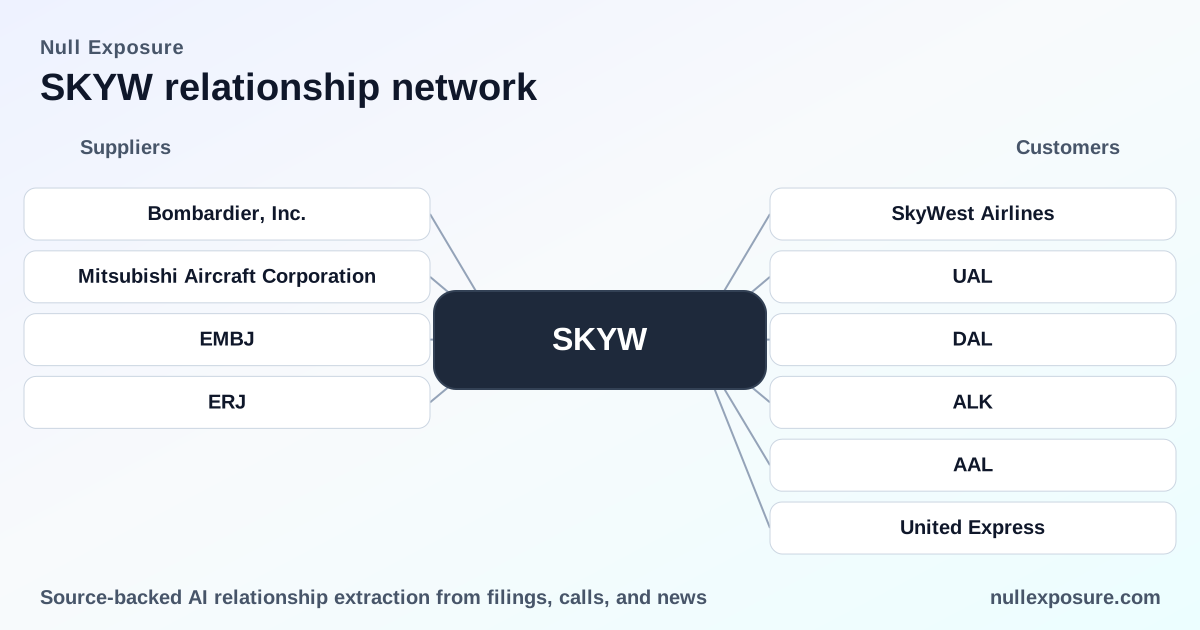
SkyWest Inc (SKYW) — Customer Map and Commercial Thesis
SkyWest operates and monetizes as a regional airline service provider: it runs aircraft under long‑term, fixed‑fee capacity purchase and code‑share agreements with major U.S. carriers, capturing stable contracted cash flow from flying rather than direct ticket sales. The business converts airline network demand into predictable, fee‑based revenue through aircraft operations, fleet placement and contract extensions with large carriers. For deeper corporate relationship analytics see https://nullexposure.com/.
Why investors should care: durable cash flows anchored to major carriers
SkyWest's economics are defined by contract structure and counterparty concentration. Long‑term, fixed‑fee agreements with United, Delta, American and Alaska secure the bulk of flying revenue, reducing direct exposure to ticket pricing while concentrating operational risk around a handful of global airlines. The company monetizes through operating scale, fleet optimization (E175s, CRJ conversions) and negotiated extensions that lock in future utilization and revenue visibility.
- Key financial context: revenue TTM ~$4.12B, EBITDA ~$967M and a trailing P/E near 8.0, reflecting a service business with high counterparty concentration and predictable earnings.
- Actionable point: for credit and equity investors, the real driver of SkyWest’s risk profile is counterparty durability and contract design; monitor contract renewals and aircraft delivery schedules.
Explore enterprise relationship intelligence at https://nullexposure.com/ for an institutional view.
The actual relationships that drive SkyWest’s revenue
Below I list every counterparty referenced in the compiled signals and summarize SkyWest’s commercial link with each, with concise source references.
SkyWest Airlines (internal operating unit)
SkyWest Airlines is the company’s operating subsidiary that performs scheduled regional flying under code‑share and capacity purchase arrangements; the FY2024 10‑K explicitly states major carriers bear fuel price risk on contracted flights. Source: SkyWest FY2024 10‑K (filed 2025 / referenced Feb 2026).
United Airlines / United Express (UAL)
SkyWest operates a large United Express footprint under capacity purchase and code‑share agreements, including a multiyear extension for 40 E175s announced January 2026, delivery of five E175s in Q4 2025, and an agreement to operate 50 CRJ550s for United. SkyWest is also converting CRJ200s into dual‑class CRJ450s and planning a dual‑class product rollout for United service. Sources: InsiderMonkey and TradingView coverage (March 2026); Q1 2026 earnings transcript and Investing.com earnings coverage (May 2026).
Delta Air Lines / Delta Connection (DAL)
SkyWest secured a multi‑year extension for 13 E175s with Delta in January 2026, reinforcing its role as a Delta Connection operator and preserving contracted flying through the end of the decade. Source: InsiderMonkey and Yahoo/TradingView reports (March 2026).
American Airlines / American Eagle (AAL)
SkyWest has initiated a prorate agreement with American, operating a handful of aircraft today with a small ramp planned through 2026 (reported operating 4–6 aircraft and guidance of up to 9 aircraft by year‑end 2026). Source: SkyWest Q4 2025 earnings call transcript and Investing.com coverage (March–May 2026).
Alaska Airlines / Alaska Horizon (ALK)
SkyWest provides regional flying for Alaska (branded Alaska Horizon), including recent E175 deliveries and placements; management reported placing nine new E175s into service for United and Alaska by the end of 2026, and a Q1 2026 delivery for Alaska. Source: SimpleFlying and Investing.com earnings coverage (FY2025–FY2026 reporting).
United Express (brand)
As the label under which SkyWest operates United flights, United Express represents the practical manifestation of SkyWest’s United capacity purchase agreements and route expansion into smaller markets (for example, new service launches referenced in company commentary). Source: SimplyWall.st and Marketscreener reporting on network expansion (2025–2026).
Delta Connection (brand)
This code‑share brand is the platform for SkyWest’s Delta flying; contract extensions and E175 assignments tie SkyWest’s fleet plan directly to Delta’s regional capacity needs. Source: TradingView and InsiderMonkey news summaries (March 2026).
American Eagle (brand)
SkyWest’s interactions under the American Eagle banner are currently limited to prorate arrangements rather than full CPA scope, representing a modest incremental revenue channel as SkyWest scales that relationship through 2026. Source: Q4 2025 earnings call transcript and InsiderMonkey (March–May 2026).
Alaska Horizon (brand)
SkyWest operates aircraft and places E175s for Alaska under the Alaska Horizon brand; recent fleet placements indicate a continuing operational relationship and aircraft allocation for Alaska’s regional network. Source: SimpleFlying (March 2026) and Investing.com (May 2026).
Operational constraints and what they imply for investors
SkyWest’s public disclosures and commentary generate a clear set of company‑level operating signals:
- Contracting posture — long‑term, fixed‑fee CPAs dominate. Management states the company “generally provide[s] regional flying… under long‑term, fixed‑fee, code‑share agreements,” which creates predictable fee streams but locks SkyWest into capacity obligations. Evidence: FY2024 10‑K (contract language).
- Counterparty profile — large enterprise counterparties. Contracts are with major global carriers, which reduces counterparty credit dispersion but concentrates exposure to airline network and procurement decisions.
- Geographic footprint — North America focused. SkyWest serves the U.S., Canada and Mexico, which centralizes regulatory, fuel and demand risk within North America.
- Materiality — contracts are critical to revenue. Company reporting shows approximately 87% of flying agreements revenue relates to capacity purchase agreement flights, making the CPA portfolio the core economic driver.
- Relationship role and stage — active service provider with an active fleet. Management disclosed 624 total aircraft in the fleet with 492 in scheduled service or under contract as of Dec 31, 2024, indicating an operationally mature, active role in regional flying.
- Segment orientation — services rather than retail airline economics. The business sits in the services segment: fixed‑fee flying plus fleet allocation and operator margins.
Investment implications and risks
SkyWest trades with attractive multiples relative to cash flow (EV/EBITDA ~7.9) but carries concentration risk: a small set of large carriers drives the majority of contracted flying. Fleet execution risk (E175 deliveries, CRJ conversions) and contract renewal cadence are primary value levers. Monitor carrier contract renewals, aircraft delivery timing and any shifts in capacity purchase pricing mechanics.
If you want a structured heat map of these commercial linkages for due diligence or portfolio monitoring, NullExposure provides analyst‑grade relationship intelligence and monitoring — see https://nullexposure.com/.
Bold takeaways: SkyWest converts major‑airline network demand into fixed‑fee cash flows via long‑term CPAs; the company's value is a function of contract durability, fleet execution and concentrated counterparty exposure.