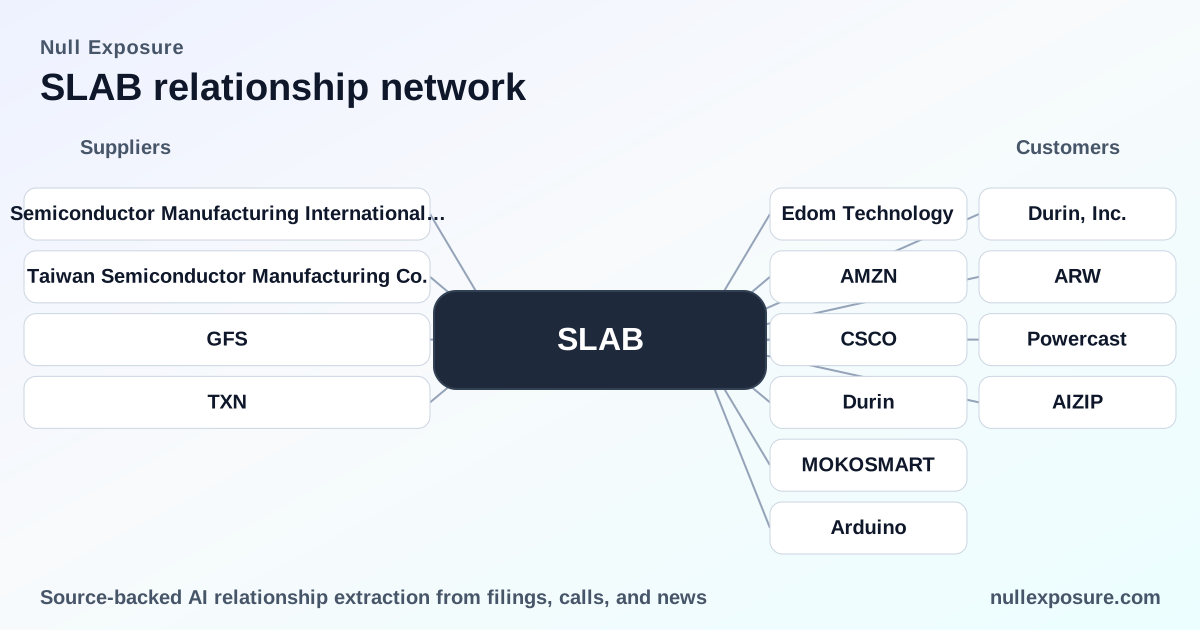
Silicon Labs (SLAB) — Customer Relationships That Drive Revenue and Concentration Risk
Silicon Laboratories operates as a factory-less semiconductor company that designs and licenses mixed‑signal integrated circuits for wireless and IoT applications and monetizes by selling these ICs to OEMs, contract manufacturers and a global network of distributors. Revenue is generated on a per‑unit basis through direct sales and distributor channels; the company reported roughly $784.8M revenue TTM with notable distributor concentration where Arrow and Edom together accounted for a majority of fiscal 2025 distributor-driven revenue. For investors, the revenue engine is predictable when design wins convert to volume, but distribution concentration and short‑term sales contracts create distinct execution and pricing risks.
For deeper relationship mapping and signals, visit https://nullexposure.com/.
Why the customer map matters for valuation
Silicon Labs’ commercial model combines highly technical product stickiness with a largely transactional go‑to‑market posture. The company relies on design‑wins that create mid‑ to long‑term product usage, but it sells primarily on short‑term or spot purchase orders and pushes volume through distributors. That hybrid dynamic produces three investment-relevant characteristics:
- Contracting posture: The company discloses that many customer engagements are short‑term and purchased via individual orders rather than long‑term contracts; management does not disclose material unsatisfied performance obligations because many contracts have original durations under one year.
- Concentration and channel risk: Distributors are central to scale—Arrow and Edom together represented a combined 49% of fiscal 2025 revenue through the distribution channel—concentrating counterparty and operational risk.
- Criticality and maturity of relationships: Design‑win economics give Silicon Labs durable end‑customer positions once a high‑volume design is in production; the company itself notes customers are reluctant to change designs after production ramps, implying sticky installed bases even though initial procurement is transactional.
- Global footprint: The company derives a large majority of revenue outside the U.S. (91% in fiscal 2025), making top‑line outcomes sensitive to global industrial cycles and regional supply‑chain shifts.
The customer roster — relationship-by-relationship takeaways
Edom Technology
Edom is one of two distributors singled out by management for material revenue contribution, representing 21% of Silicon Labs’ revenue in fiscal 2025 through distributor channels. According to the company’s FY2026 10‑K filing, Edom is a major channel partner alongside Arrow. (Source: SLAB FY2026 10‑K, filed Jan 3, 2026)
Arrow Electronics (ARW)
Arrow represented 28% of revenue in fiscal 2025 as a primary distributor for Silicon Labs products, making it the single largest channel contributor disclosed in the FY2026 10‑K. This concentration means operational or pricing pressure at Arrow could materially affect SLAB near‑term revenue flows. (Source: SLAB FY2026 10‑K, filed Jan 3, 2026)
BANF
BANF’s iSensor tire‑embedded solution uses Silicon Labs’ ultra‑low‑power Bluetooth LE parts (BG22), indicating direct product adoption in automotive/telemetry applications. News reports from May 2026 describe BANF integrating Silicon Labs’ BG22 into tire sensors. (Source: TradersUnion and TheLEC news coverage, May 2026)
Amazon / AWS (AMZN)
Silicon Labs has public collaboration and product presence with Amazon—management highlighted AWS participation at the Works with Austin Summit and exposure of partner products at CES. These public partnerships reflect ecosystem-level engagement and marketing‑channel benefits rather than a single large procurement contract. (Source: SLAB Q3 2025 earnings call; Embedded.com CES coverage, Mar 2026)
Cisco
Cisco senior leaders appeared alongside Silicon Labs at the Works with Austin Summit as part of product and tooling announcements, indicating joint go‑to‑market or interoperability positioning with major networking incumbents. This is an ecosystem signal rather than a disclosed revenue relationship in filings. (Source: SLAB Q3 2025 earnings call, 2025Q3)
Durin (Durin, Inc.)
Durin has selected Silicon Labs’ MG24 (MG24 wireless SoC) to accelerate mobile access for smart locks and readers, demonstrating SLAB traction in the physical security and access control vertical. Multiple press pieces in March 2026 report the Durin design win. (Source: PR Newswire and Finviz coverage, Mar 2026)
MOKOSMART
MOKOSMART partners with Silicon Labs to deploy BG22‑powered sensors for cold‑chain monitoring and other industrial IoT use cases, illustrating adoption in ruggedized, scalable device platforms. Trade coverage in March 2026 characterizes this as a partnership tying MOKOSMART hardware to SLAB SoCs. (Source: EETIndia and Finviz reporting, Mar 2026)
Arduino
Arduino’s Nano Matter board is powered by Silicon Labs’ MGM240S chip, signaling SLAB presence in maker/hobbyist and developer platforms that accelerate broader ecosystem adoption and developer familiarity with SLAB parts. (Source: CNX‑Software writeup, reported Mar 2024; referenced in FY2026 news rounds)
CubeWorks
CubeWorks’ next‑generation Tag integrates Silicon Labs’ EFR32BG24 SoC and adds Amazon Sidewalk connectivity, which positions SLAB silicon in asset‑tracking and supply‑chain telemetry applications. This is reported in trade news covering supply‑tracking solutions. (Source: TradersUnion coverage, May 2026)
Powercast
Powercast exhibited products at CES incorporating partner technologies alongside Silicon Labs’ offerings, reflecting co‑marketing and ecosystem diffusion rather than a single large contract. This exposure supports platform awareness for SLAB silicon among wireless power and sensor vendors. (Source: Embedded.com CES coverage, Mar 2026)
AIZIP
AIZIP appeared among partner products at CES that used Silicon Labs technology, indicating small‑to‑mid sized OEMs are integrating SLAB parts across consumer and IoT devices exhibited at industry shows. (Source: Embedded.com CES coverage, Mar 2026)
What these relationships imply for investors
- Revenue is both channel‑driven and product‑driven. Design wins with Durin, BANF and Arduino translate into product adoption; Arrow and Edom translate those product wins into volume through the distributor channel. Both dimensions must work for revenue to scale.
- Concentration is real and measurable. Two distributors alone represented nearly half of fiscal 2025 revenue, so investor diligence should focus on distributor terms, inventory practices, and payment cycles reported in the company filings.
- Commercial durability is asymmetric. Once a design wins and moves to production, customers show reluctance to change hardware, which creates durable installed revenue; however, initial procurement is transactional and often short‑term, increasing exposure to one‑time order cycles and macro demand swings.
- Global exposure amplifies macro and supply‑chain risk. With 91% of revenue outside the U.S. in fiscal 2025, geopolitical, trade, and regional demand shifts will meaningfully affect outcomes.
Risks and near‑term monitoring checklist
- Distributor concentration risk (Arrow, Edom): Monitor disclosures around revenue by customer and distributor order patterns in the next quarterly filings. (Source: SLAB FY2026 10‑K)
- Order volatility from spot purchasing: Watch revenue cadence against inventory and backlog disclosures given the company’s reliance on purchase‑order purchasing. (Company disclosure on contract terms)
- Product adoption versus replacement cycles: Track public design‑win announcements and CES/works‑with events for evidence of pipeline conversion into production volumes (recent examples include BANF, Durin, CubeWorks). (Sources: industry press Mar–May 2026)
If you want a structured, exportable map of SLAB’s customer relationships and the underlying evidence for each connection, explore more from our relationship intelligence hub at https://nullexposure.com/.
Bottom line
Silicon Labs delivers highly technical, stickier products sold through a concentrated distributor network. The combination of design‑win durability and spot, short‑term purchasing creates a revenue profile that is durable once production ramps but volatile around order cycles and channel concentration events. Investors should balance signal flows from new design wins with the structural risks of distributor concentration and global revenue exposure when modeling growth and downside scenarios.