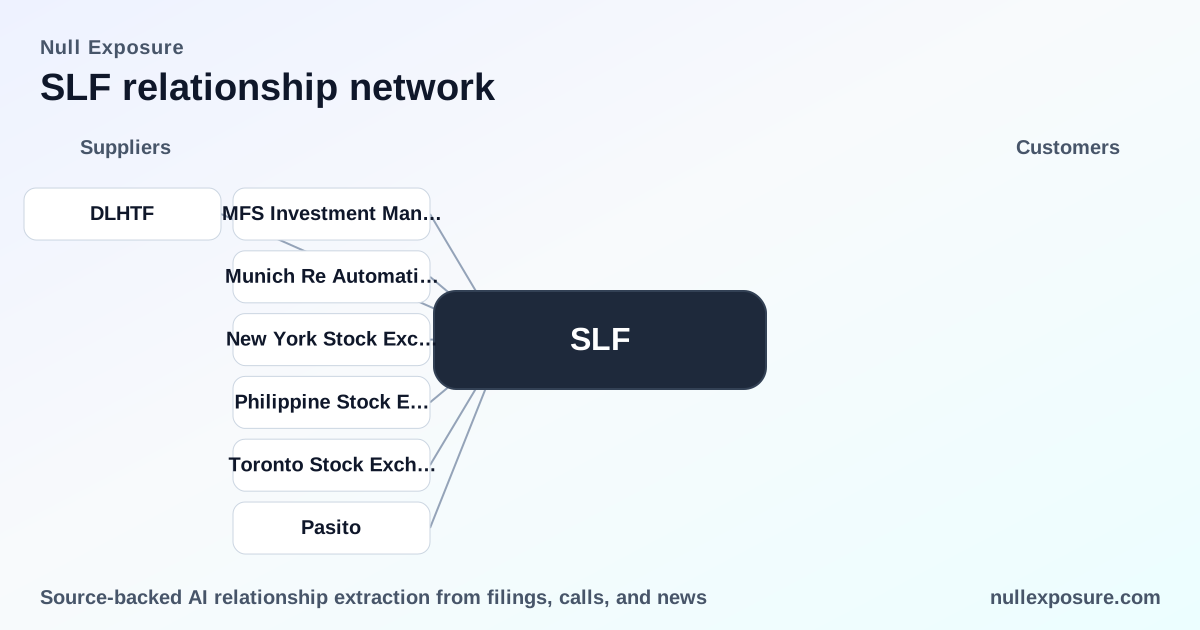
Sun Life Financial (SLF) — customer relationships and what they signal to investors
Sun Life Financial is a global insurer and asset manager that monetizes via long-duration insurance premiums, recurring wealth-management fees, and asset-management performance and custody fees. With trailing revenue of roughly $34.9 billion and a market capitalization near $39.97 billion, Sun Life’s economics combine underwriting margins, investment spread income, and fee-based asset-management revenue, producing a business that is both cyclical and contractually sticky. For a focused look at commercial signals and customer ties, see the firm’s profile at NullExposure.
How customer relationships are captured and why they matter to investors
Customer relationships for financial services firms are a direct proxy for revenue durability and counterparty exposure. In the sample of customer signals reviewed for SLF, the set of results is concise: a single public relationship mention ties to the ticker MMID. That simplicity is itself an investor signal — either because Sun Life’s customer links are broadly distributed and uneventful in public reporting, or because the firm’s primary public commercial interactions are captured elsewhere (regulatory filings, institutional disclosures, product prospectuses). There are no customer-specific constraints flagged in the reviewed results, which is a company-level signal about the absence of detected vendor-like restrictions or contract caveats in the customer feed.
The one explicit customer tie: MMID
MMID shares are issued by Sun Life Financial, Inc. — this is a direct issuer relationship, meaning MMID is a security connected to Sun Life’s corporate capital structure. According to TradingView coverage dated March 10, 2026, MMID is identified as an instrument issued by Sun Life Financial. (TradingView reference, March 2026: https://www.tradingview.com/symbols/NYSE-MMID/.)
Takeaway: This is an issuer-level linkage rather than an operational customer contract; it is relevant for creditors, capital-structure analysis and investor relations rather than for underwriting or asset-management revenue concentration.
What the limited customer results imply about commercial posture
With only a single, issuer-level public mention in the customer results, investors should treat customer concentration risk as not evidenced by the reviewed public records rather than proven absent. At a company level:
- Contracting posture: Sun Life operates under long-term, regulated insurance contracts and investment mandates that create high contractual friction to rapid revenue loss; premiums and management fees are typically governed by policy contracts or client mandates.
- Business concentration: The public result set does not show a narrow set of large bespoke customers; combined with the firm’s diversified product set (insurance, wealth, asset management), this implies revenue diversification by product and geography rather than reliance on a handful of customers.
- Criticality and maturity: Insurance contracts and asset-management mandates are generally mature, long-duration arrangements — translating into high revenue persistence and slower churn than transaction-based businesses.
These are company-level signals derived from the nature of Sun Life’s business and the absence of customer constraint data in the reviewed results.
Where capital and operating metrics reinforce the commercial picture
Sun Life’s reported metrics support a diversified, fee-and-premium driven model: trailing revenue of $34.88B, profit margin about 10.2%, and return on equity around 13.9%. Valuation multiples — a trailing P/E of 16.07 and a forward P/E of 12.63 — position the company as a mature financial services operator with yield support (dividend yield ~4.87%). These figures reinforce a thesis of stable cash generation underpinned by contractual revenue and a capital structure designed to support insurance liabilities and asset-management scale.
Risks that flow from Sun Life’s commercial model
Investors should weigh these key risk vectors with equal attention to customer signals:
- Regulatory and reserving risk: Insurance operations are capital- and regulation-intensive; adverse reserving developments or regulatory capital changes create direct profitability and solvency pressure.
- Interest-rate and investment spread sensitivity: Underwriting profitability and the value of policy liabilities are sensitive to rate moves; rising or falling rates change both investment returns and discounting for liabilities.
- Asset-gathering volatility: Fee income from asset management depends on AUM levels and market performance, so market drawdowns or persistent outflows reduce fee revenue.
- Limited public customer visibility: The narrow public listing of customer relationships in the reviewed sample increases reliance on corporate filings and quarterlies for deeper counterparty and mandate disclosure.
Practical takeaways for investors and operators
- For investors: Treat Sun Life as a diversified, contract-heavy financial operator where earnings durability is driven more by policy persistence and asset-management scale than by individual commercial customers. Monitor reserving trends, regulatory capital metrics, and net flows in wealth and asset-management businesses.
- For credit analysts: The MMID link is an issuer-level signal; credit concerns are more likely to arise from balance-sheet liquidity and reserve adequacy than from concentrated customer counterparty defaults.
- For operations/strategy teams: Maintain focus on policyholder retention and fee-margin expansion in wealth management; these are the levers that preserve long-term revenue under the company’s contract-based posture.
- For corporate development: The lack of high-visibility customer constraints in public results supports continued acquisition and partnership activity so long as integration preserves policyholder economics and capital efficiency.
For a consolidated view of commercial signals and relationship-level tracking, explore the SLF profile at NullExposure for structured summaries and ongoing monitoring.
Final read: clarity over noise
Sun Life is a large, diversified insurer and asset manager whose revenue base is predominantly contractual and recurring. The customer signal set reviewed here contains a single issuer linkage to MMID, which is relevant to investor relations and capital structure analysis rather than operational counterparty risk. Investors should therefore focus on reserving discipline, interest-rate exposure, and asset-management flows as the primary drivers of earnings variability, while using issuer-level links like MMID to validate capital and investor-communications dynamics.