Sol-Gel Technologies (SLGL): Commercial partnerships are the revenue engine; scalable upside depends on partner execution
Sol-Gel Technologies develops and commercializes topical dermatological pharmaceuticals using an Israel-patented microencapsulation delivery system and monetizes primarily through product sales executed via commercialization partners and direct channels. The company is clinical-stage but already generates product revenue, with growth dependent on partner-led market launches, geographic rollouts, and the uptake of TWYNEO® and follow-on assets. For investors evaluating counterparty exposure and customer relationships, the key lens is partner concentration and commercial execution rather than broad direct-sales scale. Learn more about counterparty analysis and relationship risk at https://nullexposure.com/.
Quick financial snapshot investors need up front
Sol-Gel is a small-cap specialty pharmaceutical company with commercialization upside and early-stage financials:
- Market capitalization: $252.2 million.
- Revenue (TTM): $19.4 million; Gross profit negative.
- Profitability: negative EPS (-2.28) and operating margins materially below breakeven.
- Valuation context: Price-to-Sales ~13.0 and EV/Revenue ~11.5, reflecting a premium priced to commercialization success and future growth.
- Ownership: roughly 60% insiders, ~35% institutions, indicating concentrated insider control.
These figures reflect a company transitioning from R&D into commercial execution; investors should price in the execution risk embedded in a commercial-partner model.
How Sol-Gel brings products to market and how it gets paid
Sol-Gel’s economic model is straightforward: develop differentiated topical formulations using its microencapsulation delivery platform, secure regulatory approvals, and monetize through product sales—often in partnership with established dermatology commercial organizations. Partnering reduces Sol‑Gel’s upfront commercial investment and speeds market access, while transferring execution risk to the partner. Revenue recognition is therefore linked to partner launches and distribution effectiveness rather than internal salesforce scale.
This arrangement produces clear financial characteristics:
- Higher revenue volatility near launch windows as partner promotions determine uptake.
- Cost leverage benefits if partners assume commercialization expense, but margin upside on successful product adoption.
- Dependency on partner contracts for U.S. scale and international distribution, which concentrates counterparty risk.
If you evaluate SLGL as an operator, treat it as a capital-light developer whose commercial value realization is contingent on external sales engines.
Business-model constraints and operational signals investors should weigh
Below are company-level operating constraints and maturity signals that shape counterparty analysis and valuation.
- Contracting posture: Sol‑Gel adopts a partner-centric commercialization posture, outsourcing large-scale U.S. launch activities and market access responsibilities to third parties. This reduces internal commercial spend but increases counterparty execution risk.
- Concentration: Product and partner concentration is a core structural risk—a small number of products and a limited set of commercialization partners drive revenue, making each partner outcome material to financial performance.
- Criticality: Partner relationships are strategically critical because they determine real-world patient access, formulary placements, and promotional intensity that directly affect sales velocity.
- Maturity: The company sits between clinical-stage development and early commercial maturity—commercial revenues exist but operating leverage and profitability are immature, reflected in negative margins and modest absolute revenue.
These signals position Sol‑Gel as a high-optionality, execution-sensitive equity: upside derives from partner-led commercial success while downside is compressed by concentrated product and partner exposure.
Customer relationships and counterparties you must track
Below is a concise, investor-focused coverage of every customer/partner relationship reported in the available results.
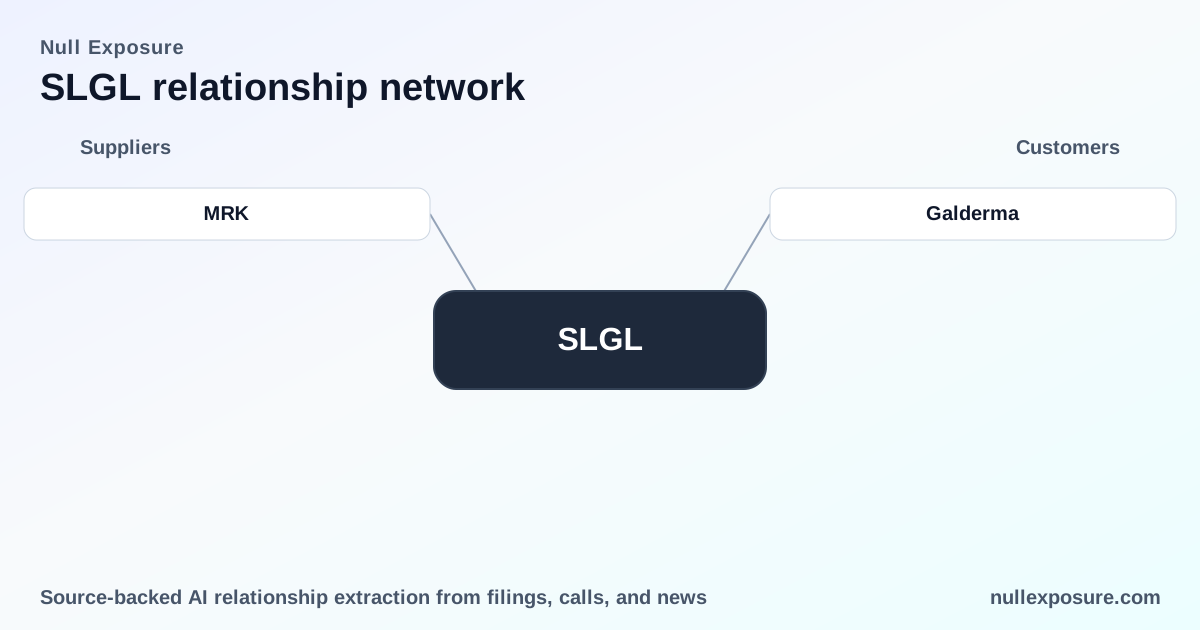
Galderma — U.S. commercialization partner launched TWYNEO® at AAD
Galderma served as Sol‑Gel’s U.S. commercialization partner and led the U.S. launch of TWYNEO® at the American Academy of Dermatology annual meeting in March 2022, establishing initial U.S. market entry and promotional presence. According to a Yahoo Finance report, the U.S. commercialization launch was executed publicly at the AAD meeting (reported March 10, 2026 referencing the March 25–29, 2022 launch event). Source: Yahoo Finance news article on Sol‑Gel commercialization (published March 10, 2026).
(That listing is exhaustive for the provided customer-scope results.)
What the Galderma relationship implies for valuation and risk
The Galderma collaboration is a canonical example of Sol‑Gel’s partner-driven model. Investors should translate that relationship into actionable investment signals:
- Execution dependency: Revenue trajectory for TWYNEO and near-term top-line growth is tied to partner go-to-market performance and promotional investment decisions.
- Concentration risk: A small number of commercial partners amplifies single-counterparty impact on realized revenue and guidance stability.
- Path to margin improvement: If partners successfully scale prescription volume, Sol‑Gel benefits from product sales without proportional SG&A expansion—producing potential margin improvement over time.
- Catalyst timeline: Commercial launch milestones, formulary placements, and quarterly sales cadence driven by partners become the primary near-term catalysts to monitor.
Given Sol‑Gel’s current multiples—EV/Revenue ~11.5 and Price/Sales ~13—the market is pricing meaningful commercial success; partner performance is the gating factor to justify this premium.
How to monitor counterparty risk as an investor
Track a compact set of observable indicators tied to partner performance:
- Quarterly product revenue trends and growth rates relative to launch baselines.
- Public statements, trade-show activity, and formulary wins issued by commercialization partners.
- Promotional spend signals and sales-force deployment updates from partner press releases.
- Changes to contractual terms, exclusivity windows, or geographic rights in company SEC filings or corporate announcements.
For investors focused on counterparty exposure, those indicators provide timely readouts on whether partner execution is converting into predictable revenue.
If you want a structured way to monitor Sol‑Gel’s partner relationships and commercial milestones, consider a relationship-based risk dashboard at https://nullexposure.com/.
Bottom line
Sol‑Gel offers a classic specialty-pharma risk/return profile: high upside tied to successful partner-led commercialization and concentrated downside if a partner rollout underperforms. Valuation assumes a favorable execution case; investors should prioritize monitoring partner announcements, sales cadence, and formulary traction to distinguish between headline risk and durable revenue growth.