Silgan Holdings (SLGN): Customer Relationships and Commercial Leverage
Silgan Holdings operates as a global manufacturer of rigid packaging and closures, monetizing through volume-based sales of metal, plastic and specialty dispensing systems to leading consumer-branded companies under multi-year supply arrangements and transactional contracts across North America, Europe, Asia and Latin America. Revenue concentration with a small number of very large enterprise customers, seasonally variable demand in metal containers, and extensive manufacturing scale drive both margin stability and supplier risk. For a concise view of customer exposures and contract posture, visit https://nullexposure.com/.
How Silgan makes money and why customers matter
Silgan sells physical packaging—metal containers, custom plastic containers and dispensing/specialty closures—directly to consumer goods manufacturers who incorporate those components into finished products. The business model is transactional manufacturing with strategic long-term supply relationships: higher-margin stability accrues where multi-year agreements exist, while spot and annual renewals inject price and volume variability. In 2024 Silgan recorded roughly $5.85 billion in net sales, with North America representing the dominant geography and several global consumer brands accounting for material shares of revenue.
The operating model in plain terms: contracting posture, concentration, criticality, maturity
Silgan’s customer book is characterized by multi-year, manufacturing-focused supply arrangements. The company reports that in 2024 roughly 90% of metal container sales and a majority of dispensing and custom container sales were governed by multi-year customer supply arrangements, establishing a contracting posture that leans long-term and supplier-committed. At the same time, dispensing and specialty closures outside the U.S. are frequently negotiated annually, giving Silgan exposure to periodic renegotiation cycles.
Customer concentration is meaningful: Nestlé alone accounted for approximately 13% of consolidated net sales in each of 2024, 2023 and 2022, and metal containers sold to Nestlé were 11.6% of consolidated net sales in 2024. This concentration elevates counterparty risk but also evidences strategic, high-volume partnerships with the world’s largest consumer brands. The customer base is very large enterprise in profile—household consumer packaged goods companies—so relationships are both commercially significant and operationally critical.
From a maturity perspective, Silgan’s footprint (123 manufacturing plants overall and 62 dispensing/specialty closures facilities) supports global supply continuity across North America, Europe, Asia and South America, serving over 100 countries. Approximately 12% of annual net sales are tied to customer-based supply chain finance arrangements, which signals active commercial-financing interplay with customers rather than passive receivables exposure.
Bold takeaway: Silgan combines manufacturing scale and long-term contracts with concentrated exposure to premier global brands—this structure supports margin resilience but creates counterparty concentration risk.
Customer relationships covered in the filings (complete list)
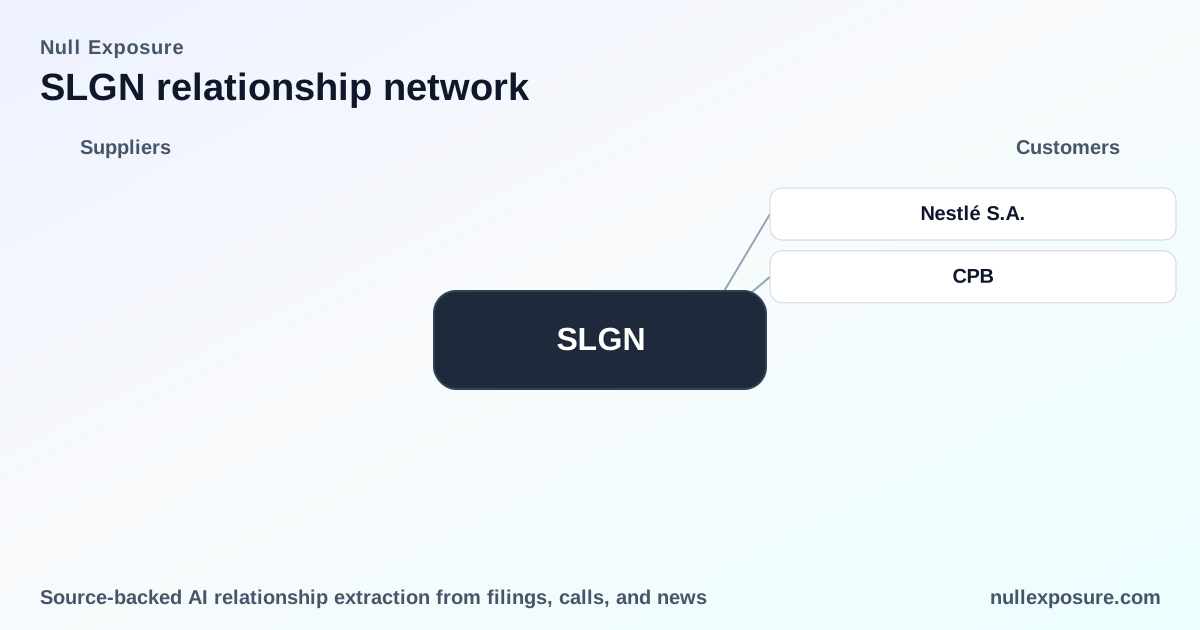
Nestlé S.A.
- Nestlé represented approximately 13% of Silgan’s consolidated net sales in each of 2024, 2023 and 2022, with the metal containers segment sales to Nestlé accounting for 11.6% of consolidated net sales in 2024. According to Silgan’s 2024 Form 10‑K, this customer is a material revenue contributor and a strategic large-volume partner. (Source: Silgan 2024 10‑K, fiscal year 2024)
Campbell Soup Company (Campbell)
- Campbell is included among the largest customers of Silgan’s dispensing and specialty closures business, indicating regular, significant purchasing across closure and dispensing product lines. This listing in the 2024 10‑K reflects Campbell’s role as a recurring buyer within the closures segment. (Source: Silgan 2024 10‑K, fiscal year 2024)
CPB
- The filing also references CPB (Campbell) under its ticker/symbol in the same enumeration of key closures customers, confirming the company’s placement within Silgan’s roster of major closure buyers. The duplicate listing underscores Campbell’s identification both by name and by market symbol in corporate disclosure. (Source: Silgan 2024 10‑K, fiscal year 2024)
What the customer list implies for investors
- Revenue concentration risk: With a single customer accounting for low-double-digit percent of consolidated revenue, investors must treat customer retention and pricing leverage as catalytic to Silgan’s top-line stability. The company’s disclosures flag this concentration explicitly for Nestlé.
- Contracting mix provides partial protection: The predominance of multi-year arrangements for metal containers and the majority of dispensing/custom container sales reduces short-term volatility in those streams, while annual renegotiations outside the U.S. mean pockets of pricing exposure remain.
- Counterparty quality is high: The customer base consists of globally recognized consumer brands, which supports collectible receivables and long-term purchasing patterns, but heightens dependency on a few counterparties.
- Geographic diversification but North American skew: North America accounts for the bulk of revenue (North America ~$4.40 billion in 2024 versus Europe and other ~$1.46 billion), so regional demand cycles and U.S. retail trends disproportionately affect outcomes.
Financial and operational signals investors should prioritize
- Monitor Nestlé volume and contract terms as a bellwether for metal containers revenue, and watch renewal cadence for major closure customers, especially outside U.S. where annual negotiations are common. The 10‑K notes multi-year US supply arrangements alongside year-by-year practices abroad—this split is central to near-term revenue visibility.
- Track seasonality in metal container demand (fruit and vegetable pack processing) and the extent of customer-based supply chain finance arrangements (roughly 12% of annual net sales), as both influence working capital and margin timing.
- Evaluate capital allocation against manufacturing footprint utilization: Silgan operates 123 plants and 62 closure sites globally; efficiency gains or plant-level disruptions will have outsized earnings effects given high fixed-cost manufacturing.
Bottom line and practical next steps
Silgan is a manufacturing-led supplier to the world’s largest consumer brands, deriving meaningful revenue from a small set of very large counterparties under predominantly long-term arrangements. That structure provides stable revenue under normal conditions but creates concentration and renegotiation risk where a handful of customers drive outsized share.
For investors and operators doing due diligence on customer risk and supplier leverage, the full customer disclosures in Silgan’s Form 10‑K give a direct view of concentration and contract posture. For an actionable breakdown of customer exposures and ongoing monitoring tools, visit https://nullexposure.com/ to access additional relationship analytics and reporting.