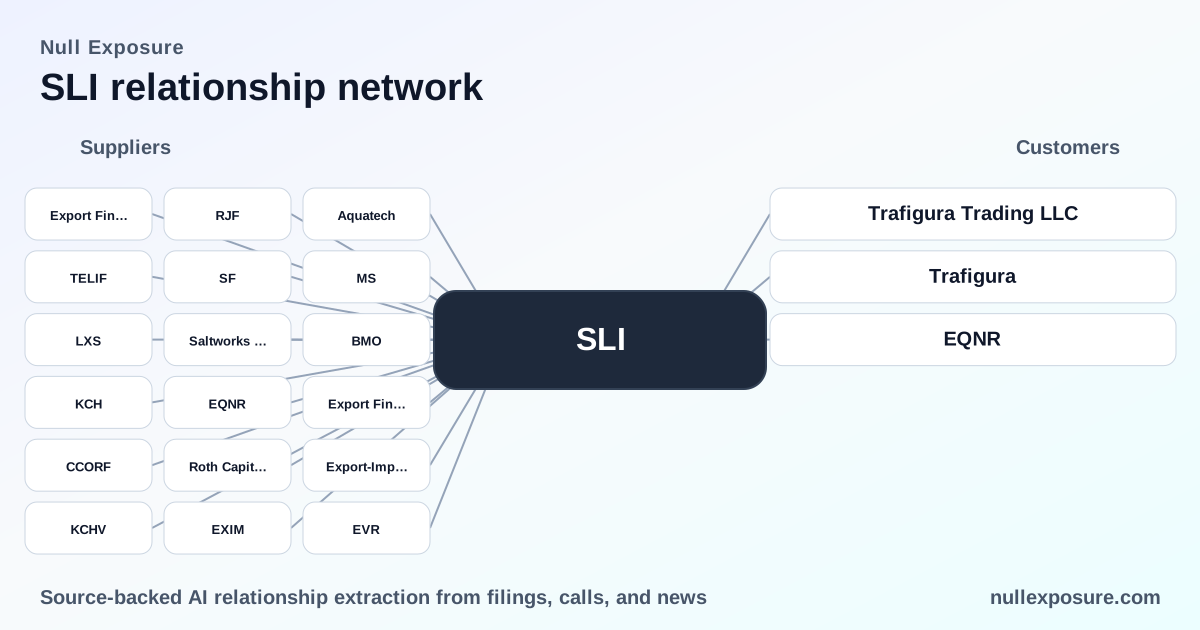
Standard Lithium (SLI) — Customer Relationships and What They Signal for Project Finance
Standard Lithium extracts and refines lithium from Smackover Formation brines using proprietary processing, monetizing through a joint-venture development model and long-term product sales contracts. The company’s cash-flow pathway is structured around a commercial-scale JV (Smackover Lithium) that will convert brine into battery-quality lithium carbonate and secure revenue via multi-year offtake agreements and strategic upstream partners; investors should treat offtake anchoring and JV partners as the primary drivers of valuation and financing outcomes. For a concise dossier on counterparties and relationship signals, visit https://nullexposure.com/.
The high-level read: anchored offtake plus strategic JV partners
Standard Lithium’s market story has shifted from technology validation to project execution. Public disclosures show a binding commercial offtake and an upstream JV partner that together provide the two building blocks lenders and equity investors require: anchored demand and upstream resource access. Operational milestones at the demonstration plant and executive commentary on scheduling indicate management is moving toward a final investment decision cycle.
Trafigura — the anchor customer
Smackover Lithium has executed a binding take-or-pay offtake that commits 8,000 metric tonnes per year of battery-quality lithium carbonate for 10 years, commencing at commercial production. This offtake is explicitly structured to support project financing and provide early revenue visibility for the JV (Standard Lithium press release, March 10, 2026; company earnings materials and GlobeNewswire reporting in March–May 2026). See the company announcement here: https://www.standardlithium.com/news/smackover-lithium-signs-first-binding-customer-offtake-agreement-for-the-south-west-arkansas-project.
Equinor — strategic upstream partner and JV co-developer
Management described a strategic partnership with Equinor on the 2025 Q2 earnings call, positioning Equinor as the JV upstream partner responsible for wellfield scheduling and reservoir access that underpin commercial operations (SLI 2025 Q2 earnings call transcript, March 2026). That partnership materially de-risks resource access and operational scale relative to a sole-developer approach.
TTI — a stakeholder referencing FID timing and upstream scheduling
Public comments from TTI indicate that final investment decisions will link to the upstream wellfield schedule produced by the JV (Standard Lithium and Equinor) and the post-lithium brine delivery timeline; TTI’s statements frame FID timing as contingent on that schedule (TTI earnings commentary, Q4 2025). This external recognition of schedule-dependency highlights the project’s remaining execution milestones and timing sensitivity (The Globe and Mail coverage of related earnings calls, March 2026).
How these relationships should shape modeling and risk assumptions
Because the constraints dataset for customer relationships contains no explicit constraint excerpts, present company-level operational signals derived from the public record:
- Contracting posture: Public filings and offtake documentation demonstrate a preference for long-duration, take-or-pay contracts that anchor cash flow. This posture supports project-level non-recourse or limited-recourse finance structures and improves bankability.
- Concentration and counterparty reliance: The announced 10-year offtake of 8,000 tpa represents a concentrated anchor of demand. Model this volume as a cornerstone of early cash flow and treat additional offtakes as incremental upside.
- Criticality and sequencing: The JV upstream schedule (as referenced by third parties) is a gating factor for FID and commercial ramp. Execution of wellfield and plant milestones is therefore the single most critical operational dependency before meaningful revenue recognition.
- Maturity and financing readiness: Demonstration-plant milestones and a signed offtake seen in March–April 2026 move the project from pilot-stage validation toward project-finance readiness; expect lenders to focus on final permits, wellfield performance data, and confirmed long-term pricing mechanisms.
Investment implications — what to stress-test in diligence
- Project financing sensitivity: Given the explicit take-or-pay structure and 10-year tenor, lenders will underwrite based on the offtake pricing mechanics and the creditworthiness of counterparties; model downside scenarios where refinancing or pricing adjustments are required.
- Counterparty risk and concentration: One anchor buyer at material volume reduces market risk but increases single-counterparty exposure; include counterparty default scenarios and replacement timelines in downside cases.
- Execution and schedule risk: FID timing is tied to upstream schedules and demonstration-plant performance; prioritize covenant timelines and escalation clauses in commercial agreements when assessing time-to-cash.
- Commercial pricing and market dynamics: The tenor of the contract improves predictability, but macro lithium pricing volatility still affects long-term project economics; stress-test across a range of industry price scenarios.
Source notes for every referenced relationship
- Trafigura Trading LLC / Trafigura: Standard Lithium’s March 10, 2026 press release and subsequent corporate filings and earnings materials state that Smackover Lithium will supply Trafigura with 8,000 metric tonnes per year of battery-quality lithium carbonate over a 10‑year period under a binding take‑or‑pay agreement, intended to support project financing (Standard Lithium corporate news, March 10, 2026; GlobeNewswire and related March–May 2026 press coverage — see https://www.standardlithium.com/news/smackover-lithium-signs-first-binding-customer-offtake-agreement-for-the-south-west-arkansas-project and GlobeNewswire March 2026 releases).
- Equinor (EQNR): Company management referred to a significant strategic partnership with Equinor during the SLI 2025 Q2 earnings call, identifying Equinor as the JV partner announced the prior May and signaling its role in upstream operations (SLI 2025 Q2 earnings call transcript, March 2026).
- TTI: Public remarks in Q4 2025 earnings commentary by TTI noted that FID intentions hinge on the final upstream wellfield schedule from Standard Lithium and Equinor’s Reynolds unit, underscoring schedule-driven commercial decision points (TTI Q4 2025 earnings call coverage and related press reporting, March 2026).
For a concise counterparty matrix and to download the primary-source links used in this note, see our research hub at https://nullexposure.com/.
Conclusion — Standard Lithium’s customer footprint has moved beyond early validation into binding commercial arrangements and strategic upstream partnership. The combination of a long-term take-or-pay offtake and an Equinor JV materially improves project bankability, but investors must underwrite schedule execution, counterparty concentration, and pricing volatility when sizing exposure.