Sallie Mae (SLM): Customer Relationships That Drive a Loan-Centric Franchise
Sallie Mae (SLM) originates and services private education loans to students and families, monetizing through interest margin, loan sales with retained servicing, and increasingly through program management fees on third‑party asset partnerships. The company’s economics are driven by a concentrated, long‑duration receivable base and recurring servicing and fee revenue tied to asset dispositions and third‑party managers. For investors evaluating SLM’s customer and partner footprint, three active relationships stand out for strategic and financial implications. Learn more at https://nullexposure.com/.
How SLM’s operating model shapes its customer relationships
SLM is fundamentally a seller of long‑term consumer credit and a continuing service provider for loans after sale. Company filings note that the weighted average life of its private education loans is roughly 5–6 years and that loans are originated with relatively long repayment periods, which creates an inherently long‑dated contractual posture for its receivables. Those long lives support recurring interest income but also concentrate credit and duration exposure in an individual borrower base—private students and families who are not government‑guaranteed borrowers.
- Counterparty concentration: SLM’s primary counterparty is the individual borrower; its business is the origination and servicing of loans made to students and families rather than institutional lending. Company disclosures explicitly describe private education loans as loans for students or their families that are not made, insured, or guaranteed by federal or state governments.
- Criticality and concentration: Private education loans represent the core asset base—about 74% of total assets and 88% excluding cash at the end of 2024—making those loans critical to enterprise value and funding needs. At the same time, brokered deposits accounted for 45% of total deposits, signaling material funding concentration that interacts with customer lending and sales strategy.
- Role and stage: SLM acts as both seller (via whole‑loan sales and securitizations) and servicer (retaining servicing rights after sales), and the company routinely reports that these relationships are active—it earns servicing revenue at market rates and remains the administrator for securitized pools.
- Geography and regulatory posture: Operations are U.S.‑centric and bank regulation is an active consideration, with oversight noted from state and federal banking agencies that govern the bank entity used in certain funding activities.
These characteristics — long contractual lives, borrower as the primary counterparty, extreme asset concentration in private loans, and an active servicing/sales model — define both SLM’s recurring revenue profile and its principal exposures.
Partner-by-partner: the relationships investors should know
CVSA — Letter of intent announced
SLM signed a letter of intent with CVSA, which management described on an earnings call as an example of a new collaboration with a long‑standing leader in student lending. This indicates ongoing business development activity to expand channel or product distribution through third parties. (Source: CVSA earnings call excerpt, 2025Q4.)
Why it matters: A LOI with an external partner signals product distribution initiatives that could expand originations or referral flows without materially changing the lending economics until a definitive agreement is executed.
KKR — Strategic capital and program management fee revenue
SLM launched an inaugural partnership with KKR in late 2025 and is building it into a fee business; management reported that the arrangement includes program management fees tied to assets under management and that SLM completed another $1.3 billion of loan sales to the partnership in the referenced quarter. As sales into the KKR vehicle close, program management fees will accrue on the AUM SLM helps place. (Source: SLM Q1 2026 earnings transcript coverage on Investing.com, FY2026 comments.)
Why it matters: The KKR partnership converts a portion of SLM’s loan flow into fee‑bearing asset management income, diversifying away from net interest margin and reducing on‑balance sheet credit concentration while creating recurring fee streams as AUM grows.
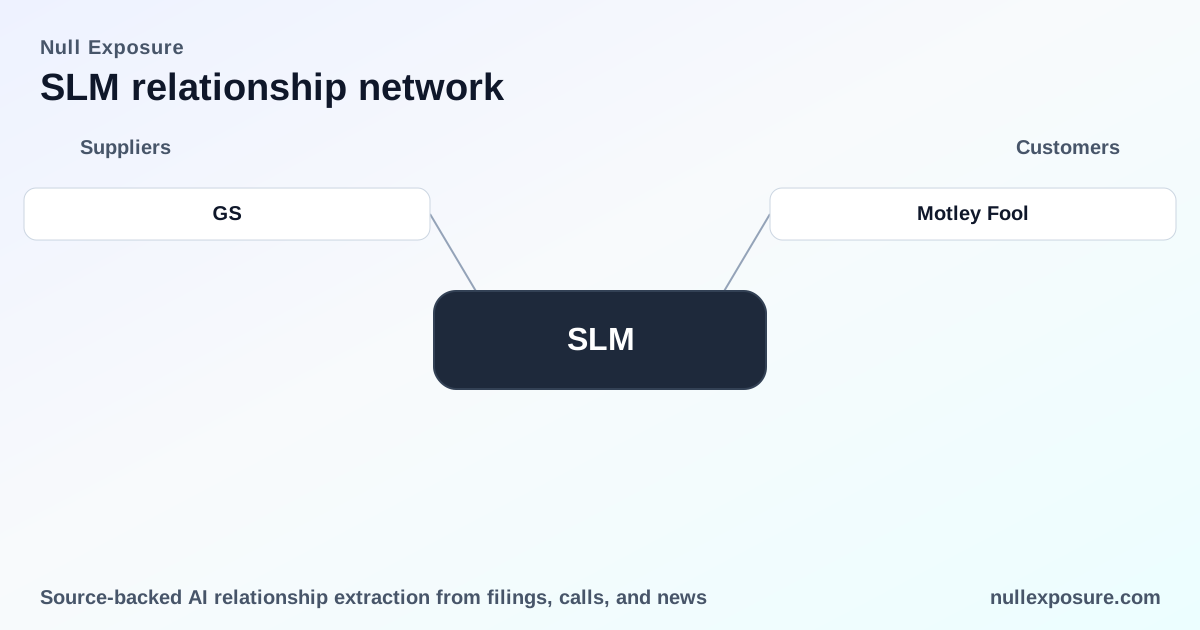
Motley Fool — Advertising partner on branded programming
SLM is an advertising partner of Motley Fool Money, a promotional relationship noted in press commentary. This is a marketing and brand distribution tactic rather than a core financial partnership, intended to support customer acquisition and brand visibility. (Source: Globe and Mail press coverage quoting marketing relationships, FY2026.)
Why it matters: Advertising partnerships are tactical tools to support origination growth; they do not alter credit exposure but reflect corporate emphasis on customer acquisition and brand positioning.
What the relationship map implies for investors: drivers and constraints
SLM’s relationship portfolio reflects a dual strategy: monetize credit through interest and spread while extracting recurring fees and reducing balance‑sheet concentration via sales and third‑party capital. That strategy has practical constraints:
- Contracting posture is long‑term. The weighted average life of loans and typical repayment periods make the revenue base slow‑turning and sensitive to interest‑rate and employment cycles.
- Counterparty concentration is retail/individual. Credit outcomes track education and labor market dynamics more than institutional credit cycles.
- Funding and counterparty materiality are significant. With private education loans representing the bulk of assets and brokered deposits close to half of total deposits, funding concentration and asset quality are strategic risks.
- Maturity and product mix. The business is mature in core lending and servicing, while fee businesses (e.g., KKR management fees) are nascent growth drivers that repurpose origination flow into AUM‑based revenue.
These are company‑level signals drawn from SLM disclosures and public remarks; they shape how management negotiates partnerships and structures asset sales.
Investment implications and a concise risk checklist
SLM’s mix of interest income, servicing fees, and emerging program management fees positions it as a loan‑originator with growing fee diversification. Key positives and risks for investors:
-
Positives:
- High margin core product with strong profitability metrics (operating margin and return on equity among peer strengths).
- Scalable fee potential from institutional partnerships like KKR, which reduces balance‑sheet intensity over time.
- Servicing retention drives recurring revenue even after loan sales.
-
Risks:
- Concentrated asset base in private education loans exposes earnings to student credit trends and regulatory shifts.
- Funding concentration via brokered deposits increases sensitivity to wholesale funding conditions.
- Execution risk on turning partnerships into durable fee revenue—AUM needs to scale and management must stay as the servicing/administration provider.
For a deeper relationship map and contract‑level intelligence on counterparties, visit https://nullexposure.com/ to see how these partner dynamics translate into revenue and risk scenarios.
Bottom line
SLM remains a tightly focused originator/servicer with important strategic shifts toward fee monetization through institutional partnerships. Investors should weigh the benefits of recurring servicing and program fees against the continued concentration in private student loans and funding sources; the KKR arrangement is the most consequential commercial relationship for near‑term revenue diversification, while marketing partnerships and exploratory LOIs point to steady customer acquisition efforts.