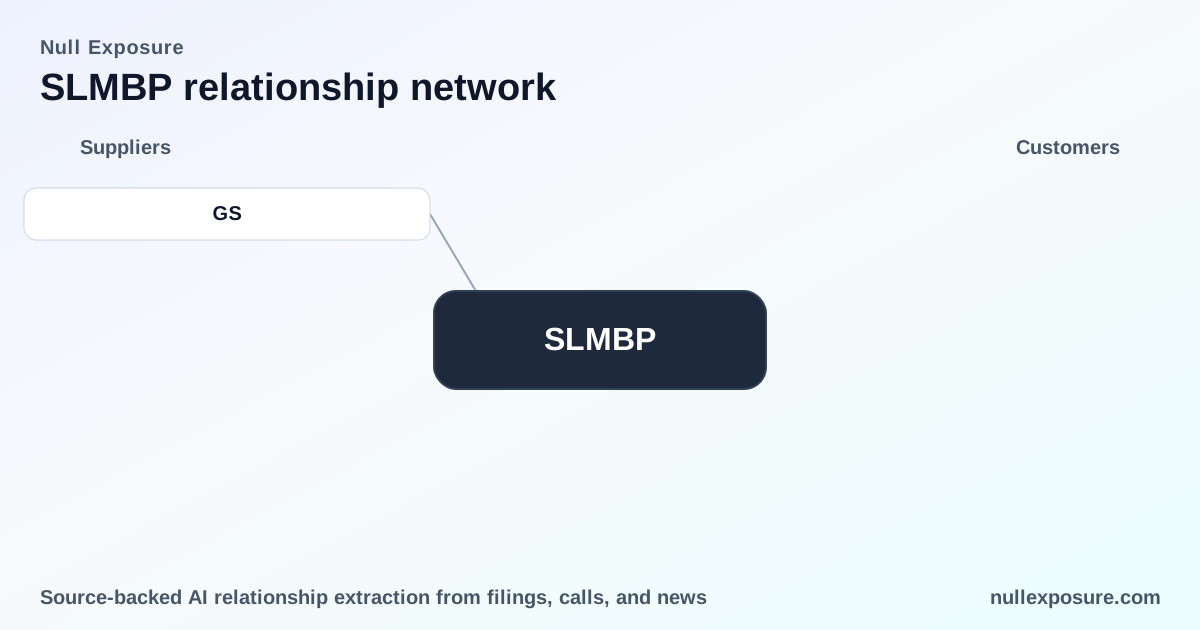
SLM Corp Pb Pref (SLMBP): Fee-bearing servicing and loan sales drive earnings
SLM Corporation originates and services private education loans to students and families in the United States and monetizes primarily through interest income on retained loans, fees from loan originations and sales, and recurring servicing and program management fees when loans are sold but serviced on behalf of investors. For fixed-income investors evaluating SLMBP, the credit characteristics of the underlying franchise are driven less by trading volatility and more by the durability of fee streams tied to loan servicing and asset-management arrangements.
Learn more about Null Exposure’s coverage and signal sets at https://nullexposure.com/.
How SLM makes money — the business in plain English
SLM is a focused credit-services firm: it originates private education loans, holds a material portion on its balance sheet, and sells loans into funding structures while typically retaining the servicing contract. Revenue therefore splits across interest on retained assets and non‑interest fee income—notably third‑party servicing fees and program management fees when SLM partners with institutional investors. This mixed model produces both lending-style returns and more stable annuity-like fee streams tied to assets under management and servicing portfolios.
Financials anchor the claim: about $1.665 billion in trailing twelve‑month revenue and a profit margin near 45% reflect a high-margin, credit‑oriented business. Market capitalization sits above $4.8 billion, signaling public market recognition of earnings durability and brand value in the student-lending niche.
A meaningful new customer relationship: KKR
SLM announced an inaugural partnership with KKR in late 2025 that embeds a program management fee into the arrangement. The deal includes sales of SLM-originated assets into the KKR structure, with program management fees paid to SLM as a recurring revenue stream tied to AUM under management. This converts loan originations and loan sales into an ongoing fee business as the sold assets remain under management. According to an earnings call transcript reported by InsiderMonkey on May 3, 2026, the program management fee is built into the KKR partnership and will begin to contribute to fee revenue as asset sales are completed (InsiderMonkey, FY2026 earnings call transcript, May 3, 2026: https://www.insidermonkey.com/blog/slm-corporation-nasdaqslm-q1-2026-earnings-call-transcript-1745783/).
Key takeaway: The KKR agreement accelerates SLM’s transition from pure originator/servicer to a hybrid originator-plus-asset-manager, creating a durable fee layer that reduces reliance on interest spread volatility.
All customer relationships in scope
- KKR — SLM linked with KKR in an inaugural partnership that embeds program management fees; as assets are sold into the KKR vehicle, SLM will recognize program management fees tied to AUM. This detail comes from SLM’s FY2026 earnings call transcript reported May 3, 2026 (InsiderMonkey, May 3, 2026).
(There are no other customer relationship entries in the results set for SLMBP beyond the KKR partnership.)
Company-level operational constraints that affect customer relationships
The following signals are drawn from SLM’s public disclosures and explain how the company structures customer arrangements, risk, and revenue recognition. These are company-level characteristics, not attributes of any single partner unless explicitly named.
-
Contracting posture: long-term lending relationships. SLM’s private education loans have a weighted average life of multiple years (approximately 5.6 years as of December 31, 2024), loans are originated with long repayment periods, and contracts allow for structural modifications (for example, permanent rate reductions or maturity extensions in limited circumstances). These terms emphasize duration and lock-in of cash flows, and they reduce turnover risk on retained portfolios (SLM FY2024 disclosures, December 31, 2024).
-
Counterparty type: individual borrowers. The primary counterparties are students and families; the business is fundamentally retail credit rather than wholesale corporate lending. That makes credit performance sensitive to macro and labor-market trends that affect individual repayment capacity (company filings and consumer-risk disclosures, 2024–2025).
-
Geographic concentration: United States‑centric with state clusters. SLM’s loan book is concentrated in a subset of U.S. states — California, New York, Pennsylvania, Texas, New Jersey, and Florida make up the largest shares — creating state-level concentrations in credit exposure and regulatory oversight (disclosed concentrations as of December 31, 2024).
-
Materiality and criticality: private education loans are the balance-sheet center. As of December 31, 2024, approximately 74% of total assets and 88% of total assets excluding cash were private education loans. Private education loans are the principal asset and new originations are a key indicator for future earnings and growth. This concentration makes SLM’s franchise intrinsically sensitive to student‑loan origination cycles and asset quality trends (FY2024 10‑K disclosures).
-
Relationship roles: seller and service provider. SLM both originates and sells loans into funding arrangements and typically retains servicing after sale, earning market‑rate servicing fees. That dual role means SLM can realize upfront sale gains while preserving recurring servicing income—an important structural feature for modeling sustainable cash flows (company servicing policy disclosures and recent servicing-fee trends).
-
Relationship stage: active monetization of sold assets. Recent periods showed increases in third‑party servicing fees tied to approximately $3.7 billion of sold loans that SLM continues to service, signaling active engagement in loan sales while monetizing servicing positions (FY2024–FY2025 results commentary).
-
Segment focus: single, core product orientation with ancillary services. Management runs the business as a single line of business centered on private education loans, supported by services that amplify lifetime customer economics and brand value.
What investors should price in
-
Fee diversification is real and value-accretive. The KKR program management fees convert one‑off loan sales into recurring revenue. This reduces earnings cyclicality and increases the predictability of cash flows used to pay preferred coupons.
-
Concentration risk is non‑trivial. With the balance sheet dominated by private education loans and geographic clustering, downside scenarios tied to employment, regulatory shifts, or localized economic stress will have outsized balance-sheet impact.
-
Servicing economics are a strategic lever. Retaining servicing rights while selling loans allows SLM to scale originations without proportionally expanding funded assets; successful asset sales paired with retained servicing is a value-enhancing trade for shareholders and fixed-income holders.
-
Regulatory and consumer-credit dynamics remain central. Given the individual borrower base, policy changes or shifts in borrower assistance programs can materially affect loss timing and volumes.
Bottom line: positioning SLMBP in a portfolio
SLM’s preferred security is backed by a franchise that balances lending yields with durable fee income from servicing and program management arrangements such as the KKR partnership. Investors should view SLMBP as exposure to a specialized credit-services operator that is actively converting originating capacity into recurring fee revenue while still retaining material balance-sheet loan exposure. For investors focused on coupon reliability and franchise durability, the combination of loan concentration and growing program-management income is the central trade-off to underwrite.
Explore more signal-driven commentary and relationship coverage at https://nullexposure.com/.