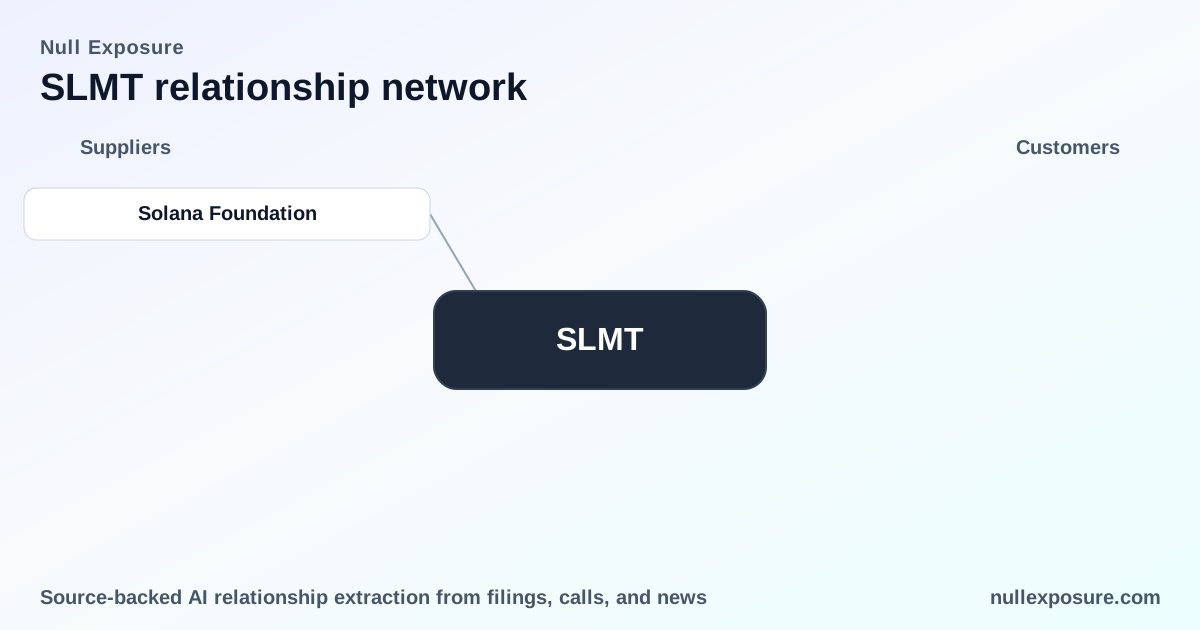
Brera Holdings (SLMT): Strategic divestiture reshapes a compact football-asset operator
Brera Holdings PLC operates by acquiring, managing, and monetizing football clubs and related commercial rights; the company generates revenue from matchday and commercial income, player transfers and trading, and occasional strategic asset sales. Revenue is modest and volatile, while balance-sheet management—through disposals or capital injections—is the clearest lever for value realization. For relationship-level intelligence and ongoing monitoring of Brera’s counterparties, see NullExposure for standardized coverage: https://nullexposure.com/
Executive thesis — what investors should track now
Brera is a small-cap club-operator with a concentrated asset base and negative operating metrics. The company monetizes through club operations and episodic asset transactions, and the May 2026 disposal of an Italian Serie B club highlights an explicit shift to liability reduction over revenue retention. Given a low revenue base (Revenue TTM $2.67M) and negative EBITDA (-$6.77M), management’s ability to prune loss-making assets is a primary determinant of near-term solvency and optionality for shareholders.
The transaction in focus: Juve Stabia sold for a symbolic €1
On April 17, 2026, Brera agreed to sell its entire equity interest in S.S. Juve Stabia S.r.l. to Stabia Capital S.r.l. for a total consideration of €1.00. TipRanks reported the transaction in early May 2026, noting the transfer of the club’s equity and its related debt exposure to the buyer. According to TipRanks (reported May 3, 2026), this was a balance-sheet-driven disposal rather than a value-accretive sale.
What the Stabia deal signals about Brera’s operating posture
The symbolic sale price strongly indicates that the primary objective was transferring liabilities and operational burden off Brera’s balance sheet. For an operator with limited recurring revenue and negative operating cash flow, shedding debt-laden assets is a pragmatic move to stabilize liquidity and reduce downside risk for the corporate entity. The Stabia transaction is therefore a textbook example of asset disposal as a solvency tactic rather than revenue optimization.
Relationship coverage: every customer relationship in the record
- Stabia Capital S.r.l.: Brera sold S.S. Juve Stabia S.r.l. to Stabia Capital for €1 on April 17, 2026, transferring the club equity and associated debts to the buyer; this was reported by TipRanks on May 3, 2026.
This article records every customer-side relationship present in the available disclosures. The single identified counterparty transaction is the April 2026 sale of Juve Stabia to Stabia Capital S.r.l., which represents a direct change in Brera’s customer and asset profile. TipRanks coverage (May 3, 2026) provides the public account of the deal.
Company-level signals and operating model characteristics
With no separate relationship constraints returned in our records, the dataset provides these company-level operational signals:
- Contracting posture — defensive and transactional. Management is executing disposals to remove liabilities rather than pursuing long-term partnership contracts; the Stabia sale is consistent with a posture that prioritizes balance-sheet repair.
- Concentration — high. Brera’s revenue base is small and its portfolio of operating assets is compact, creating idiosyncratic exposure to individual club outcomes and bilateral counterparties.
- Criticality — high for retained assets, lower for divested ones. Each club represents both revenue potential and concentrated operational risk; divestitures reduce the criticality of those specific assets to the company’s future cash flows.
- Maturity — restructuring / early turnaround. Negative EBITDA and operating losses align with an organization in a remediation phase where disposals and re-capitalizations are the dominant levers for restoring financial stability.
These characteristics shape how counterparties and investors should evaluate Brera: contractual counterparty risk is concentrated and materially influenced by management’s willingness to divest loss-making assets.
Investor implications — what to watch next
- Liquidity and covenant pressure are the immediate focus. Given negative EBITDA and small revenues, monitor cash, debt maturities, and any creditor arrangements disclosed in filings.
- Asset-light strategy versus revenue dilution trade-off. Continued disposals reduce liability but also shrink the revenue base; track whether management allocates proceeds to delever or to reinvest in higher-return club operations.
- Counterparty concentration risk remains elevated. Few large counterparties or a limited number of clubs make single transactions—like Stabia’s sale—potentially decisive for results.
- Governance and insider alignment. With insiders holding roughly 34% of shares and institutions holding a similar proportion, governance decisions on asset sales and capital allocation will materially affect minority holders.
Risk checklist: how this transaction changes the profile
- Reduced immediate balance-sheet stress — offloading Juve Stabia removes an operational and debt burden.
- Lower future revenue potential from that club — the company sacrifices future top-line upside tied to that asset.
- Improved solvency trajectory if proceeds and liability transfers are complete and documented.
- Persistent execution risk — the company must demonstrate consistent execution beyond single-asset sales to stabilize earnings.
For an integrated view of Brera’s counterparty movements and to track subsequent relationship updates, visit NullExposure for ongoing signal coverage: https://nullexposure.com/
Conclusion — read the transaction in the context of the capital story
The sale of Juve Stabia to Stabia Capital for €1 is a clear operational reset: Brera is prioritizing the elimination of loss-making exposures over retaining marginal operating revenue. For investors, the critical questions are whether management will follow with disciplined deleveraging and whether remaining assets can be scaled to produce sustainable cash flow. Given the company’s compact portfolio and negative operating metrics, future disposals, capital raises, or restructuring actions are now the primary variables driving equity value.