Southland Holdings (SLND): Projected revenue from heavy civil contracts, not cyclical services
Southland Holdings builds and delivers large-scale infrastructure projects — bridges, tunnels, water and wastewater systems, transportation and civils — and recognizes revenue over the life of long-term construction contracts. The company monetizes through project-based construction margins, change orders and ancillary services delivered by its six subsidiaries, with a material share of revenue driven by public-sector contracts and a concentrated customer base. For ongoing tracking of customer-level exposures and project news, visit https://nullexposure.com/.
How Southland actually makes money and where the risk lives
Southland operates as a seller of engineered construction services, bidding competitively for multi‑year projects and recognizing revenue over time as performance obligations are satisfied. Revenue is concentrated and project-driven, with two customers accounting for more than 10% of 2024 revenue and foreign work representing roughly 17% of total revenue. The firm’s financials show negative margins and significant EBITDA volatility, consistent with a company whose profits or losses hinge on the execution of a small number of large projects.
- Contracting posture: Revenue recognition language confirms Southland predominantly executes long‑term contracts and recognizes revenue over time, which increases exposure to contract accounting adjustments and cost-to-complete estimation risk.
- Customer mix: The company retains both public and private clients, with a meaningful share of work for federal, state and local agencies — a profile that brings competitive procurement dynamics and payment stability but can concentrate project risk.
- Geographic footprint: The majority of projects are in North America, with material but not dominant foreign revenue, supporting a primarily domestic risk profile with pockets of international exposure.
Active customer relationships and recent project headlines
Below I list every relationship item captured in the available results, with a concise 1–2 sentence description and the public source.
-
Coastal Water Authority — $40 Million Capers Ridge Pump Station expansion in Cleveland, Texas. According to a May 3, 2026 press release reported on MyCarrollCountyNews, Southland is tied to a $40M expansion project for the Coastal Water Authority. (MyCarrollCountyNews, May 3, 2026: https://www.mycarrollcountynews.com/online_features/press_releases/article_a81afd08-0ba1-57ee-8e09-a3d94c26eaa0.html)
-
City of Cape Coral, Florida — $30 Million NE Reservoir Pump Station & Transmission Main. A May 3, 2026 announcement lists a $30M pump station and transmission main contracted for the City of Cape Coral, Florida, within Southland’s civil project backlog. (MyCarrollCountyNews, May 3, 2026: https://www.mycarrollcountynews.com/online_features/press_releases/article_a81afd08-0ba1-57ee-8e09-a3d94c26eaa0.html)
-
Washington State Convention Center — $136 Million unfavorable adjustment tied to project within American Bridge subsidiary. Management disclosed a $136M unfavorable adjustment related to the Washington State Convention Center project during the company’s Q4 2025 earnings discussion. (Earnings transcript reported on Investing.com, 2026 earnings call transcript: https://m.investing.com/news/transcripts/earnings-call-transcript-southland-holdings-faces-steep-q4-2025-losses-93CH-4585410?ampMode=1)
-
city of Cape Coral, Florida — $30M pump station referenced among civil segment contracts including a $48M data center job. In the Q4 2025 commentary, management cited a $30M Cape Coral pump station and a $48M data center contract in the Southwest as leading civil backlog contributions. (Earnings transcript reported on Investing.com, 2026 earnings call transcript: https://m.investing.com/news/transcripts/earnings-call-transcript-southland-holdings-faces-steep-q4-2025-losses-93CH-4585410?ampMode=1)
-
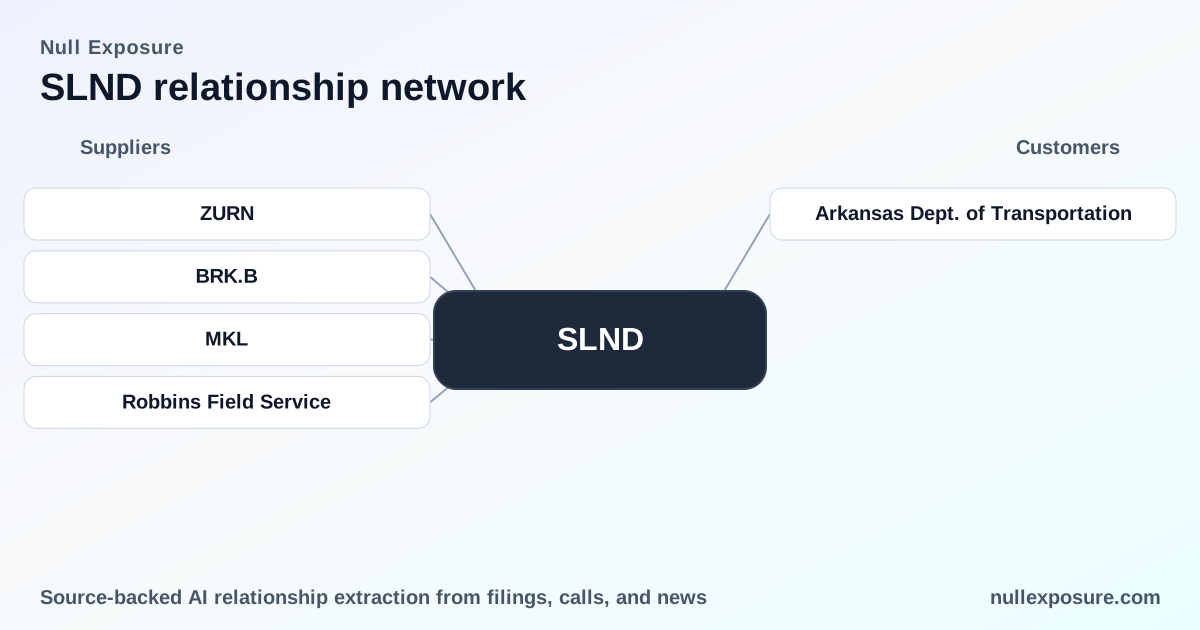
Arkansas Dept. of Transportation — I‑30 widening construction contract awarded to Johnson Bros. Corp., a Southland division. Engineering News‑Record reported that Johnson Bros., part of Southland, won the I‑30 widening construction contract via competitive bid on Dec. 5, 2018, illustrating Southland’s presence in DOT project work. (Engineering News‑Record, article on I‑30 widening: https://www.enr.com/articles/52149-labor-materials-nature-complicate-i-30-widening)
-
City of Cape Coral — $30M NE Reservoir Pump Station & Transmission Main referenced on Intellectia news aggregate. Intellectia aggregated a report noting the $30M Cape Coral pump station and transmission main as part of Southland’s FY2026 project announcements. (Intellectia news aggregation, May 2026: https://intellectia.ai/en/stock/SLND/news)
-
Coastal Water Authority — $40M Capers Ridge Pump Station expansion referenced on Intellectia news aggregate. Intellectia also aggregated a notice of the $40M Capers Ridge pump station expansion for the Coastal Water Authority in Cleveland, Texas. (Intellectia news aggregation, May 2026: https://intellectia.ai/en/stock/SLND/news)
Key takeaway: the set of items shows Southland’s portfolio mixes municipal water and large civil work, DOT highway projects and heavy structural contracts — all high-dollar, execution‑sensitive projects where cost overruns or accounting adjustments can rapidly swing results.
What the relationship evidence implies about Southland’s operating model
The relationship data, read alongside company disclosures, produces several clear company-level signals about how Southland operates:
-
Long-term contracting posture: Southland recognizes revenue over time on long-term contracts, so project accounting and cost‑to‑complete estimates are central to earnings quality. (Company notes cited in financial disclosures.)
-
High public-sector exposure and procurement concentration: Government work represents a meaningful portion of customers — federal, state, and local agencies — which provides payment stability but concentrates exposure to a small set of large public projects.
-
Material customer concentration: Management reports that a few customers exceed 10% of revenue, a concentration that makes each major project outcome material to financial performance.
-
Mature vendor relationships and seller role: Management emphasizes long-term relationships and Southland acts as the primary seller/designer/constructor on infrastructure projects, embedding the firm in the full project lifecycle.
-
Infrastructure segment focus and global footprint: The company is positioned in specialty infrastructure construction with primarily North American exposure and selective international work.
Investment implications: upside, execution risk, and monitoring priorities
Southland’s upside derives from backlog conversion and successful project delivery; downside flows from execution failures on a small number of large contracts. Investors should prioritize the following:
-
Monitor project adjustments and backlog composition. Large accounting adjustments — like the $136M Washington State Convention Center adjustment disclosed in Q4 2025 — are immediate red flags requiring follow-up on reserve adequacy and subcontractor exposures.
-
Watch customer concentration metrics. With two customers historically exceeding 10% of revenue, single project outcomes can materially move margins and cash flow.
-
Track public-sector procurement timing and change-orders. Given the public client mix, delays or scope changes affect revenue timing but also can create opportunities for change-order recovery if managed tightly.
-
Focus on cash flow and liquidity. Negative margins and large project swings make cash management and access to working capital central to survival and value creation.
Final read and where to go next
Southland is a classic project‑risk construction story: large, lumpy contracts, concentrated public customers, and earnings that are highly sensitive to execution and accounting judgments. For a structured feed of customer relationship alerts and ongoing project monitoring, visit our research portal at https://nullexposure.com/.