Stabilis Solutions (SLNG): Customer relationships that drive a small‑scale LNG play
Stabilis Solutions monetizes by selling and delivering liquefied natural gas (LNG), renting cryogenic equipment, and providing engineering and field services to industrial and marine customers. Revenue is generated at delivery for LNG sales, and through short‑to‑medium term service and equipment contracts, giving the company a distribution‑and‑services business model rather than a long‑term commodity offtake model. For readers tracking counterparty and contract risk, Stabilis combines a geographically concentrated North American footprint with a small number of large, material customers—an operational profile that amplifies both growth opportunities and counterparty concentration risk. Learn more at https://nullexposure.com/.
Quick investment thesis for relationship risk
Stabilis operates a high‑turnover customer book: short‑dated LNG supply contracts, equipment rentals and site services create repeat revenue but low contractual lock‑in. The company shows clear customer concentration—two customers accounted for more than 10% of 2024 revenue—and also leverages anchor marine contracts to develop infrastructure. Investors should value Stabilis on a hybrid services + distribution multiple and stress test scenarios where one or two large customers reduce volumes. For deeper company context visit https://nullexposure.com/.
What the relationships look like — the roll call
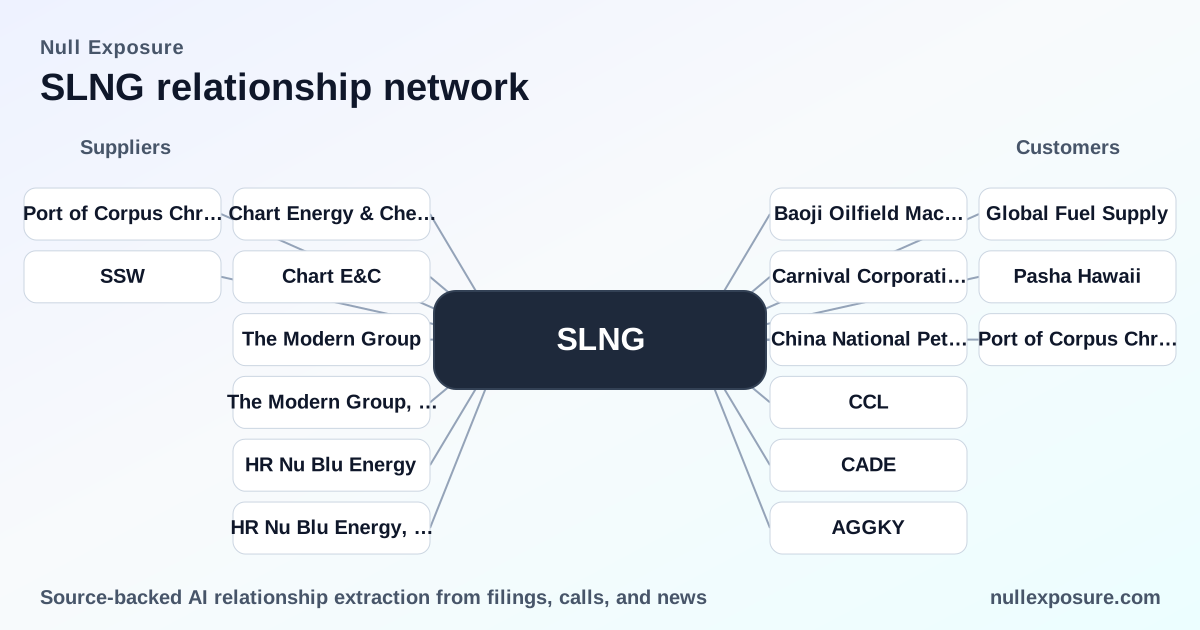
Below I summarize every customer / partner relationship identified in public filings and press coverage, with concise source notes.
-
Carnival Corporation (CCL / Carnival Corp. & plc / Carnival Cruise Lines) — Stabilis announced a multi‑year relationship with Carnival that has oscillated between large commitments and contract wind‑downs: a December 2025 press release disclosed a definitive 10‑year offtake to supply LNG at the Port of Galveston, while subsequent company commentary and trade press show the firm also wound down a truck‑to‑ship marine bunkering contract previously run for Carnival and, later, a trade report indicated termination activity related to the Galveston offtake. (Accesswire press release, Dec 2025; SLNG Q4 2025 earnings call transcript; Ship & Bunker report, May 2026.)
-
Aggreko Plc (AGGKY) — Aggreko is a material revenue contributor: the 2024 Form 10‑K states Aggreko accounted for more than 10% of Stabilis’s revenues for the year, positioning it as a top customer whose business mix matters to SLNG’s topline. (SLNG 2024 Form 10‑K.)
-
Global Fuel Supply — In October 2025 Stabilis disclosed a 10‑year agreement with Global Fuel Supply as its first marine bunkering offtake tied to the company’s Texas Gulf Coast expansion, signaling efforts to secure long‑run anchor demand for planned liquefaction capacity. (WorkBoat coverage and company announcements, Oct 2025.)
-
Cadence Bank (CADE) — Cadence Bank serves as the lender under Stabilis’s revolving credit facility: a three‑year loan agreement (the Revolving Credit Facility) was executed on June 9, 2023, establishing Cadence as a financial counterparty that underpins working capital and project finance flexibility. (SLNG 2024 Form 10‑K.)
-
China National Petroleum Corporation (CNPC) — The 2024 Form 10‑K references CNPC by way of a foreign joint venture: Stabilis holds a 40% interest in BOMAY Electric Industries Co., Ltd., where the majority partner is a subsidiary of CNPC that holds 51%, exposing Stabilis to manufacturing and JV governance with a large state‑owned Chinese entity. (SLNG 2024 Form 10‑K.)
-
Baoji Oilfield Machinery Co., Ltd. — As the majority local partner in the BOMAY JV, Baoji (a CNPC subsidiary) is the 51% owner of BOMAY, the JV that builds electrical systems in China where Stabilis owns 40%, reflecting a manufacturing and joint‑venture supplier/partner relationship rather than a pure customer. (SLNG 2024 Form 10‑K.)
-
Pasha Hawaii — Stabilis has provided technical and operational LNG bunkering services to Pasha Hawaii, completing the first LNG bunker for the MV George III in Long Beach, CA, a case study of Stabilis executing shipboard bunkering and technical service delivery. (VesselFinder coverage, FY2022.)
-
Port of Corpus Christi — Stabilis entered an MOU with the Port of Corpus Christi to develop LNG fueling infrastructure at the port, reflecting municipal and terminal partnerships used to scale marine and coastal distribution. (Local press reporting, Port MOU, 2021 coverage.)
-
Global provider of mobile power generation (unnamed in excerpts) — Management commentary in SLNG earnings materials referenced winding down a multiyear contract with a leading global provider of mobile power generation servicing an electrical cooperative in Louisiana, indicating exposure to power‑sector mobile generation contracts in addition to marine work. (SLNG Q4 2025 earnings call transcript as reported in Q1 2026 news coverage.)
What these relationships imply about the operating model
-
Contracting posture: predominately short‑term, operationally executed contracts. The company’s own disclosures say LNG contracts are generally one to 24 months, and historical deals include two‑year marine bunkering agreements and short‑duration supply arrangements—this structure favors volume flexibility but limits long‑term revenue visibility. (SLNG 2024 Form 10‑K.)
-
Concentration and counterparty risk: elevated. Carnival and Aggreko each accounted for over 10% of 2024 revenues, making Stabilis vulnerable to the loss or renegotiation of a small number of large customers. (SLNG 2024 Form 10‑K.)
-
Customer criticality and service mix: dual product/service role. Stabilis is both a seller of LNG (revenues recognized at delivery) and a service provider (engineering, field support, cryogenic equipment rental), aligning its economics with transactional product sales plus recurring equipment/service fees, which increases operational touchpoints and customer stickiness but leaves room for churn. (SLNG 2024 Form 10‑K.)
-
Geographic footprint: North America core with occasional EMEA deliveries. Revenue is concentrated in the U.S., Mexico and Canada, though the company reports limited deliveries to Europe under specific authorizations—an expansion vector that requires regulatory and logistics capability. (SLNG 2024 Form 10‑K.)
-
Maturity and scale: small public company with project financing reliance. Stabilis is a small cap with limited institutional ownership and a credit facility to support operations; growth initiatives depend on securing anchor offtakes (e.g., Carnival/Global Fuel Supply) and converting projects into predictable cash flows. (Market data and SLNG filings.)
Key takeaways for investors
- Revenue sensitivity is high—a handful of counterparties materially affect results.
- Business model mixes short contract tenors with operational services, so execution and logistics are the primary moat, not long‑dated contract economics.
- Anchor marine offtakes can transform project economics, but public reporting already shows the potential for both rapid ramp and rapid unwind (examples with Carnival).
- Monitor counterparty announcements, credit facility terms with Cadence, and execution milestones for the Galveston/Texas Gulf Coast expansion.
For a focused feed of customer‑level signals and contract tracking on small‑scale LNG operators, visit https://nullexposure.com/.
(Primary sources: SLNG 2024 Form 10‑K and 2025 Q4 earnings materials; press releases and trade coverage Dec 2025–May 2026 from Accesswire, WorkBoat, Ship & Bunker, VesselFinder, and regional press.)