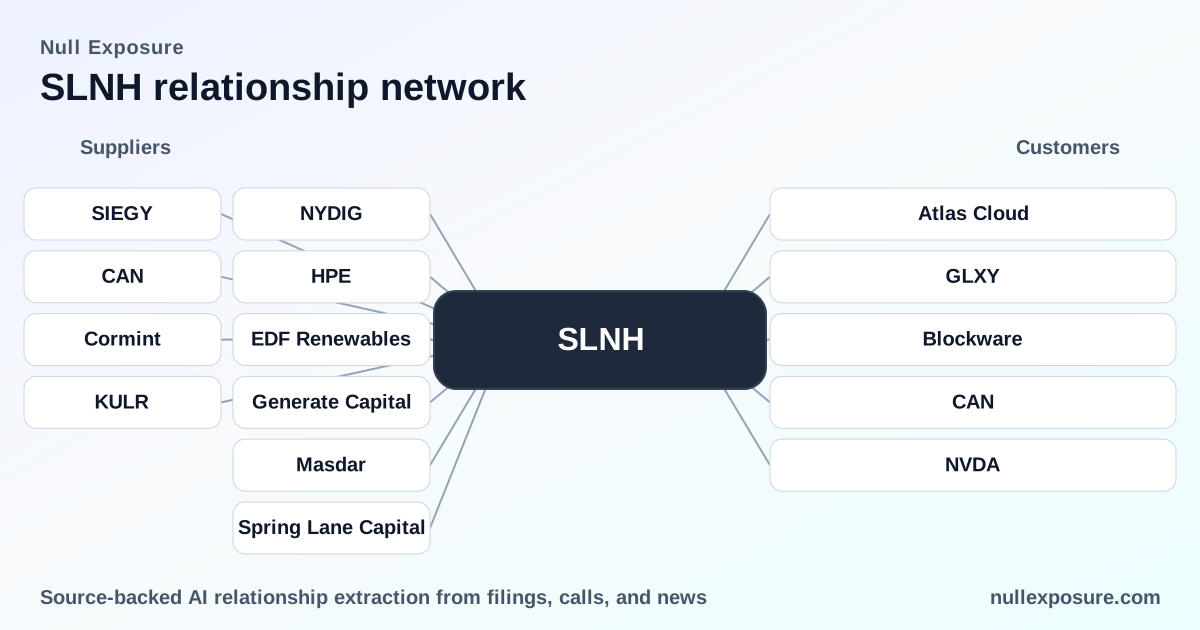
Soluna Holdings (SLNH): Customer Map and Commercial Signals for Investors
Soluna operates renewable-powered colocation and hosting facilities that monetize through a mix of fixed hosting fees per MWh, profit‑share on hosted mining operations, and service/installation fees. The company builds data centers adjacent to wind and other renewable generation, leases energized space to large-scale miners and AI customers, and intermittently operates mining capacity on behalf of partners — a model that converts otherwise curtailed green power into recurring hosting revenue and upside participation in mining economics. For investors, the core trade is exposure to capacity-hosting economics with high customer concentration and short-term, usage‑sensitive contracting. For deeper relationship intelligence, visit https://nullexposure.com/.
Customer roster — who Soluna hosts and why each relationship matters
Below are the relationships surfaced in public reporting and news; each entry is a concise, plain‑English take with a source reference.
Siemens / SLNHP — strategic grid and controls partner
Soluna and Siemens agreed on a 2 MW pilot at Project Grace in Texas that integrates Siemens’ electrical infrastructure, controls, and commissioning processes to document performance under rapid load swings for behind‑the‑meter AI deployments. This is framed as a repeatable blueprint for future renewable‑tied compute projects. (Siemens press release, March 2026: https://news.siemens.com/en-us/soluna-siemens-collaborate-gpu-power-swings-ai/)
Atlas Cloud — customer for AI compute capacity
Soluna signed Atlas Cloud as a customer to provide AI compute colocated at Soluna facilities, reflecting the company’s pivot to higher‑value generative AI hosting alongside Bitcoin mining. (DataCenterDynamics, March 2026: https://www.datacenterdynamics.com/en/news/soluna-to-provide-ai-compute-to-atlas-cloud/)
Galaxy Digital (GLXY) — anchor Bitcoin hosting agreement at Project Kati
Galaxy Digital committed to deploy 48 MW at Project Kati 1, expanding that site’s capacity and positioning Galaxy as an anchor customer for the facility’s Bitcoin hosting. (Investor reporting on Q3 2025 results, FY2025 commentary: https://investingnews.com/soluna-reports-q3-25-results/; investingnews Project Kati coverage: https://investingnews.com/soluna-breaks-ground-on-its-largest-site-to-date-project-kati/)
KULR Technology Group (KULR) — hosted Bitcoin mining capacity
Under an arrangement described in KULR’s financial release, Soluna will operate about 3.3 MW of Bitcoin mining capacity for KULR at Project Sophie in Kentucky, representing hosted operational services for a third‑party hardware owner. (KULR press release, Nov 18, 2025: https://www.globenewswire.com/news-release/2025/11/18/3190500/0/en/KULR-Technology-Group-Reports-Third-Quarter-2025-Financial-Results.html)
Blockware — repeat host and growth customer at Dorothy 1B
Blockware expanded its footprint with Soluna by roughly 3.3 MW at Dorothy 1B, pushing its aggregate deployed capacity with Soluna above 17 MW and marking multiple successive expansions that validate the hosting model at an established site. (Multiple reports including TradingView, March–May 2026: https://www.tradingview.com/news/tradingview:b306cba14b18d:0-soluna-holdings-adds-3-3-mw-with-blockware-pushing-blockware-capacity-past-17-mw/; Finviz and related press.)
Sazmining — new U.S. hosting deployment
Sazmining contracted Soluna for an initial 3 MW deployment at Project Dorothy 1B, representing the customer’s second U.S. mining operation and Soluna’s continued traction with mid‑sized miner clients. (Bakersfield.com coverage and company news, April–May 2026: https://www.bakersfield.com/ap/news/soluna-and-sazmining-announce-3-mw-bitcoin-mining-operation-at-project-dorothy-1b/article_9045e35c-8b11-5200-aa02-ed0e9164f92a.html; Investing.com summary.)
Canaan Inc. (CAN) — equipment partner and hosted miner deployment
Canaan’s collaboration involves deploying 20 MW of Bitcoin miners at Project Dorothy, signaling manufacturer‑led customers leveraging Soluna’s green power hosting to market “greener” mining solutions. (StocksToTrade coverage, October 2025 / FY2025 context: https://stockstotrade.com/news/soluna-holdings-inc-slnh-news-2025_10_16/)
NVIDIA (NVDA) — supply environment referenced in company filings
Soluna’s 2024 Form 10‑K documents that market constraints on NVIDIA H100 GPUs at launch affected economics tied to fixed‑cost agreements for high‑performance compute, underlining dependence on GPU supply and pricing for Soluna’s HPC/AI ambitions. (SLNH 10‑K FY2024, reference to GPU market dynamics and the HPE Agreement.)
(For consolidated customer intelligence and ongoing updates, see https://nullexposure.com/.)
What the relationship map and filing excerpts communicate about Soluna’s operating model
- Short‑term, usage‑oriented contracts dominate. Company disclosures indicate contracts typically run 12–24 months and often include monthly “stand‑ready” curtailment commitments, reflecting a flexible, short‑duration contracting posture that supports rapid re‑deployment of capacity.
- Pricing mixes fixed per‑MWh fees and profit‑sharing. Hosting economics combine per‑MWh charges with a percentage of mine net income, aligning Soluna’s revenue to hosted customers’ operating performance rather than pure long‑term fixed leases.
- High customer concentration is structural and material. The company reports two customers >10% of revenue and one customer delivering 56% of hosting revenue in 2024, a concentration that is a persistent feature rather than an anomaly — and which already led to a material termination in Q4 2024.
- Counterparties include hyperscale miners and equipment OEMs. Filings reference “very large enterprise” miners among customers; public deals confirm engagements with both industry incumbents (Galaxy, Blockware, Canaan) and smaller miners (Sazmining, KULR).
- Geographic concentration in North America, notably Texas. Revenue attribution in filings shows Project Dorothy (Silverton, TX) as the dominant revenue source in 2024, making regional generation and interconnection conditions a company‑level exposure.
- Service provider and seller roles are embedded. The company consistently identifies itself as a host/colocator and operator — providing power, utilities, network, management and, in some cases, operating mining capacity for third parties.
- Business maturity shows active and terminated relationships. Disclosures document active hosting contracts and at least one significant contract termination; Soluna has also wound down direct cloud HPC provision to refocus on colocation services.
Key investment takeaways and risks
- Upside: Renewable‑tied colocation captures otherwise curtailed green energy and participates in upside via profit share; repeat expansions with Blockware and anchor deals with Galaxy validate demand for Soluna’s model.
- Concentration risk: One customer historically drove a majority of hosting revenue, making revenue volatility and churn realistic outcomes; investor models must stress test loss of large customers.
- Contracting risk: Short-term, usage‑based contracts increase revenue variability but also enable rapid redeployment and pricing resets. Capital planning must reflect this cadence.
- Operational dependency: GPU supply dynamics (NVIDIA H100) and grid/infrastructure partners (Siemens) materially influence Soluna’s ability to scale AI compute offerings and to stabilize equipment economics.
- Geography and regulation: Heavy exposure to Texas wind and a small number of sites concentrates operational, regulatory, and transmission risk at the company level.
Monitor expansions, customer retention notices, and any shift toward longer‑duration contracts or fixed capacity commitments as the primary indicators that Soluna is reducing top‑line volatility.
For ongoing coverage and structured relationship tracking on Soluna and peers, visit https://nullexposure.com/.
Conclusion: Soluna is executing a focused hosting play that converts renewable generation into monetizable compute capacity; the model delivers differentiated revenue leverage to hosted workloads but carries material customer concentration and short‑contract duration risk — the trade investors must underwrite.