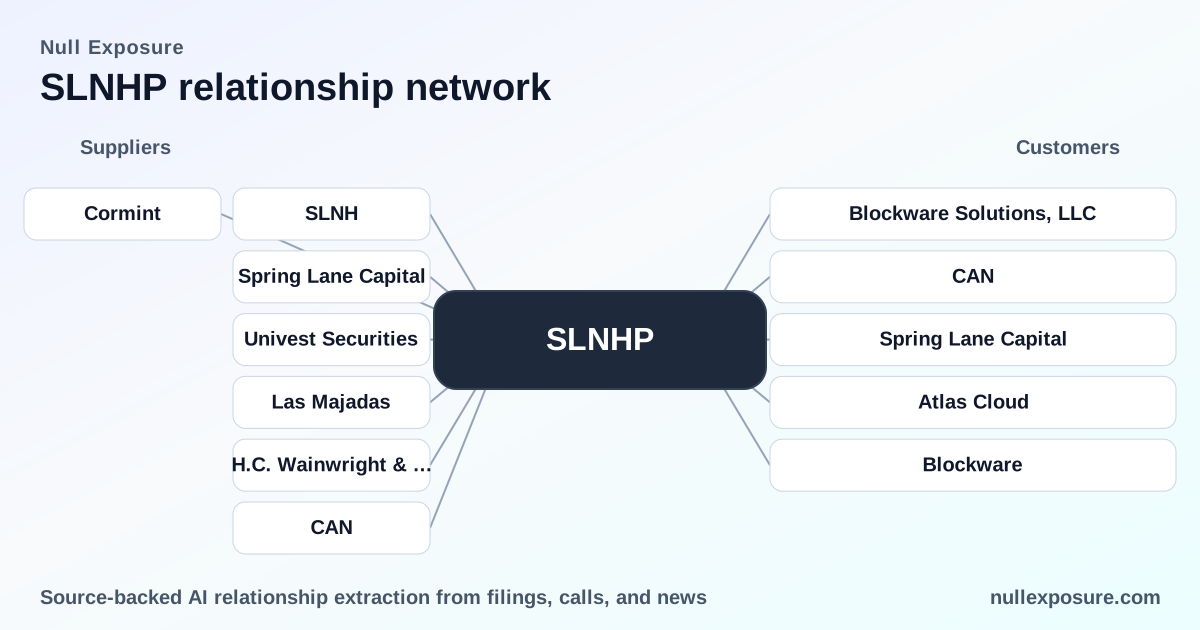
Soluna (SLNHP) — customer relationships drive a hosting-first cash flow with concentrated counterparties
Soluna monetizes by selling energized colocation, power and operational services to large-scale cryptocurrency miners and select HPC customers, charging fixed per-MWh fees, usage-based MWh pricing and profit-share arrangements while also participating directly in mining revenue and demand-response programs. The company’s business model is a services-heavy hosting play that converts surplus renewable energy into a saleable computing commodity, with revenue highly correlated to customer deployments and short-duration hosting contracts. Learn more at https://nullexposure.com/.
What the customer footprint looks like in plain language
Soluna runs renewable-powered data centers (Project Dorothy, Sophie, Marie) and monetizes through hosting contracts, high-performance computing services and demand-response capacity. Contracts skew short-term (12–24 months) and include significant usage-based elements, where revenue is often variable and recognized only once mining pools confirm block rewards. The customer base includes very large-scale miners (hyperscale) and specialized buyers, producing material revenue concentration: one customer represented 56% of hosting revenue and 28% of total revenue in 2024 and subsequently terminated that contract in Q4 2024.
Key operating-model signals:
- Contracting posture: Predominantly short-term hosting agreements with explicit per-MWh and profit-share mechanics.
- Revenue profile: Mix of fixed per-MWh billing and variable, outcome-dependent mining payments; revenue recognition is constrained until mining results are confirmed.
- Counterparty concentration: High — a handful of customers produce a large share of revenue.
- Geographic exposure: North America-focused (Project Dorothy in Texas is the dominant revenue source).
- Relationship roles: Soluna functions primarily as a service provider (colocation, operations, emergency demand response) and customers act as buyers/lessees of capacity.
- Segment focus: Services (data hosting, crypto mining hosting, HPC, demand-response).
Relationship inventory — direct and paraphrased from coverage
Below are every customer relationship referenced in the source material with a concise, source-linked takeaway.
Blockware Solutions, LLC
Soluna expanded its partnership with Blockware Solutions, LLC by adding an additional 6 MW of capacity at the Dorothy 1 site in West Texas as announced in March 2026. According to a Seeking Alpha press release (March 10, 2026), this is an expansion of an existing hosting relationship that converts surplus renewables into computing capacity. (Source: Seeking Alpha, March 10, 2026 — https://seekingalpha.com/pr/20401095-soluna-expands-partnership-with-blockware-adding-6-mw-at-project-dorothy-1)
Blockware (general press coverage)
Multiple outlets reported a multi-megawatt hosting and hosting-extension relationship with Blockware, including a two-year, 5 MW hosting agreement and subsequent expansion at Dorothy; Soluna provides behind-the-meter renewable-powered capacity and hosting services under these arrangements. DatacenterDynamics and Bitcoin.com covered the 5 MW hosting arrangement and the later 6 MW Dorothy expansion (DatacenterDynamics, March 2025; Bitcoin.com, May 2026). (Sources: DatacenterDynamics FY2025; Bitcoin.com May 2026 — https://www.datacenterdynamics.com/en/news/soluna-and-blockware-sign-5mw-crypto-hosting-agreement/ and https://news.bitcoin.com/bitcoin-miner-soluna-expands-behind-the-meter-capacity-in-texas-via-blockware-pact/)
Atlas Cloud
Atlas Cloud is identified as a customer at Project Dorothy 2 via Soluna’s cloud offering, indicating that Soluna’s services extend beyond raw mining hosting into hosted cloud/HPC propositions. DatacenterDynamics reported Atlas Cloud as a Dorothy 2 customer in a piece describing Soluna’s hosting contracts and partners (DatacenterDynamics, FY2025). (Source: DatacenterDynamics FY2025 — https://www.datacenterdynamics.com/en/news/soluna-and-blockware-sign-5mw-crypto-hosting-agreement/)
Spring Lane Capital
Spring Lane Capital participated in a prior Soluna capital raise and was mentioned in the context of a share issuance that included funding from the backer; press coverage from 2022 described a round that included Spring Lane Capital as a previous backer. CoinDesk’s reporting (October 2022) referenced an issuance to Spring Lane Capital that raised additional capital. (Source: CoinDesk, October 24, 2022 — https://www.coindesk.com/business/2022/10/24/crypto-mining-data-center-firm-soluna-tumbles-after-capital-raise)
Canaan Inc. (CAN)
Soluna announced a hosting agreement placing 20 MW of Canaan’s Avalon A15 XP Bitcoin miners at Project Dorothy; coverage identifies Canaan as a tenant that deployed significant ASIC capacity in Texas. Sustainability Magazine reported the 20 MW hosting placement as part of Dorothy deployments (Sustainability Magazine, FY2025). (Source: SustainabilityMag, FY2025 — https://sustainabilitymag.com/news/soluna-and-canaan-partner-on-20mw-wind-powered-texas-project)
CAN (ticker mention / duplicate reporting)
Press outlets also referenced Canaan under its ticker (CAN) and noted Project Dorothy’s operating capacity (Project Dorothy 1A operating at full capacity after deployments with Blockware and Canaan). Investing.com coverage (May 2026) described Dorothy 1A’s 25-megawatt operation and the role of both Blockware and Canaan in that capacity buildout. (Source: Investing.com (AU), May 2026 — https://au.investing.com/news/company-news/soluna-acquires-full-ownership-of-texas-data-center-for-165m-93CH-4366189)
What these relationships mean for investors
- Revenue dependence and concentration are first-order risks. The company’s disclosure that one hosting customer represented 56% of hosting revenue in 2024 — and then terminated the contract — is a clear structural vulnerability to churn and pricing pressure. That concentration amplifies the economic importance of renewables-to-compute commercialization wins such as Blockware and Canaan placements.
- Contracting is transactionally flexible but operationally lumpy. Short-term (12–24 month) contracts and usage-based pricing create higher near-term volatility in revenues and cash collections but allow Soluna to reprice or reallocate capacity as market conditions and ASIC economics change.
- Variable revenue recognition increases earnings volatility. The company recognizes some revenue only when mining pool results are confirmed, producing lumpy accounting outcomes and challenging forward guidance comparability.
- Geographic and project concentration centers risk in Texas. Project Dorothy dominates crypto-hosting revenue, concentrating regulatory, grid and weather exposure in a single U.S. region.
- Customer mix includes hyperscale miners and specialized buyers. The presence of large miners (Blockware, Canaan) and cloud/HPC customers (Atlas Cloud) diversifies use cases but does not materially reduce concentration given the few customers driving most revenue.
Investment takeaway — concise and actionable
Soluna’s model converts stranded/renewable power into a monetizable computing product via short-term, usage-sensitive hosting contracts. Recent expansions with Blockware and the 20 MW placement with Canaan represent meaningful demand validation, but investors must price-in customer concentration, revenue recognition variability and regional exposure when evaluating SLNHP. For detailed tracking of counterparties and contractual risk, consider visiting NullExposure for structured relationship intelligence: https://nullexposure.com/.
Bottom line: this is a services-first, capital-intensive hosting business with high operational leverage to a small set of large miners — upside comes from continued commercial deployments; downside is concentrated counterparty and regional operational risk.